Realtime AI News
AReaL 2.0 Goes Open Source: Building RL Infrastructure for Self-Evolving AI Agents
The open-source reinforcement learning infrastructure project AReaL has released version 2.0, targeting AI agents already deployed in real business environments with online RL training capabilities. The system enables agents to record their interaction data during real tasks and feed it back into model training, allowing agents to continuously improve through actual use.
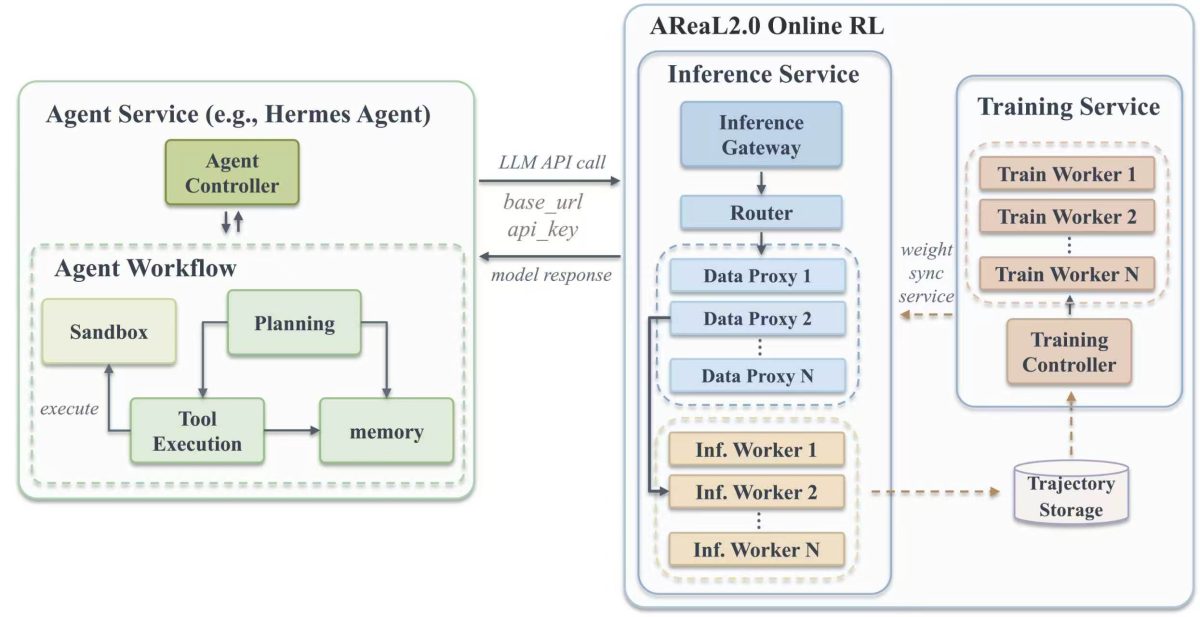
On July 2, the open-source reinforcement learning infrastructure project AReaL officially released version 2.0. AReaL aims to bridge the gap between foundational model training and modern agent applications by providing efficient RL training support for agent scenarios. The new release targets agents already operating in real business environments, offering a system infrastructure that lets agents continuously learn while being used.
Through AReaL 2.0, the interaction processes generated by agents completing real tasks can be recorded, organized, and fed into subsequent training workflows to continuously optimize the underlying model, allowing agents to grow stronger through use while maintaining safety and control. This addresses a growing problem: agents work every day but rarely learn from that work. In real business contexts, agents generate valuable experience data — which tasks performed well, where tool calls failed, why users were dissatisfied — but this information is mostly saved as logs and rarely converted into capability improvements.
AReaL 2.0 solves the problem of how agents can continue to improve after deployment. Developers don't need to rebuild their agents; they simply route their agent's original requests through AReaL 2.0's unified inference gateway to access the online RL pipeline. This means agent improvement no longer depends solely on manually constructed data, offline training, and redeployment — real-task conversations, tool calls, execution results, and feedback signals can all become training material.
This is especially important in enterprise scenarios, where agents face real, complex, and ever-changing tasks: codebases get updated, business processes are adjusted, user needs evolve, and tools and systems change. If an agent's capabilities are essentially fixed once deployed, it cannot adapt to its real environment over the long term. Additionally, continuous learning in real business environments requires careful consideration of access control, data anonymization, isolation, and auditing, since agents may interact with code, customer information, knowledge bases, and internal systems. AReaL 2.0 introduces an agent-trajectory data proxy mechanism to manage real task data safely and controllably.
AReaL was co-founded in 2024 by teams from Ant Group, Tsinghua University, and Hong Kong University of Science and Technology. In May 2026, AReaL was spun out from Ant's InclusionAI as an independent open-source community and joined the PyTorch Foundation Ecosystem project. The community has also gained support from Huawei Cloud and MindLab, among others.
AReaL 2.0's technical report and code are now available on GitHub. Going forward, AReaL will continue to iterate on online RL, automated evaluation, and multimodal agent training, working with the community to advance the self-evolving agent ecosystem.
Why it matters
AReaL 2.0 provides the missing infrastructure layer that enables deployed agents to evolve through real-world usage, shifting the paradigm from one-time training to continuous self-improvement.
Nearby Updates
All07/02, 20:00
Someone is using OpenClaw and Claude Code to automate dating — AI tools are reshaping social behavior
Developer Ben Guez built an automated dating script using OpenClaw, Claude Code, and Instagram trials, claiming he now has a steady stream of potential matches in his DMs. The case highlights how AI automation tools are expanding beyond coding into everyday life.
07/02, 18:29
WAIC 2026 announces details: opens July 17 in Shanghai with three venues and AI Entrepreneur Forum lineup
The World AI Conference 2026 will be held July 17-20 in Shanghai under the theme 'Smart Partners, Creating the Future Together', spanning three venues across Pudong and Xuhui. The conference also revealed the first speaker lineup for its AI Entrepreneur Forum.
07/02, 18:24
Tiangong 3.2 launches Skywork Tags: AI Agent joins your team chat as a colleague
Kunlun Tech's Tiangong AI released version 3.2 with Skywork Tags, allowing the AI agent to join team chats on Slack, Feishu, DingTalk, Discord, and Telegram as a permanent team member. Unlike personal AI assistants, Skywork Tags is shared, transparent, and improves with team-wide context.
07/02, 21:53
Microsoft launches its own AI deployment company with $2.5 billion commitment
Microsoft has established a new AI deployment group, joining Amazon, OpenAI, and Anthropic in the enterprise AI deployment space. The move underscores the growing competition among tech giants to help businesses integrate AI solutions into their operations.