Realtime AI News
Children's Hospital of Philadelphia models kids' hearts in seconds with open-source NVIDIA AI
Children's Hospital of Philadelphia is using the open-source MONAI framework to build patient-specific 3D heart models in seconds, replacing a workflow that previously took a skilled researcher about four hours. The hospital is now working with NVIDIA to bring GPU physics simulation, built on Warp and the Newton engine, into that pipeline so device deployment can be studied near real time.
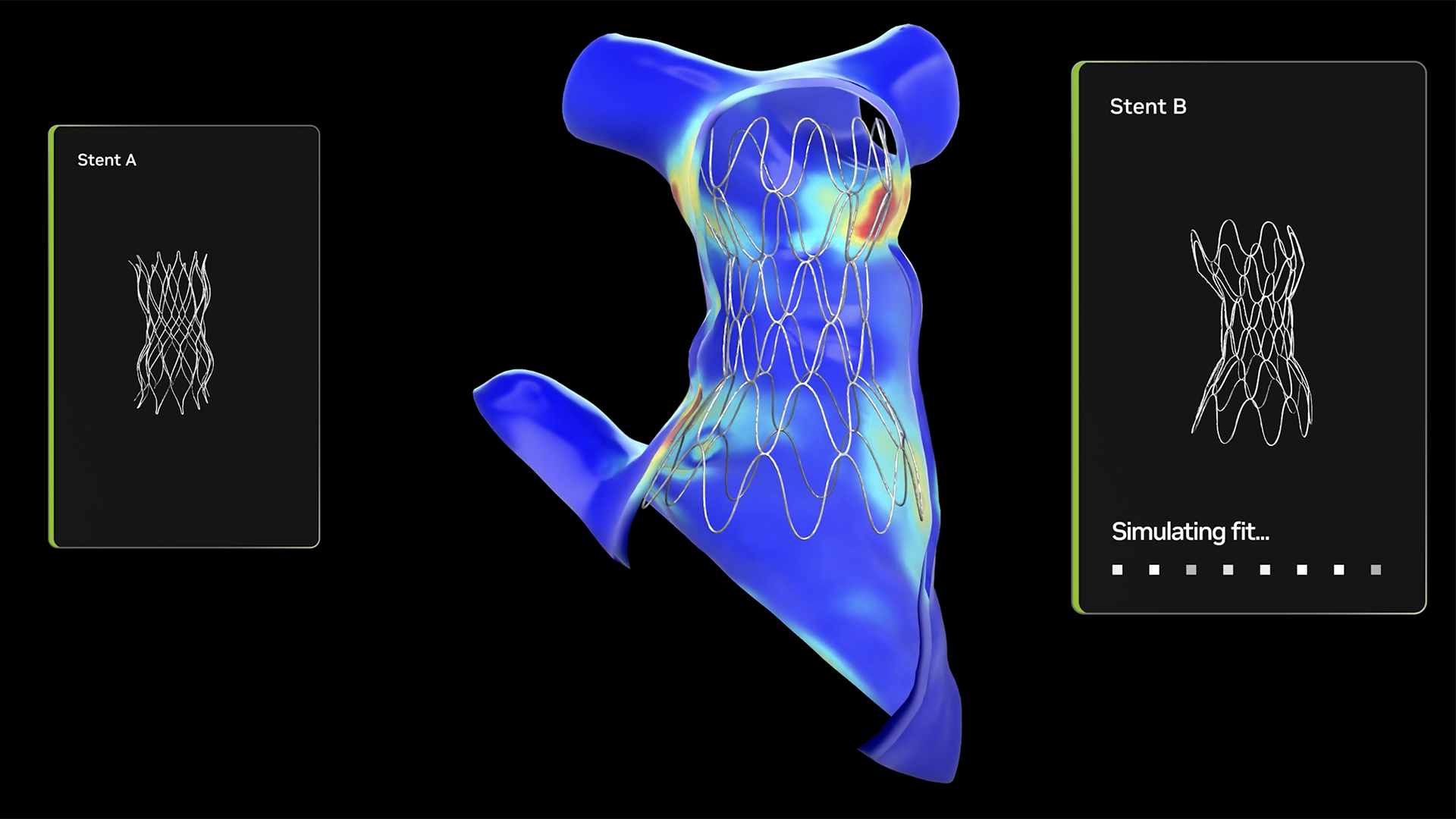
Children's Hospital of Philadelphia is using open-source AI tools to build individual 3D models of children's hearts, compressing a process that once took a skilled researcher hours into seconds. NVIDIA's blog detailed the work on September 15, describing how CHOP's cardiac modeling service is built on MONAI, the open-source medical imaging framework NVIDIA cofounded.
Congenital heart defects appear in roughly 1% of all live births, and no two are alike. Dr. Matthew Jolley, a cardiologist and researcher at CHOP, frames the problem plainly: the patient is one of a kind, while the devices surgeons reach for were almost never designed with that specific child in mind. Modeling lets the team work out what fits before anyone enters the cath lab or operating room.
The mechanics are straightforward. CHOP's service takes images a child's care team already has, such as CT scans, MRI and 3D ultrasound, and produces anatomically precise heart models in just seconds. Producing a single model previously meant a skilled research assistant spending about four hours at a workstation, a gap that has now closed enough for routine clinical use.
On the technical side, Jolley's team trained segmentation networks on pairs of prior images and models using MONAI Label and NVIDIA's Auto3DSeg implementation, with output that meets the same quality standard a trained human would produce. Jolley said that as soon as the lab has made 10 or 20 image-model pairs, it can train a model and start applying it, and that machine learning has become bread and butter.
Clinical spread is the most telling part of the story. More than 20 children's hospitals across the U.S. now run cardiac modeling programs; at Boston Children's Hospital, modeling supports more than half of all cardiac surgeries, roughly 500 cases a year, while CHOP expects to reach about 200 modeled cases this year. In one early case, a child who had already undergone two failed repairs was finally fixed on the first try after a 3D model clarified the anatomy.
The next step is moving from shape to outcome. CHOP is working with NVIDIA and the open source community on biomechanics simulation frameworks built on NVIDIA Warp, connected to Newton, an open source physics engine originally intended for simulation-based AI robot training. Linked to 3D Slicer and SlicerHeart, those frameworks would let doctors understand how tissue material properties determine device deployment, cutting cardiac device simulation from up to four hours, or an overnight run for multiple configurations, to near real time.
CHOP has already started implementing Warp- and Newton-based features for the closure devices used to seal holes in children's hearts, and hopes to apply similar methods to transcatheter valves. Longer term, the plan is to connect Warp and Newton with SlicerHeart so real-time simulation lands inside clinical workflows, while a coupler using SlicerHeart and NVIDIA Omniverse digital twins powered by OpenUSD is also in development to move simulations into virtual reality and pair them with vision-language models.
What stands out is the shape of the pipeline: rather than building algorithms from scratch, a hospital trains models on top of open-source imaging frameworks and uses GPU physics to rehearse the procedure in advance. Jolley also aims to spread the same tools beyond cardiac care through the hospital's IDEA Lab. The open questions are whether these simulations clear clinical and regulatory validation, and whether the approaches developed at more than 20 hospitals can be standardized and reused.
Why it matters
For hospitals, the case shows open-source imaging frameworks turning a research capability into routine clinical workflow; for NVIDIA, it is a template for pushing its medical imaging and physics simulation stack into real care settings.
Nearby Updates
All09/15, 17:00
Grab's Agent Framework LLM-Kit Speeds Up AI Agent Production Deployment
InfoQ reports that LLM-Kit, Grab's agent framework, is accelerating AI agents from development toward production deployment. The report offers a look at how a Southeast Asian super app operator approaches the engineering side of agent adoption.
09/15, 16:48
Yiling Pharmaceutical's Luoshu large model listed among Hebei's 100 AI + Manufacturing typical cases
Hebei province has published its list of 100 typical cases for AI + Manufacturing, and Yiling Pharmaceutical's Luoshu large model is among those selected. The entry puts a pharmaceutical industry large model into a provincial showcase, a sign that such models are reaching regulated manufacturing settings.
09/15, 17:43
Zidong Taichu open-sources ZDTaichu5.0-9B, pitching spatial embodiment under 10B parameters
The Zidong Taichu series has open-sourced ZDTaichu5.0-9B, which the release describes as the strongest general multimodal model under 10 billion parameters for spatial embodied ability. Keeping the model at the 9B level points at a clear goal: getting multimodal understanding onto robots and other physical devices rather than chasing general chat leaderboards.
09/15, 17:50
MediaTek Launches 2nm Dimensity 9600 Pro Flagship, Betting on an AI-Native Architecture for Agents
MediaTek has unveiled the Dimensity 9600 Pro, a 2nm flagship mobile chip marketed around an AI-native architecture and aimed explicitly at agentic AI. It is a clear signal that on-device AI is shifting from “can it run a model” to “can it run agents well, continuously.”