Realtime AI News
University of Manchester Uses NVIDIA Earth-2 to Forecast UK Air Pollution
The University of Manchester is using NVIDIA's Earth-2 platform to forecast air pollution across the United Kingdom. With air pollution linked to an estimated 30,000 deaths in the U.K. last year and chemistry-based models costly to run, data-driven forecasting is drawing fresh attention.
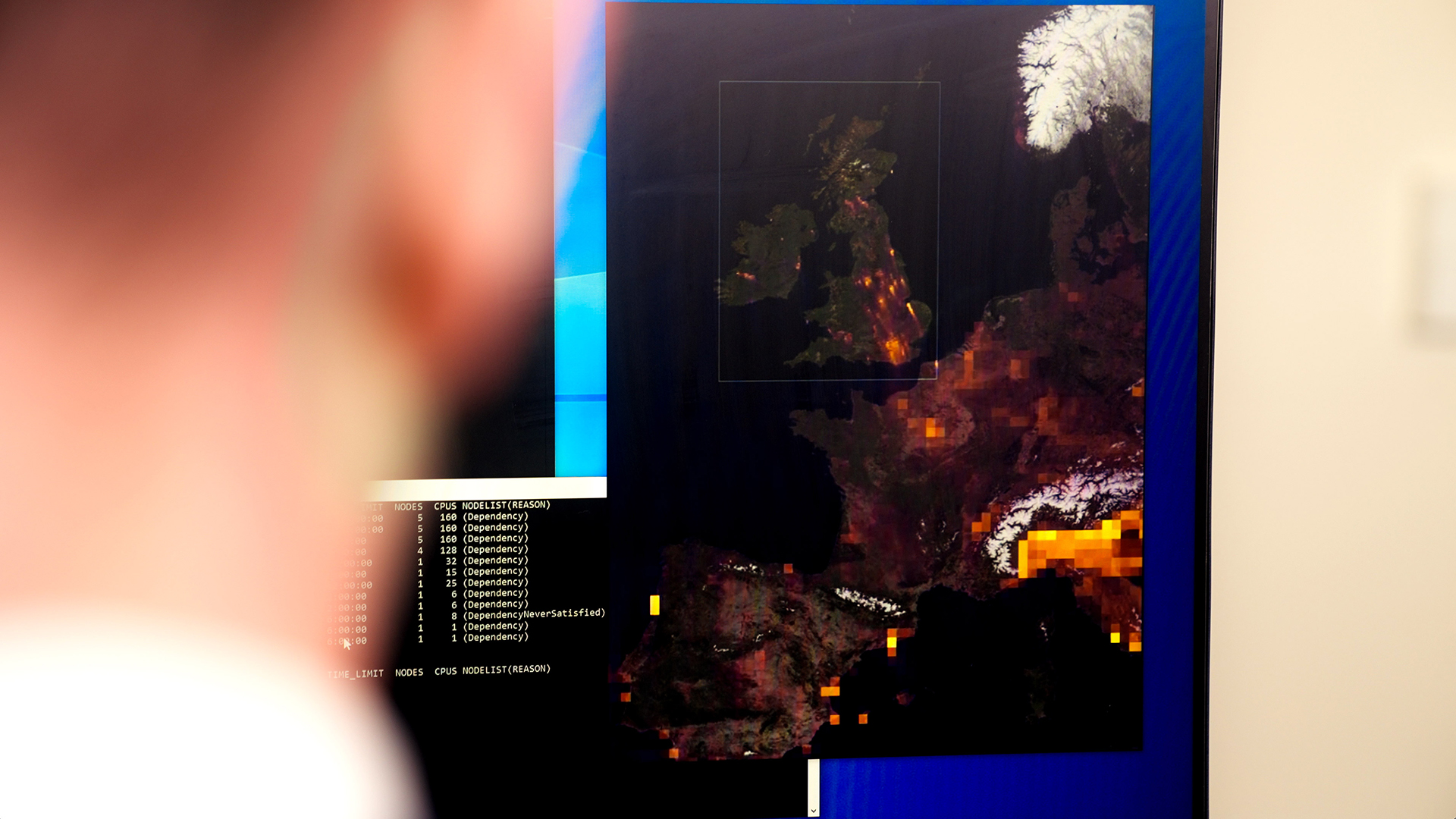
The University of Manchester is using NVIDIA's Earth-2 platform to produce air pollution forecasts across the United Kingdom, according to a post on NVIDIA's official blog. The work moves air quality modelling from isolated research toward something closer to an operational forecasting service.
The motivation is public health. Air pollution is a serious health risk, and an estimated 30,000 deaths in the U.K. last year have been linked to it. Cutting that toll requires forecasts fine-grained enough and fast enough to support warnings, travel advice, and public health decisions.
The obstacle is computational cost. Traditional air quality models are built on atmospheric chemistry: they compute the formation, transport, and transformation of pollutants, and that workload is heavy. The expense limits two things at once — how detailed a simulation can be, and how often it can be re-run.
Data-driven approaches target both limits. If machine learning can produce finer and more frequently updated air quality fields at comparable compute cost, forecasting can shift from occasional studies to a routine that runs daily or even hourly.
NVIDIA's blog names David Topping, a professor involved in the work, among those behind the project. Earth-2 is NVIDIA's earth-system simulation platform, and here it is applied specifically to air quality forecasting.
Using an earth-system platform for air pollution matters because it connects the compute, models, and tooling built up for weather and climate work to a downstream public health application. For environmental and meteorological agencies, the value of such a tool depends on whether it can deliver a usable forecast product reliably and continuously.
Three things are worth watching: whether this pipeline graduates from research project to routine operation, whether coverage expands beyond the U.K., and whether it can handle more pollutant metrics than those currently modelled. If so, AI's role in environmental forecasting shifts from add-on to primary instrument.
Why it matters
The project shows AI earth-system platforms extending from weather prediction into public health applications, where finer and more frequent air quality forecasts could become an affordable routine capability for environmental agencies.
Nearby Updates
All09/16, 13:00
Tencent Cloud Open-Sources Its In-House AI Assistant Octop
Tencent Cloud has officially open-sourced Octop, its in-house AI assistant. The move turns the assistant from a vendor-maintained product into a project outside developers can inspect, deploy, and build on.
09/16, 13:47
WSO2 ships Agent Manager to rein in enterprise AI agent sprawl
WSO2 has made Agent Manager generally available, an open-source control plane for governing AI agents across any framework, model, or deployment. Licensed under Apache 2.0 and offered self-hosted or as managed SaaS, it covers agent identity, MCP governance, guardrails, sandboxed runtime, observability, and evaluation.
09/16, 14:02
vivo previews BlueCode phone coding agent, explores 30B MoE model for on-device use
vivo has previewed BlueCode, a coding agent built for phones, and says it is exploring a roughly 30B-parameter mixture-of-experts model for on-device use, according to TechNode. Both items are framed as previews and exploration rather than shipping products, with no launch date or supported handset list disclosed.
09/16, 11:50
Bilibili launches AI arena with 100 models competing, GPT-6 on top
Bilibili launched its AI Infinite Arena on September 16 and published a first leaderboard in which GPT-6 Astra took the top spot across evaluations from ten creators, with domestic Chinese models taking three of the top five places, according to Securities Market Weekly. The board aggregates creator-run real-world tests of more than a hundred models and will update in real time.