Realtime AI News
Germany signs industrial AI declaration with NVIDIA as Huang backs four German startups
German Chancellor Friedrich Merz and NVIDIA CEO Jensen Huang discussed Germany's industrial AI roadmap in Berlin, the same day Berlin signed a joint declaration of intent with NVIDIA on physical AI. Huang also announced planned investments in four German startups and a Siemens partnership on autonomous factories.
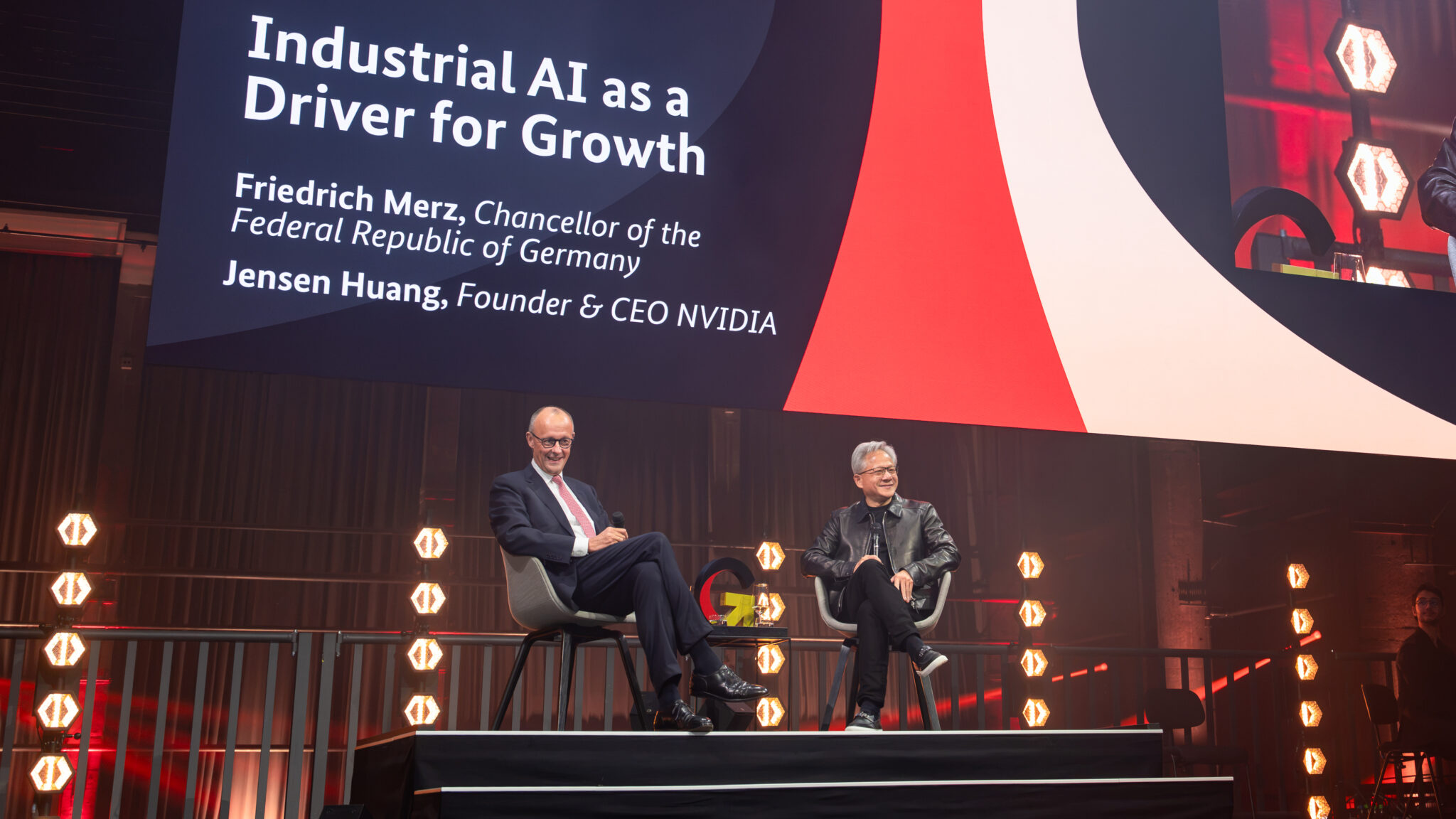
On October 19, German Chancellor Friedrich Merz and NVIDIA founder and CEO Jensen Huang sat down in the hall of Kraftwerk, a former power station in Berlin, to work through Germany's AI roadmap — with industrial applications at the center of the conversation.
Earlier that day, as part of the Invest in Germany Summit, Merz, the Federal Ministry for Economic Affairs and Energy and the Federal Ministry for Research, Technology and Space signed a Joint Declaration of Intent with NVIDIA, according to the company's blog. The declaration sets out a joint initiative to advance cutting-edge AI models for physical AI.
The agreement also formalizes and expands NVIDIA's collaboration with the federal government and its Industry 4.0 Platform, which gathers representatives from politics, industry, research and trade associations. Berlin's stated goal, quoted in the post, is to “systematically bring industrial AI into widespread use and to establish a state-of-the-art industrial AI ecosystem in Europe.”
Merz framed the ambition in national terms, saying Germany is “fully committed to be one of the most advanced places in the world” for working with AI and integrating it into industry. He addressed the Mittelstand — Germany's small and medium-sized manufacturers — directly: “Please open your doors for AI to make use of your data.” Huang answered that such knowledge “belongs to you” and that AI “can only augment your capability, it will not replace your capability.”
Huang also announced planned investments in four German startups: Munich-based Agile Robots, which builds robotic arms and the Agile ONE humanoid for manufacturing, logistics and healthcare; Avelios Medical, also of Munich, which develops an AI-native hospital information system; Mirelo, which generates sound effects, speech and music for video; and Berlin-based Reflex Aerospace, whose satellites are designed for launch in about 12 months. The investments sit inside a nearly $10 billion NVIDIA commitment to Europe, after earlier backing for n8n, Neura Robotics and Black Forest Labs.
The same day, Siemens said it is partnering with NVIDIA on AI-driven autonomous factories and showed new AI solutions at its Erlangen plant, where fully virtual production ramp-up cuts engineering effort by up to 85% and agent-based production planning saves up to 20% in costs. NVIDIA researchers also used JUPITER, Europe's largest supercomputer at the Jülich Supercomputing Centre, to run a 104-qubit simulation of a fault-tolerant quantum computer — the largest of its kind to date, according to the company.
The timing matters: the conversation came two days before Huang's GTC Berlin keynote on October 21. For an economy built on manufacturing and automotive engineering, tying physical AI to the government's Industry 4.0 Platform suggests the next phase of the AI race may be fought less in the cloud than on factory floors, in robots and inside digital twins.
What to watch next is whether the declaration turns into named projects and funding, whether Mittelstand companies actually open up their operational data, and whether Huang's Berlin keynote adds product and ecosystem specifics beyond the political framing.
Why it matters
Germany is turning industrial AI into national industrial policy and pulling NVIDIA into its Industry 4.0 Platform, which points to government-led ecosystem building rather than scattered pilots. For NVIDIA, that locks in long-term demand in one of its largest industrial markets and deepens ties with local giants such as Siemens.
Nearby Updates
All10/20, 03:00
Tolan raises $30M for its AI companion as active users pass 250,000
Tolan, an AI companion app for managing daily life and emotions, raised $30 million from Union Square Ventures, Khosla Ventures and Homebrew, doubling its total funding. The startup says it has more than 250,000 active users, 70 million conversations in the past year, and annual recurring revenue in the double-digit millions.
10/20, 04:01
DHS orders DeepSeek removed from federal civilian IT systems
The Department of Homeland Security ordered US civilian agencies to remove DeepSeek products and DeepSeek-based third-party services from their IT systems, and barred buying them. DHS cited data flows to China, possible malware and intelligence risks, extending a wider Trump administration crackdown on Chinese technology.
10/20, 02:49
Replika's Kuyda opens Wabi to all users: a multi-threaded, shareable AI assistant
Replika founder Eugenia Kuyda has opened Wabi to all users: a personal AI assistant built as a messaging app, with multiple shareable threads and apps the agent creates on its own. It is free for now, has no settled business model, and the company says it is in talks to raise more funding.
10/20, 02:37
Tenstorrent raises $1.5B at $6.2B valuation to stay independent and scale open-weight AI chips
Tenstorrent has raised $1.5 billion at a $6.2 billion valuation, more than doubling the $2.6 billion it was worth in late 2024. CEO Jim Keller told Bloomberg the inference chip startup chose to remain independent and raise more capital after its Galaxy servers proved they could run DeepSeek models.