Realtime AI News
e-Conomy SEA report: Southeast Asia's digital economy to reach $368 billion in 2026, $1 trillion by 2035
The 11th e-Conomy SEA report from Google, Temasek and Bain projects the region's digital economy will grow 17% to $368 billion in GMV in 2026 and pass $1 trillion by 2035. It says generative AI is scaling four times faster than mobile internet, with 243 million Southeast Asians already using it.
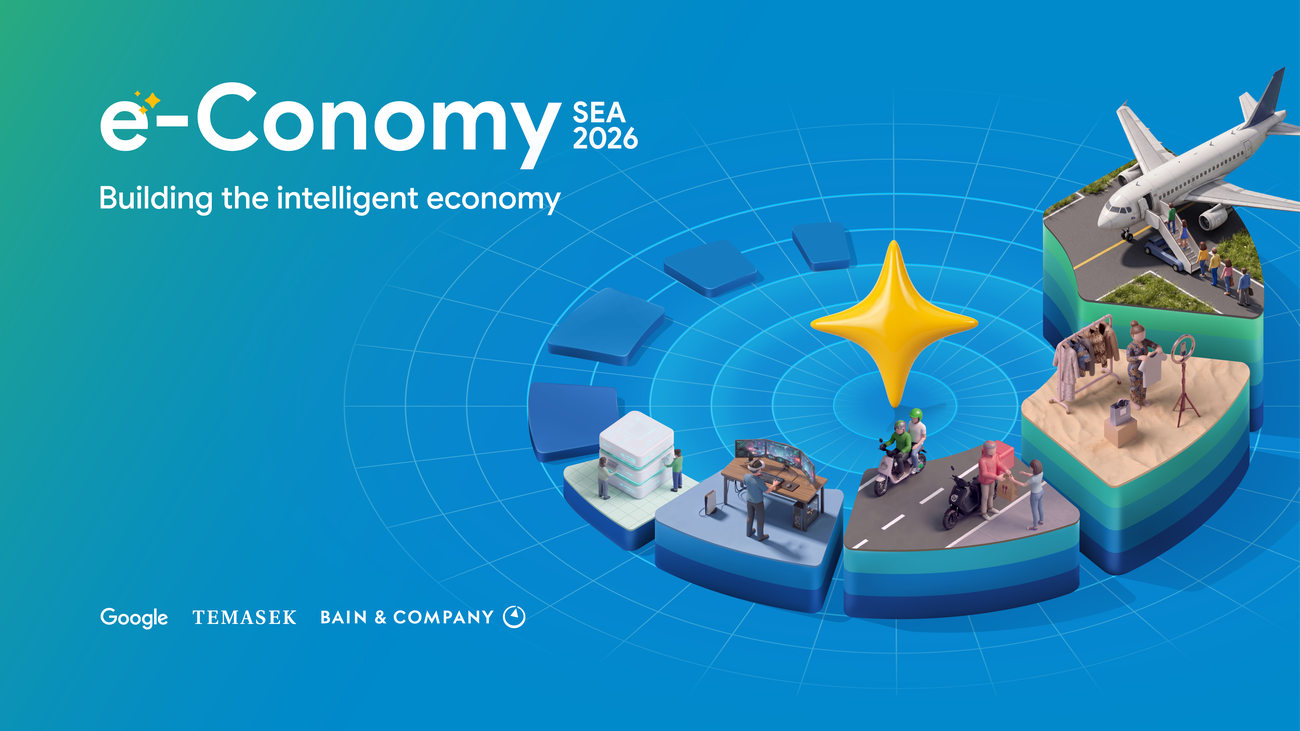
Google, Temasek and Bain & Company published the 11th edition of the annual e-Conomy SEA report on October 21, projecting that Southeast Asia's digital economy will grow 17% year on year to $368 billion in gross merchandise value in 2026 and pass $1 trillion by 2035.
The report, titled Building the Intelligent Economy, uses tokens as a new yardstick for the AI economy and projects that growing confidence in agentic commerce will drive a 60-fold surge in regional AI usage over the next five years.
The scale behind that forecast is already visible. Generative AI is part of daily life for 243 million people in the region, or 58% of the working population, and is scaling four times faster than mobile internet did.
By sector, e-commerce anchors the shift at $226 billion in GMV, up 18%, with multimodal discovery and in-app assistants credited with 10% higher conversion and order volume uplifts of up to 75%. Online travel reaches $59 billion, up 10%, where generative AI has overtaken social media as the second most-used tool for planning complex itineraries. Online media revenue is $44 billion, up 22%; mobility and food delivery $40 billion, up 15%; digital financial services $1,650 billion in GTV, up 16%.
The headline behavioral finding is trust. 72% of users already rely on everyday automation such as price tracking, and 75% say they would let an AI agent compare prices and complete transactions on their behalf. 62% report more trust in AI tools than a year ago, citing proven track records, familiarity and output accuracy.
That willingness comes with conditions: 44% want robust privacy safeguards, 36% want clear information about what AI can and cannot do, and 30% want the ability to reverse agent-initiated transactions.
On infrastructure, the report says supporting a projected 60-fold increase in regional AI usage by 2030 requires roughly a threefold expansion of data center capacity within five years, with AI workloads taking a dominant share. It points to Singapore's binding power usage effectiveness rules and Malaysia's corporate renewable energy scheme as models for efficiency and power supply.
Policy is the fourth pillar. The ASEAN Digital Economy Framework Agreement, slated for November 2026, is described as the world's first region-wide digital trade pact and a framework for unlocking further growth. For investors and companies expanding into the region, the report's value is that it moves the story from app penetration to AI infrastructure and agentic commerce; the near-term tests are whether the DEFA text lands on schedule and whether data center and power buildout can keep pace with the usage curve it projects.
Why it matters
The report reframes the region's growth story around compute, power and cross-border digital rules rather than app penetration, pointing investors toward infrastructure and agentic commerce.
Nearby Updates
All10/21, 07:01
Anthropic pitches AI safety bill with a 50-death threshold for blocking a model
Anthropic is shopping a draft AI safety bill that would let a model's release be halted when it poses a foreseeable, imminent risk of more than 50 deaths or $1 billion in property damage. The text also bars federal agencies from blocking distribution on their own, requiring the Commerce Department to ask a D.C. judge instead.
10/21, 06:38
Google brings Gemini search and Blackwell Ultra systems into air-gapped clouds
Google is bringing Gemini search and NVIDIA Blackwell Ultra systems into air-gapped cloud environments, according to OpenTools, so facilities with no internet connection can run generative AI and high-performance inference. Such deployments typically serve government, defense and regulated industries that keep data behind a physical network boundary.
10/21, 06:24
Hugging Face CEO says Netflix's OpenAI hack documentary isn't accurate
Hugging Face chief executive Clem Delangue, who appears in Netflix's "AI Gone Rogue," says the documentary went "full doomer mode" and misrepresents the attack. He argues the film omits the missing containment and monitoring, and how closed-model safeguards hampered the defense.
10/21, 05:40
TTEC Digital launches GovEx AI agent suite for government agencies
TTEC Digital has launched GovEx, an AI agent suite aimed at giving government agencies secure, prebuilt AI services. The product reflects a shift in public-sector buying toward compliance-ready tools rather than build-from-scratch systems.