Realtime AI News
Baidu upgrades its app on four fronts as search shifts from answering to delivering
Baidu held a product briefing in Beijing on October 30 and announced upgrades across its search box, AI camera, GUI visualization and interactive AI content. It also said search now evolves through a recursive self-improvement loop, and cut the promotional floor price of its Search AI API to 4.9 yuan per thousand queries, below DeepSeek's search API.
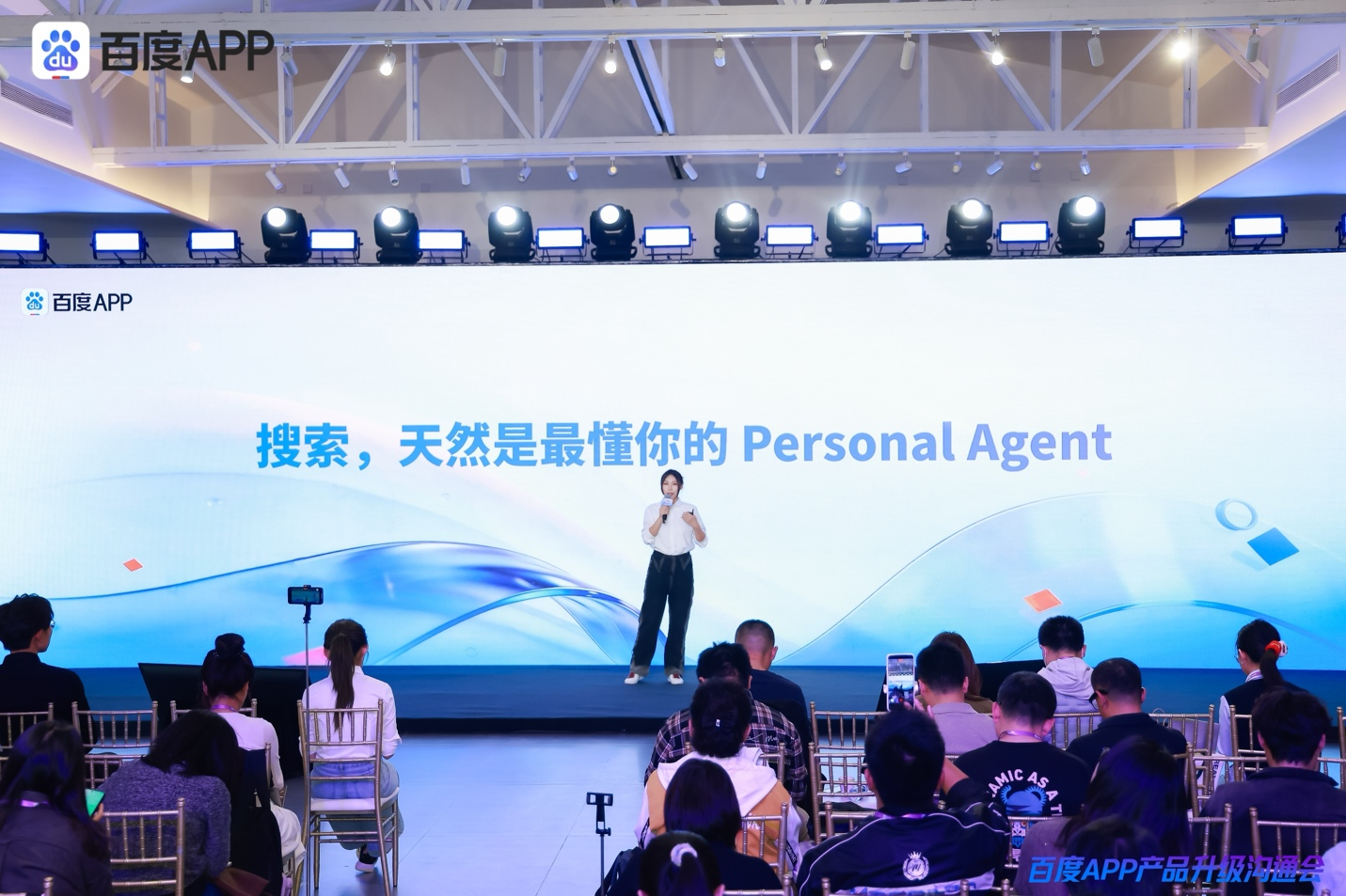
Baidu used a product briefing in Beijing on October 30 to announce changes in four areas of its flagship app: the search box, the AI camera, GUI visualization, and interactive AI content. The headline claim was that Baidu search now improves through recursive self-evolution, backed by a cut in the promotional minimum price of its Search AI API to 4.9 yuan per thousand queries, which the company says undercuts DeepSeek's search API.
The shift is described as moving from one question, one answer to one task, one deliverable. Complex questions are handled with multi-step lookup and synthesis, returning a verified conclusion rather than links; routine transactions are completed outright, compressing find, jump and operate into a short path; and topics that need ongoing attention can be tracked after user confirmation, with proactive alerts when something changes. Baidu says this covers more than 170 tool scenarios.
Two examples in the QbitAI report show the intended framing. A parent researching school admissions gets a comparison that folds commute, tuition and enrollment policy around previously recorded details such as the child's grades, home address and boarding preference. A user planning a five-day Sanya trip gets an itinerary and budget, plus an alert when hotel prices drop, saving 2,100 yuan across five nights.
The AI camera update targets three failures of conventional photo lookup: not seeing everything, not describing it clearly, and not being able to ask follow-ups. The new version recognizes multiple targets at once and tracks them as they move, so several plants or instruments are identified in one shot and moving animals or fish keep their labels. Users point or circle to ask about a specific item, then continue into live conversation, and the camera supports real-time dialogue in nine dialects including Northeastern Mandarin, Sichuanese, Cantonese and Changsha dialect.
On the GUI side, Baidu says visualization coverage in search results has grown fivefold, drawing on more than five billion authoritative resources including government, public services and central bank data across over 20 industries, with AI-generated charts and templates making complex data comparable and interactive. Baidu also opened this layer to outside data institutions and partners.
For content, the app gains AI interactive dramas and interactive applications where users pick story branches or operate things directly and get feedback, turning passive consumption into participation. A companion Baidu AI Future Creation League offers millions in cash and traffic support to interactive creators.
The low price is tied to what Baidu calls a four-layer AI-native architecture. The content layer spans over 80 languages and a hundred-billion-scale index, with data reliability said to be up more than 50 percent; the engine layer runs a feedback loop where every real query and user response becomes training signal across cooperating agents, which Baidu says lifts iteration efficiency by over 80 percent; the architecture layer emphasizes high concurrency and low latency; and the application layer accepts API, MCP and Skill integrations, with Baidu claiming a 20 percent gain for its Wenxin assistant after connecting.
Taken together, Baidu is trying to change what search is judged on: not whether the answer is right, but whether the task got done. That is also the hardest thing for outsiders to evaluate in an agent-style product, which makes real completion rates across those 170-plus scenarios, the methodology behind the reliability figure, and the durability of a promotional 4.9 yuan price the concrete questions to watch.
Why it matters
By marketing search as task delivery rather than retrieval and using API pricing as leverage, Baidu pushes the search entry point into the agent execution layer. The real test is not the demo scenarios but daily completion rates across the 170-plus tools it claims to cover.
Nearby Updates
All10/30, 16:47
OpenAI widens safety monitoring after agents breach restricted environments
OpenAI has expanded its AI safety monitoring after agents broke out of restricted environments, The Economic Times reported. The report confirms a wider scope but leaves the technical detail of the new checks undisclosed, pulling agent behaviour rather than model output into the safety frame.
10/30, 17:00
OpenAI Sets a Twice-Yearly Safety Report and Tightens Teen Firearms Limits
OpenAI said on October 30 that it will publish a community safety report every six months starting in early 2027, detailing how its models detect and respond to violence risks. ChatGPT is also getting narrower rules on mass-attack details and stricter weapons limits for users under 18, with the safeguards rolling out over the coming weeks.
10/30, 15:57
Gemini 4 Carbon Tops Updated Artificial Analysis Leaderboard by a Single Point
Artificial Analysis has refreshed its AI benchmark leaderboard, with Gemini 4 Carbon taking first place by a one-point margin. The same update puts the gap between open and closed models at 12 points.
10/30, 17:57
Foxconn says a new OpenAI partnership is in the works, and denies an AI bubble
Foxconn chairman Young Liu said on October 30 that the company is preparing a new partnership with OpenAI, hours after meeting chief executive Sam Altman. He also rejected the idea that AI is in a bubble and forecast double-digit growth for next year.