Realtime AI News
NVIDIA and SETI put AI agents inside a radio telescope's nightly search
NVIDIA disclosed on October 30 that Breakthrough Listen and the SETI Institute now run agentic AI in daily operations at the Allen Telescope Array, steering the instrument and processing data on a natural language request. The Holoscan-based pipeline handles 2.4 terabits per second on RTX PRO 6000 Blackwell GPUs and has delivered the first real-time AI detection of a pulsar in the Crab Nebula.
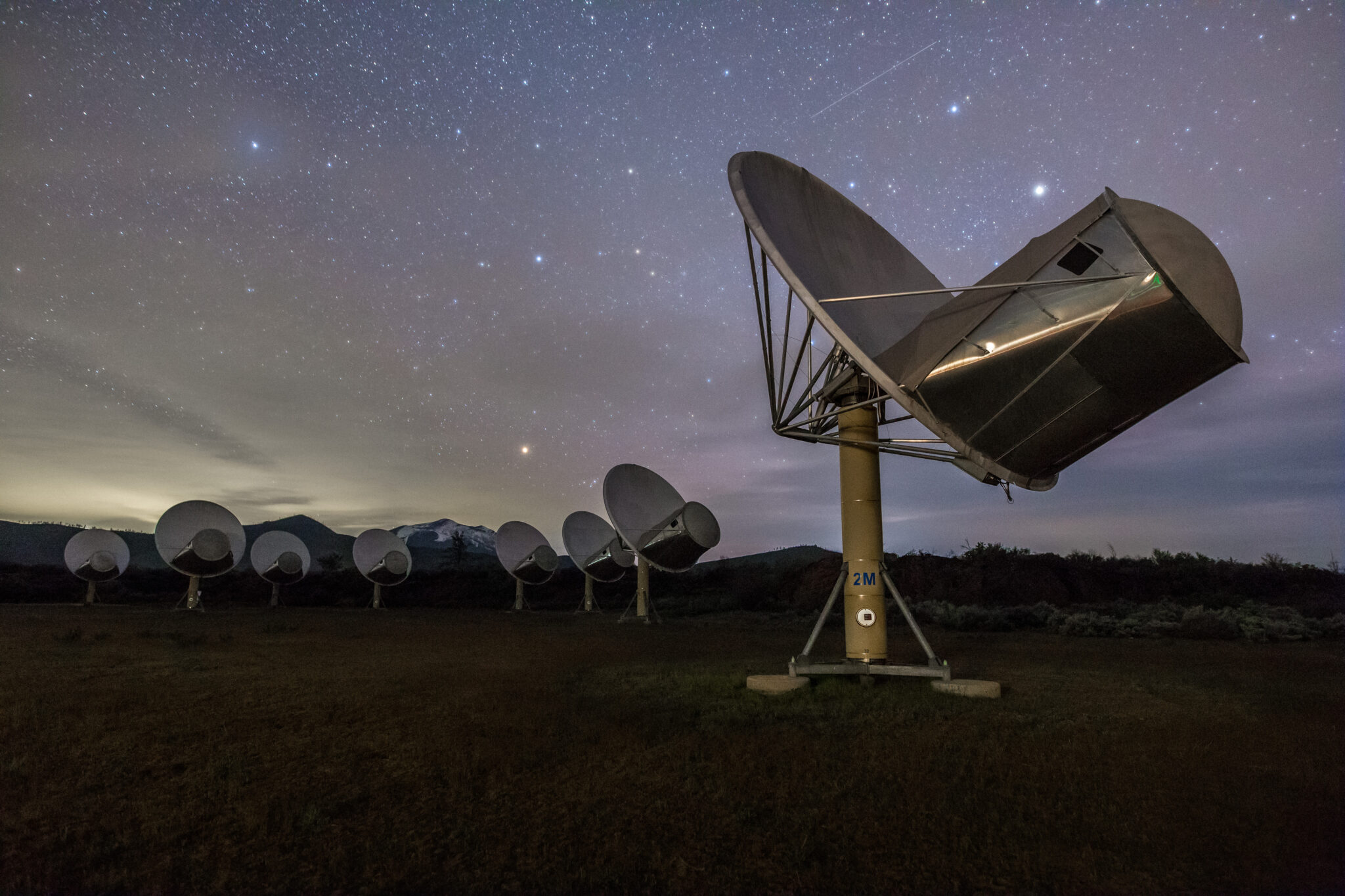
NVIDIA's blog on October 30 described a working deployment at the Allen Telescope Array in Northern California, where Breakthrough Listen and the SETI Institute have put agentic AI into the daily search for extraterrestrial intelligence. A single natural language request can now steer the instrument, calibrate and focus it, correct data errors, and plot the result.
The data path is built on NVIDIA Holoscan. DAQIRI, a Holoscan platform library, pulls terabits per second of sensor data directly into GPU memory so observations are processed in flight rather than filling hard drives, while CyberEther, a signal-processing framework developed at the SETI Institute, does the math with CUDA-X libraries including cuFFT and cuBLAS.
Nexus, a web-based observatory orchestrator, acts as the agent harness, giving agents a single source of truth for instrument state, compute resources, and pipelines. Researchers can monitor packet loss, read live spectrograms, and rewrite signal-processing blocks by prompting the system in natural language.
NVIDIA says the setup handles 2.4 terabits per second on RTX PRO 6000 Blackwell GPUs, with inference running on premises next to the instrument, and that agents compress work that would take humans weeks or years into hours. That claim is best read narrowly: it covers the repetitive tuning, calibration, error correction, and plotting inside an observation, not the scientific interpretation of what is found.
The pipeline has already produced a result: the first real-time AI detection of a pulsar, in the Crab Nebula. Pulsars are rapidly spinning stellar remnants whose beams sweep past Earth like a cosmic lighthouse, and moving detection into the live stream means observers can adjust follow-up observations while a signal is still arriving.
Andrew Siemion, the Bernard M. Oliver chair for SETI and principal investigator of Breakthrough Listen, framed the shift in unusually literary terms, saying that as agentic observatories reach out into the universe, what they find may have much more in common with themselves than with the humans who created them, and that this is a breakthrough in translation rather than something to fear.
The team is now evaluating open models including NVIDIA Nemotron for cases where data locality and turnaround matter most, and for observatories that might one day run offline on the far side of the moon. That points toward a longer-term route in which telescopes carry their own compact models into places with no usable network.
For SETI, the significance is less about raw compute than about loop time. The search is fundamentally a hunt for anomalies in enormous noise, and agents shorten the cycle from detection to retargeting and re-observation from weeks to hours, which is the kind of capability that could become standard practice for the next generation of radio arrays.
Why it matters
This moves agents from executing tasks on a screen to closing the loop on physical instruments, where a model can change what is observed rather than only interpret it. If the reliability holds, natural-language instrument control is likely to spread to other big-science facilities and industrial sites.
Nearby Updates
All10/30, 22:30
Phase launches decentralized AI agent blockchain mainnet with $45M backing
Phase has launched the mainnet of a blockchain built for decentralized AI agents, backed by $45 million, according to Beinsure. The report discloses no investors, token design or first applications, so the launch's real weight depends on usage data still to come.
10/30, 22:03
Jinri Yixiu launches ISHO Ring and iFlow to build an AI sleep-tech stack
Chinese sleep-tech startup Jinri Yixiu launched the ISHO Ring smart ring and the ISHO iFlow temperature-control system on October 29, alongside a personal sleep-health AI stack built on an agent app and an in-house physiological-signal model. The company says its hardware-and-software approach aims to build a leading global AI sleep-tech brand within five to ten years.
10/30, 21:54
DoorDash says AI agents have placed only 'several hundred' orders
DoorDash told analysts on its third-quarter earnings call that third-party AI agents such as Muse, Instinct and Fo have generated only "several hundred" orders in total, against roughly 3 million deliveries a day. CEO Tony Xu said customers still order through DoorDash's own app and that the company wants a healthy relationship with agent makers.
10/30, 21:00
Runware Is Building a Factory to Mass-Produce AI Data Centers
TechCrunch reports that startup Runware is building a factory to turn out prefabricated AI data centers on an assembly line, with a pitch of going online within 48 hours. The open question is whether that manufacturing model can actually deliver at scale.