Realtime AI News
DeepSeek releases a new agent architecture where one AI directs another
DeepSeek unveiled a new agent architecture on October 31 that Chinese tech outlet ifanr framed as “AI beginning to direct AI to do the work,” with an upper model planning and dispatching tasks to executing agents. Concurrent reports describe a two-tier Router-and-Worker design issued as an agent foundation, suggesting DeepSeek now treats multi-agent orchestration as reusable infrastructure rather than a single model upgrade.
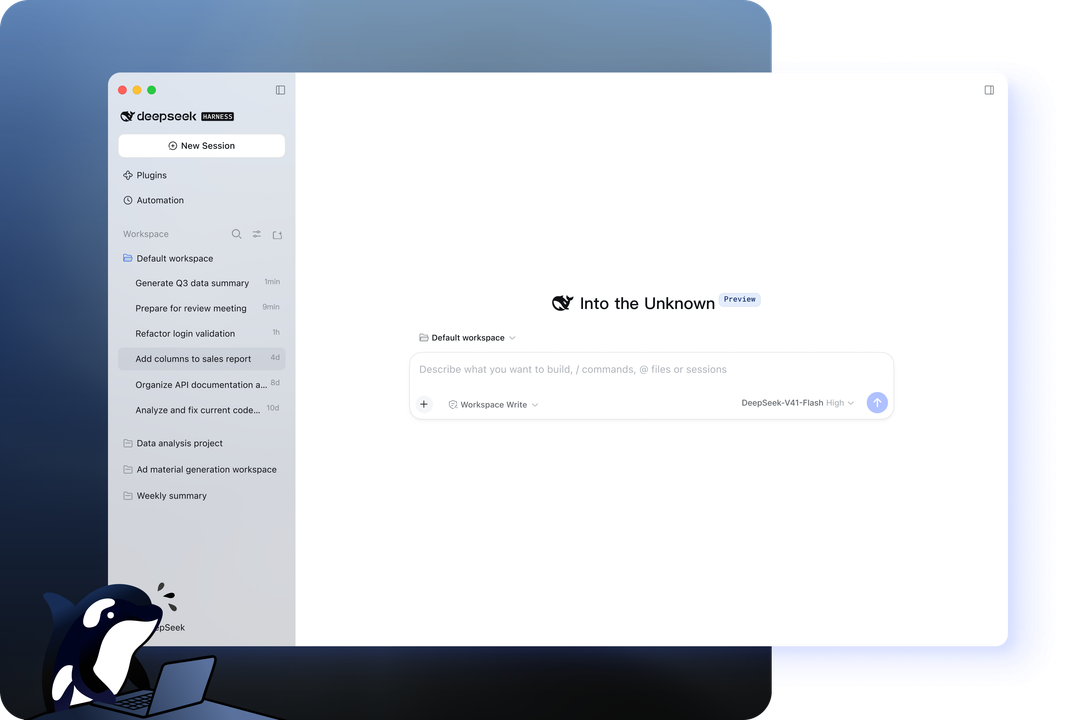
On October 31, Chinese tech outlet ifanr reported that DeepSeek has released a new agent architecture, summed up in its headline as “AI beginning to direct AI to do the work.” The emphasis sits on structure rather than a benchmark number: a job no longer runs end to end inside a single model.
The division of labor is the point. An upper model reads the request, builds a plan and cuts the overall goal into sub-tasks it can hand out; lower-level agents pick up those instructions, call tools, carry out the concrete steps and return results so the top layer can decide what happens next. What shipped, on this reading, is less a stronger model than a way for models to cooperate.
Other outlets moved on the same story within the same hour. Phoenix Tech described DeepSeek proposing a “Super-agent” design built on a two-tier Router and Worker structure, while Sohu characterized the release as DeepSeek open-sourcing an agent foundation architecture. Different headlines, one event: DeepSeek is pulling the orchestration layer out of individual applications and shipping it as reusable infrastructure.
That matches where agent competition has moved in 2026. The industry question has shifted from whether a model can call a tool to who coordinates dozens of calls, who retries when one fails and who keeps the bill under control. Once a task is split across several agents working in parallel, scheduling policy, context handoff and error recovery decide whether the system works, and raw model capability recedes into the background.
If the release is in fact open source, the effect would be immediate for outside developers: instead of building multi-agent orchestration from scratch, they could write business logic on top of a shared base layer. For DeepSeek it is also a distribution play, embedding its models inside other people’s systems rather than competing only on leaderboards.
“AI directing AI” is still a directional slogan. Whether the architecture holds up depends on details the coverage has not settled: how agents share context, how sub-tasks roll back when they fail, how much information is lost as instructions pass down the chain, and whether cost scales linearly with parallelism.
Three things are worth watching next: whether the technical documentation or code is published, whether independent evaluations reproduce the claimed behavior, and whether any developer completes a real end-to-end workflow on it. Until then, the safe reading is that DeepSeek is betting on the orchestration layer, not that agents can already manage themselves.
Why it matters
The signal is the productization of orchestration: agent competition is shifting from raw model strength to who schedules work, passes context and handles failure. If the foundation spreads as open source, DeepSeek could become the default layer others build agent applications on.
Nearby Updates
All10/31, 22:04
AI agents run millions of micro-payments on the XRP Ledger, but total value stays at $33,506
AI agents have now executed millions of micro-payments on the XRP Ledger, yet the total settlement value remains just $33,506, according to a Crypto Briefing report summarized by Pluang. The gap between transaction count and value suggests the rails work, while demand for agentic commerce is still unproven.
10/31, 21:49
Darkbloom Warns Idle-Mac AI Inference Earnings Have Fallen to $1.23 a Day
Darkbloom, a network that pays users to rent out idle Macs for AI inference work, is warning that its economics are deteriorating as token prices fall. According to Tom's Hardware, per-machine earnings have dropped to about $1.23 a day after Anthropic token prices fell 77%.
10/31, 22:44
Hailiang Tech unveils HaiMate, an AI workbench built for teachers
Hailiang Technology released HaiMate, a one-stop AI workbench for teachers, at the China Educational Equipment Exhibition in Changsha. The company is selling the product on the claim that it understands education, rather than on hardware alone.
10/31, 21:02
Chinese Hackers Used DeepSeek AI Agents to Attack 200+ Organizations
A report published on October 31 says Chinese hackers used AI agents and DeepSeek models to attack more than 200 organizations, putting a large language model at the core of the intrusion chain rather than on its periphery. The reported scale goes well beyond a single-target breach and renews questions about how agentic tooling changes the economics of attack, though no timeline or victim list has been disclosed.