Realtime AI News
NVIDIA's open 5G/6G tools pass 1 million downloads as researchers test 6G ideas on real hardware
NVIDIA said its open source 5G/6G tools have passed 1 million downloads, with adoption of AI Aerial and Sionna up 10x over the past year and more than 8,000 research and academic institutions using the platforms. A November 6 blog post also detailed results from King's College London, SoftBank, ETH Zurich and the University of Leeds, spanning semantic communications for robots, neural receivers and energy-saving base stations.
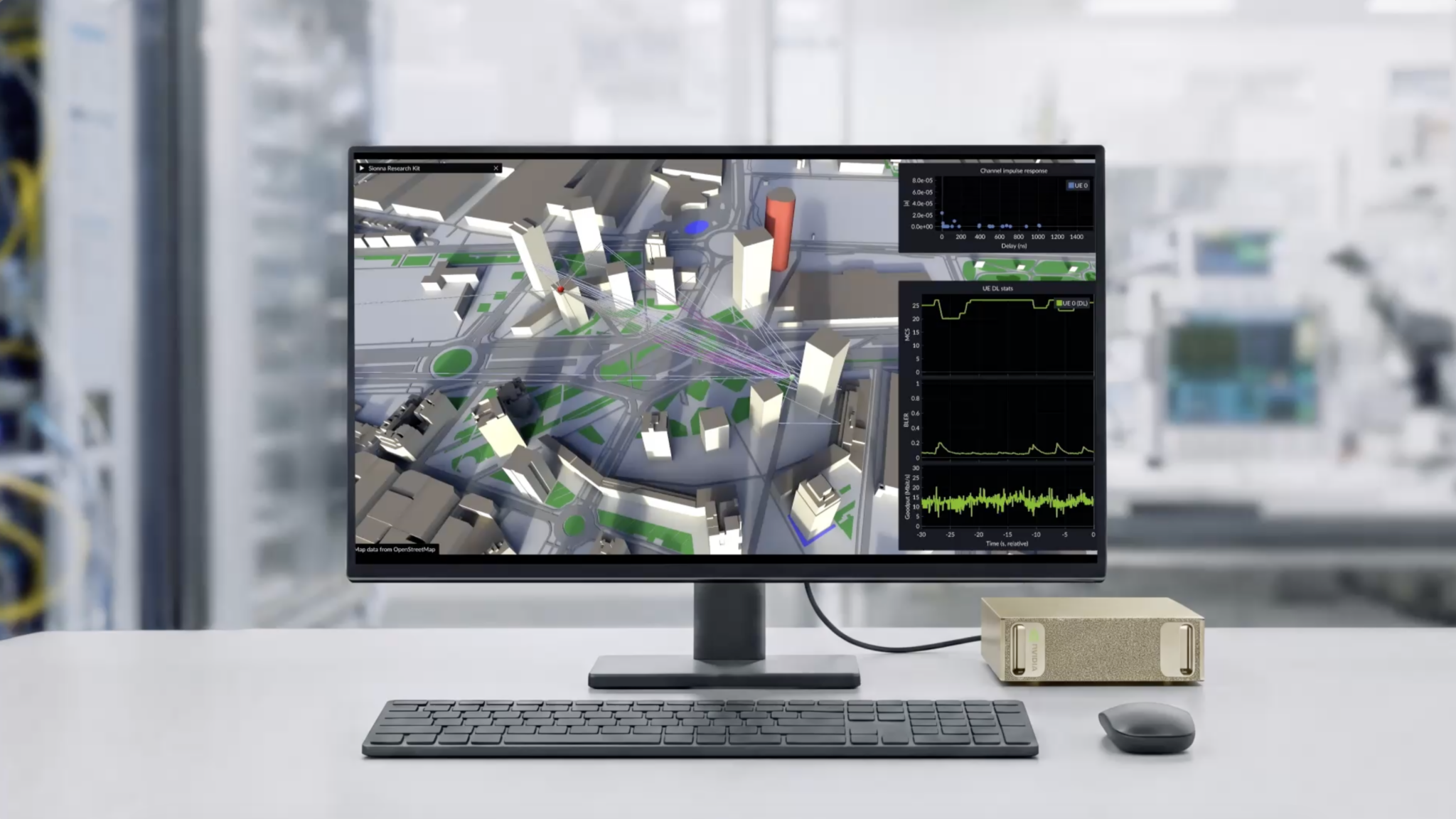
NVIDIA published a status report on November 6, roughly a year after it open sourced its Aerial wireless software. Adoption of NVIDIA AI Aerial and NVIDIA Sionna has grown 10x over the past year, its open source 5G/6G tools have passed 1 million downloads, and more than 8,000 research and academic institutions now use the platforms.
The pitch behind the toolchain is continuity. Researchers can move between simulation, AI training and real over-the-air experiments on one foundation instead of stitching together separate stacks. NVIDIA frames the goal as AI-native 6G, in which connectivity, computing and sensing run on a single software-defined platform serving people, machines and agents.
King's College London supplied the robotics example. Researchers attached a camera-equipped robot arm to an NVIDIA Jetson AGX Orin running Sionna, which handles both the software-defined 5G link and edge AI processing. Rather than sending full images, the robot transmits compact descriptions of objects, their positions and their relationships, an approach called goal-oriented semantic communications.
In fruit-packing and cube-stacking trials with deliberately injected faults, that cut task completion time by up to 52.6% and improved success rates versus sending periodic images. The setup also detected dropped objects, recovered from failed actions and, with a digital twin, checked planned moves for collisions before execution.
On the receiver side, SoftBank integrated a neural receiver into NVIDIA Aerial CUDA-Accelerated RAN and tested it with a commercial 5G smartphone. Under interference it delivered higher uplink throughput than a conventional receiver at all 15 tested settings, with a maximum gain of roughly 60%. ETH Zurich took a different route using the Aerial Testbed, tuning neural receivers on local measurements to cut block error rates by more than a third against selected pretrained versions.
Energy is the third theme. A University of Leeds team predicts network demand 10 minutes ahead and uses the forecast to decide when base stations can sleep, checking first that neighbouring active stations can still serve affected devices. Tested on a DGX Spark-powered portable 5G network-in-a-box alongside a digital twin, the approach cut RAN power consumption by 45.6% against a full-power baseline while keeping devices connected.
Simulation speed improved too. CTTC brought GPU-accelerated radio channel models running on ACAR into its open source 5G-LENA simulator, reducing runtime from about three hours to 10 to 20 minutes in an early evaluation while preserving expected statistical behaviour and network performance.
The projects are still research results, well short of a commercial 6G standard, but they show the open toolchain moving ideas from papers into reproducible over-the-air experiments. NVIDIA said it will host 6G developer sessions at GTC in Washington, D.C.
Why it matters
For telecom operators and vendors, shared open tooling makes 6G research easier to reproduce and compare across labs, which could shorten the path from prototype to standard. For NVIDIA, it extends GPU demand from the data centre into radio access networks and edge devices.
Nearby Updates
All11/06, 23:54
Ramp data shows AI spending flattening just as Anthropic nears its IPO
Transaction data from spending platform Ramp shows enterprise AI usage still climbing while the money spent on it has stalled, TechCrunch reports. The split arrives as Anthropic approaches its IPO, a moment when investors must price AI growth.
11/06, 23:37
CloudBolt Adds AI Agent Governance to Its Cloud Management Platform
CloudBolt has added new AI agent governance capabilities to its cloud management platform, VMblog reports. As agents begin taking cloud actions on users' behalf, scoping permissions, keeping audit trails and blocking overreach is becoming a procurement requirement.
11/06, 23:36
Anthropic taps Claude to help its 15-person team design custom AI chips
Crypto Briefing reported on November 6 that Anthropic is using Claude to help a 15-person team design custom AI chips, cutting development time compared with traditional methods. The detail matters less as a product story than as evidence that model makers are pushing design work upstream into their own silicon.
11/07, 01:16
Gemini Omni 1.2 Flash adds 15-second AI video and cuts generation cost by 30%
Google's Gemini Omni 1.2 Flash now generates AI video clips of up to 15 seconds while cutting generation costs by 30%, according to Techgenyz. The report frames the update around duration and unit cost, the two levers that decide whether generated video can be used at production scale.