Realtime AI News
NVIDIA Unveils GR00T 2 World Action Model and an Open Robotics Stack at CoRL
At CoRL in Austin, NVIDIA released GR00T 2, an open world action model built on Cosmos that completed 40 of 50 evaluated tasks without task-specific demonstrations. The accompanying Isaac Lab 3.0, Newton physics integration and data tools push simulation-based robot training toward industrial deployment.
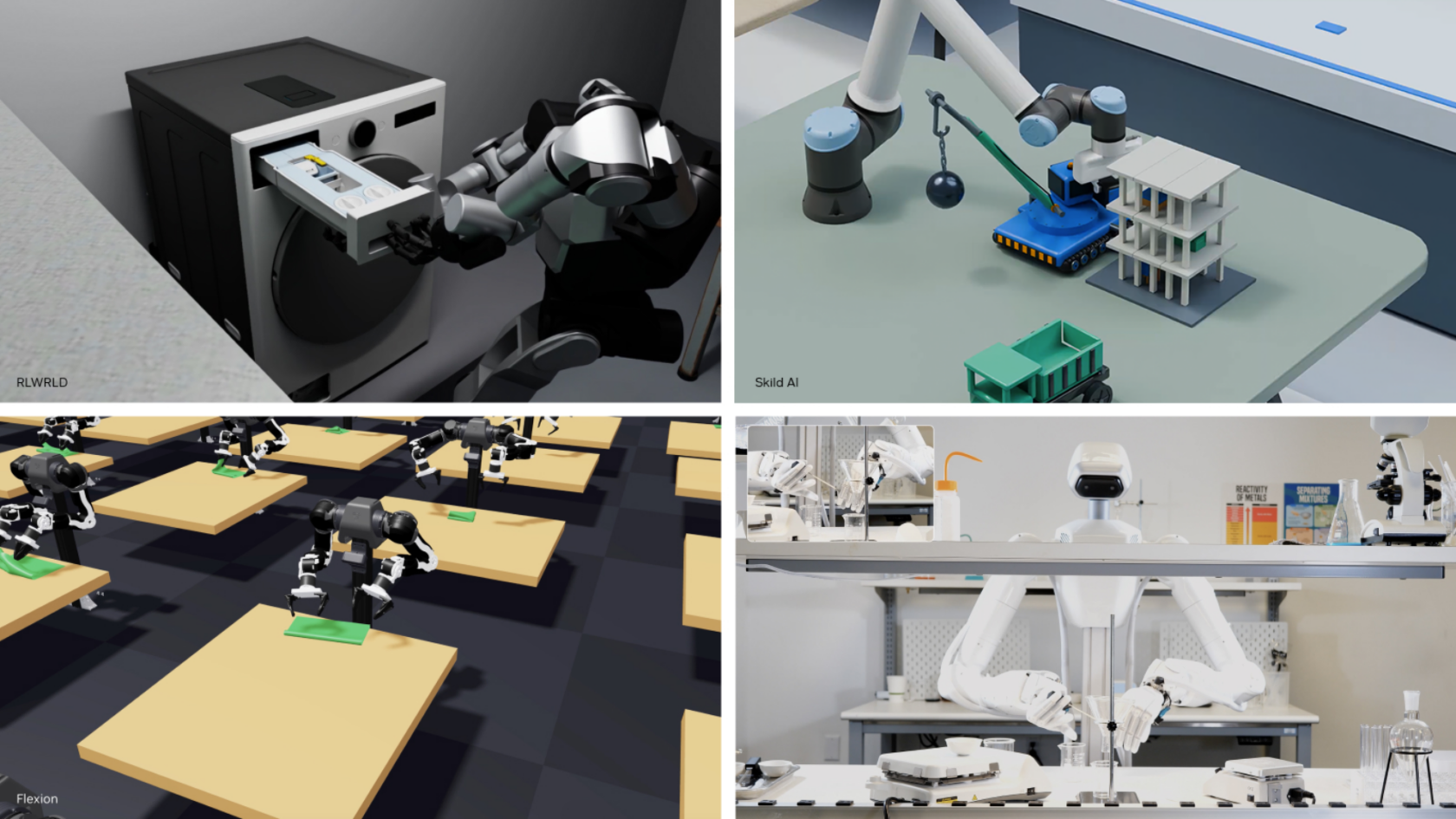
NVIDIA used this week's Conference on Robot Learning (CoRL) in Austin, Texas, to release a bundle of open robotics technologies covering world action models, simulation tools, benchmarks and agentic workflows. The company's framing is that robot learning is moving on from locomotion — the walking, rolling and hopping that simulation has long supported — toward manipulation tasks that demand a finer touch, such as aligning gears, connecting cables and assembling small components.
The centerpiece is GR00T 2, an open frontier world action model built on NVIDIA Cosmos. It was trained on diverse robot and human data, including 100,000 hours of NVIDIA's open source human egocentric data, and is meant to let robots learn dexterous manipulation skills.
The published numbers are specific. GR00T 2 completed 40 of 50 evaluated tasks at least once without task-specific demonstrations; with one demonstration per task it averaged 71% success across those 50 tasks, rising to 95% with five demonstrations. It can also learn from human demonstrations and transfer skills between different robot bodies without robot demonstrations.
Leaderboard position and customer trials are being cited alongside the benchmarks. NVIDIA says GR00T 2 currently ranks in the top three across all vision language action and world action model categories on RoboCasa365, RoboLab, RoboDojo and MolmoSpaces, with multiple first-place finishes. Nexuni is testing it for robotic laundry handling, Foxconn is applying it to factory automation for server manufacturing, Siemens is evaluating industrial use cases, and MicroAGI has post-trained the model with reinforcement learning to swap Ethernet cables on a YAM arm.
On the simulation side, NVIDIA shipped Isaac Lab 3.0. The open source robot-learning framework now lets researchers use agents to stand up training environments, switch between the NVIDIA PhysX and Newton physics solvers, choose renderers for perception-based training, and apply a new reinforcement post-training library to foundation models such as GR00T. Tighter Newton integration adds deformable objects such as cables and cloth, along with articulated systems like multi-jointed robot hands.
The efficiency claim comes with a comparison: in a vision-based dexterous manipulation benchmark, Isaac Lab 3.0 with Newton reached up to 2.5x the training throughput of Isaac Lab 2.3 with PhysX. The shift NVIDIA is selling is not a smarter demo but a training loop: simulate thousands of robots in parallel, evaluate, turn failures into the next round of learning, then transfer the policy to physical hardware.
Data tooling is being filled in as well. A new open Video to Data workflow converts human video into simulated robot demonstrations, and NVIDIA launched a challenge inviting researchers to improve it. The EgoHand open model reconstructs 3D hand motion from data supplied by Noitom Robotics; NVIDIA says it passed 40,000 Hugging Face downloads in the two weeks since launch.
Academically, two NVIDIA papers are among six finalists for the CoRL Best Paper Awards. GRAIL (Generating Humanoid Loco-Manipulation from World Models) presents a generation pipeline for 3D assets and simulator-ready scenes for robot learning, while RoboTTT: Context Scaling for Robot Policies scales visuomotor context three orders of magnitude beyond state-of-the-art policies without growing inference latency. With more than a dozen partners including Ambi Robotics, Bosch Research, Skild AI, Siemens and UC Berkeley, NVIDIA is trying to turn rehearsal in simulation and work on the line into shared public infrastructure.
Why it matters
NVIDIA is shifting competition from a single model to a full training stack of model, simulation and data. If partners such as Foxconn and Siemens reproduce the published numbers, the engineering barrier for humanoid robots drops considerably.
Nearby Updates
All11/09, 21:53
Disney and Adobe Sign Multi-Year Deal to Build Private AI Models
Disney and Adobe have signed a multi-year agreement to develop private AI models, according to a FourWeekMBA report. The deal points to large content companies moving from off-the-shelf generative tools toward models built and controlled for their own operations.
11/09, 21:48
Report: NVIDIA Looks to Brightspeed Central Offices for Its Inference Network
NVIDIA is reportedly looking to use Brightspeed's telecom central offices as locations for its inference network, according to Data Center Dynamics. If confirmed, it would mark a shift toward distributing AI compute into existing telecom facilities closer to users instead of concentrating everything in large data centers.
11/09, 22:43
Apple Clears Key China Regulatory Step for Apple Intelligence on iPad and Mac
Apple has cleared a key regulatory step in China for bringing Apple Intelligence features to iPads and Macs, according to a TipRanks report, sending the company's shares slightly higher. The report does not name the approving authority, list the cleared features or give a launch timeline.
11/09, 21:06
Space and Time launches an enterprise platform for verified AI calculations on private data
Space and Time announced Space and Time Enterprise on November 9, letting companies run AI tools over private databases and prove the results are correct without handing over the underlying records. The platform extends its Proof of SQL work using zero-knowledge proofs and needs no blockchain, GPUs or specialized hardware, running on ordinary laptops and servers.