Realtime AI News
Google Cloud launches Gemini for healthcare to unify clinical data and automate workflows
Google Cloud has launched Gemini for healthcare, aiming to unify clinical data and automate workflows for hospitals and care providers. The company is pitching the product around reducing administrative burnout, marking another push by a major cloud vendor into vertical AI solutions.
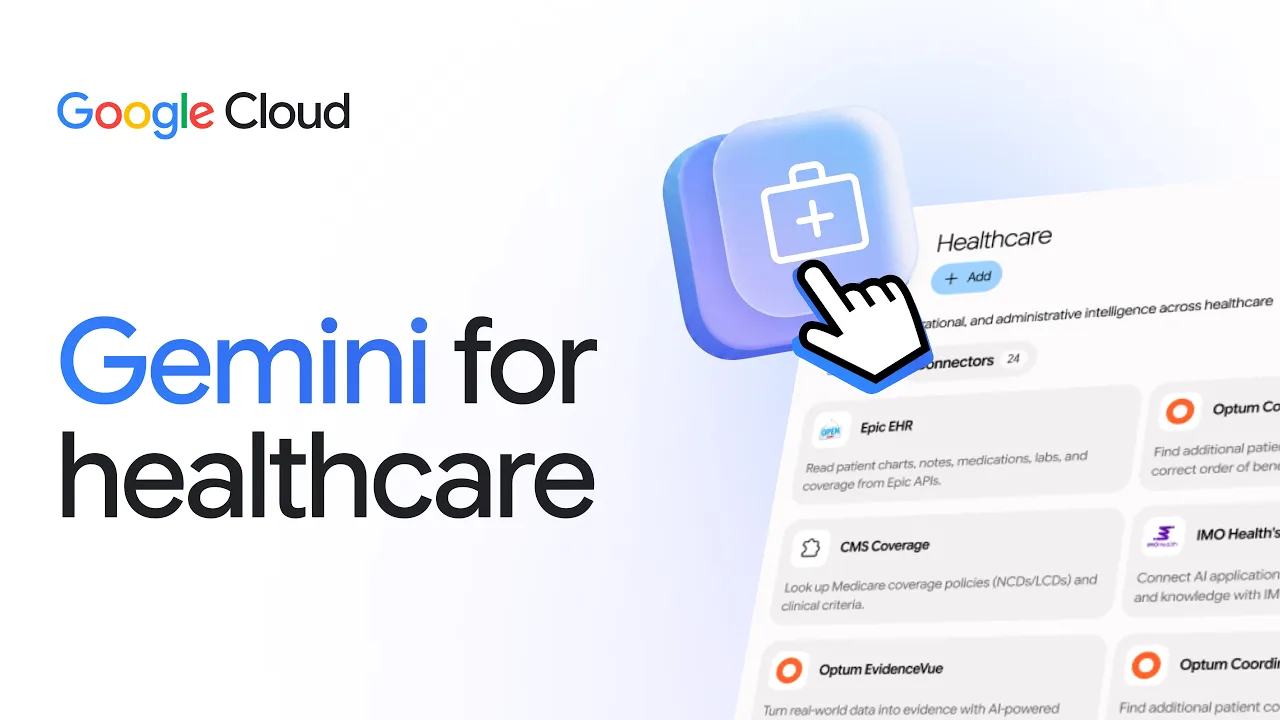
Google Cloud has launched Gemini for healthcare, pitching it as a way to unify clinical data and automate workflows for hospitals and care providers. The announcement came through Google's official blog and frames the product around reducing administrative burnout.
According to Google Cloud, the offering has two main thrusts: bringing patient information scattered across different systems into a single AI entry point, and automating repetitive administrative work that consumes clinicians' time.
The emphasis on burnout is telling. Documentation and coordination have long crowded out clinical time, and Google Cloud is positioning generative AI as a way to absorb that load rather than as a narrow diagnostic aid.
That positioning matters because most healthcare AI so far has focused on point tasks such as imaging or decision support. Gemini for healthcare aims at the data layer and the workflow layer, where control over the clinical data entry point can make AI part of day-to-day hospital operations.
For Google Cloud, healthcare is also a strategic enterprise battleground. Packaging Gemini as an industry solution helps turn model capability into durable cloud contracts instead of one-off API usage.
Execution will be the hard part. Clinical data carries privacy and compliance obligations, hospital systems are fragmented, and model output still needs clinical validation and clear lines of accountability. Unifying data sounds simple until format, permissions and audit requirements arrive.
The signals to watch are early customers and measurable results: whether administrative time actually falls, whether clinicians trust the workflows, and whether Google Cloud can deliver deployments that satisfy healthcare regulators. Those answers will matter more than the launch-day vision.
Why it matters
Healthcare is a high-value enterprise market for cloud vendors, and Gemini for healthcare shifts competition from point diagnostics toward the data and workflow layer. Verifiable efficiency gains could change how hospitals buy AI, while compliance and integration costs could slow adoption.
Nearby Updates
All11/10, 20:00
OpenAI Academy Brings Free ChatGPT Workshops to Caregivers in Five U.S. Cities
OpenAI Academy is bringing free, hands-on ChatGPT workshops to caregivers in five U.S. cities, aiming to help them build practical AI skills for everyday life. The program targets a group that often lacks the time and tailored guidance to adopt new tools on its own.
11/10, 18:05
Hanqiao, an AI agent for international Chinese education, launches at BLCU
Beijing Language and Culture University reported on Nov. 10 that a launch event for Hanqiao, an AI agent for international Chinese-language education, was held on campus. The university's post discloses only that the launch took place, with no base model, feature list or availability date.
11/10, 17:54
Google's cloud catalog lists Gemini 4 Carbon at $4/$20
FourWeekMBA reports that Google has listed a model called Gemini 4 Carbon in its cloud catalog at $4/$20. No model card or release notes accompany the entry, which reads more like pre-launch catalog configuration caught early than an official launch.
11/10, 16:55
Flexxon wins third CyberCall grant to build hardware-level security for AI agents
Flexxon has been named a CyberCall 2025 awardee under the 'Cybersecurity for AI' challenge and will develop X-PHY AI Armor, a hardware-rooted secure MCP gateway. The project sits between AI agents and the systems they reach, moving authorization and audit records for high-risk actions into hardware.