Realtime AI News
AI Day Seoul wraps with 2,000-plus attendees focused on physical AI and agents
Nvidia's event recap says AI Day Seoul drew more than 2,000 attendees to COEX over two days, bringing together Korean industry leaders, startups and developer communities around physical AI and AI agents. At the plenary, Nvidia robotics and edge AI vice president Deepu Talla said Korea is punching above its weight in the field.
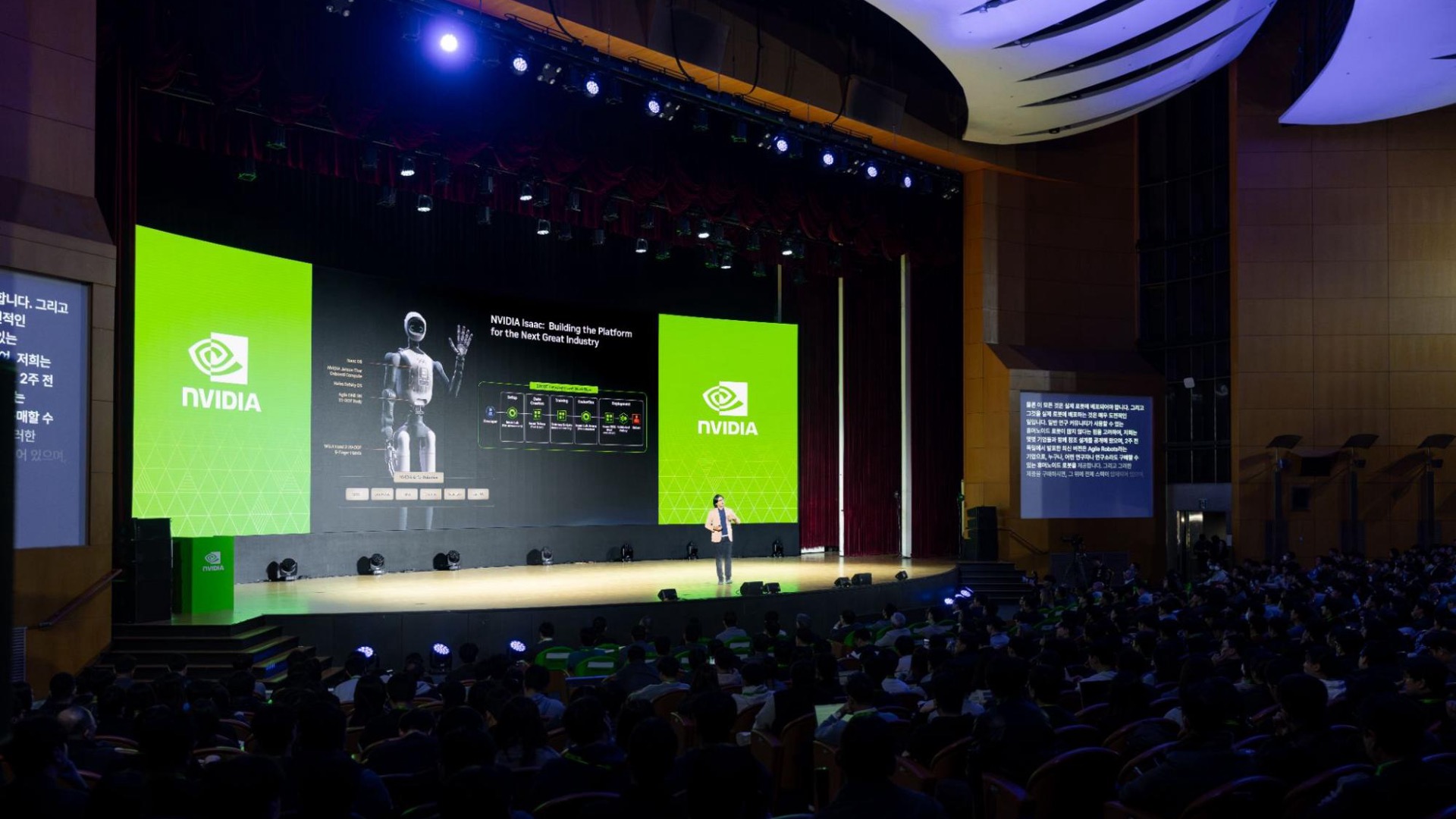
Nvidia published a wrap-up of AI Day Seoul, closing out a two-day industry gathering that the company framed as a meeting point for Korean industry leaders, startups and developer communities working on physical AI and AI agents. It was positioned as an ecosystem event rather than a single product launch.
The event took place at COEX in Seoul, where more than 2,000 attendees turned up across the two days. The recap sorts the audience into three groups: Korean industry leaders, startups, and developer communities, a mix that suggests organizers wanted enterprise deployment needs and hands-on builder skills in the same room.
At the plenary sessions, Deepu Talla, vice president of robotics and edge AI at Nvidia, said Korea is punching above its weight in this area. The remark came from an executive whose portfolio covers both robotics and edge AI, pointing at Korea's existing base in hardware manufacturing and robotics engineering.
In naming participants, the recap cites Doosan Robotics and Hyundai among the companies involved, anchoring the discussion in industrial robots and physical systems rather than purely software model demos. Physical AI is precisely the category of work that requires sensing, deciding and acting in real environments.
For Nvidia, grouping robotics and edge AI under a single vice president lines up with its long-running effort to push compute from the data center out to devices. AI agents usually sit in the software layer in these conversations, orchestrating device capabilities into complete tasks, and they formed the event's second main thread.
Startups and developer communities were treated as distinct participant groups. For ecosystem builders, the value of a gathering like this tends to lie less in the keynote stage than in whether developers can actually get tools, hardware samples and usable interfaces.
What to watch next is how far the named Korean companies push physical AI and agents into real deployments, and whether Nvidia's developer ecosystem in the country produces more publicly documented case studies as a result.
Why it matters
The event shows physical AI and agents now serve as Nvidia's main framing for building regional ecosystems beyond the data center. Korea is positioned as a key node in that story, making local deployments the metric to track.
Nearby Updates
All11/16, 07:30
Indian chip startup Bharat Semi raises $24M seed to target global AI sensor market
Bharat Semi, an Indian chip startup, has raised a $24 million seed round as it targets the global market for AI-enabled sensors. The company says it has secured design wins for its AI sensor technology with customers including General Atomics.
11/16, 06:00
A step toward defining the Standard Model on a lattice
A step toward defining the Standard Model on a lattice. Explore a candidate nonperturbative lattice definition of the Standard Model and how GPT 6 Astra helped turn the idea into a detailed proof.
11/16, 06:00
OpenAI launches a new blog dedicated to science
OpenAI has published a post titled "Our new blog for science" on its news site, introducing a blog focused on scientific work. According to the description, it will share new findings, practical methods, and firsthand accounts from researchers using AI to advance scientific discovery.
11/16, 05:56
Is bad news for Jensen Huang also bad news for the AI industry?
Is bad news for Jensen Huang also bad news for the AI industry?. "Jensen is Nvidia, right? And so much of this economy is riding on Nvidia."