English translation
Example text
AI Article Decision Snapshot
Turn the lesson into workflow, model, budget, and security checks before choosing tools.
Use this quick snapshot before leaving the article. It keeps the next search tied to practical AI software, model/API, cost, privacy, and implementation questions.
Workflow fit
Identify the real job behind the article: coding, research, document review, support, analytics, content, or internal automation.
Model or tool decision
Decide whether the next step is a software shortlist, an AI tool comparison, an API platform choice, or a model benchmark.
Budget and usage signal
Estimate seats, API calls, prompt volume, retries, review time, and fallback work before assuming the workflow is cheap.
Security and privacy review
Check whether source code, customer data, private documents, prompts, logs, or embeddings will enter the AI workflow.
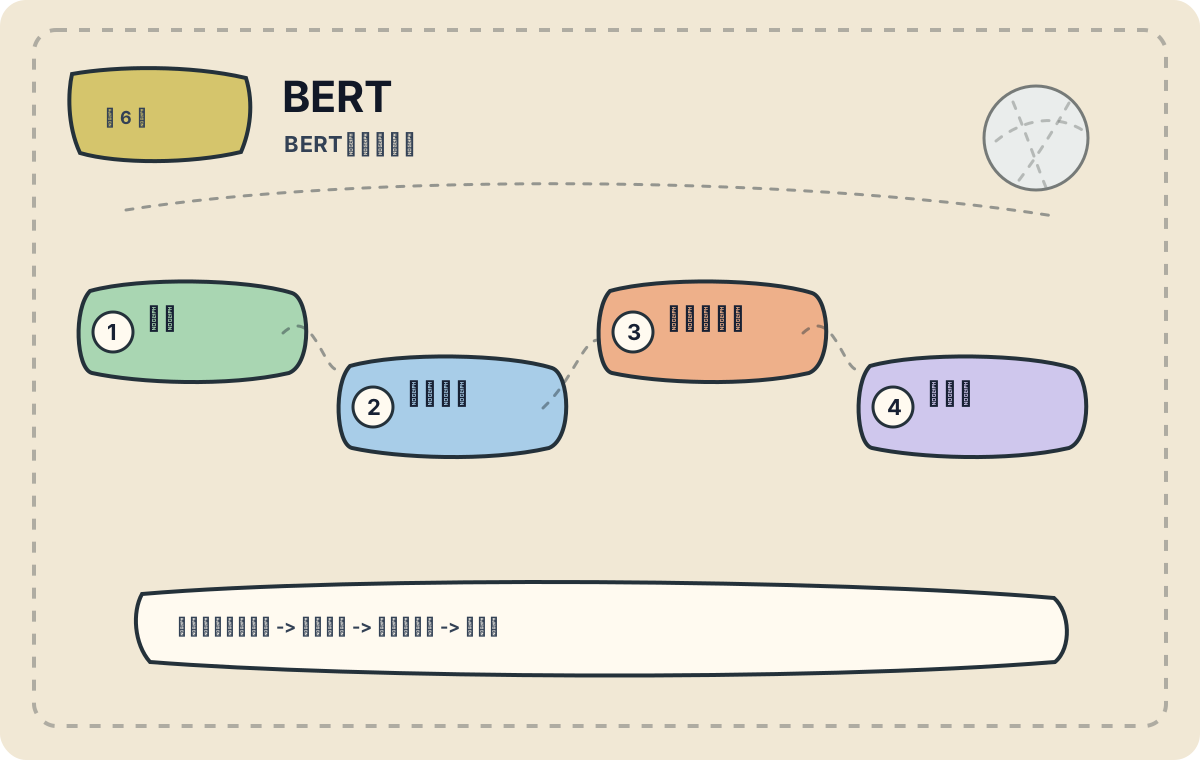
BERT can be understood as first reading an entire sentence, then swapping in a small, task-specific output head. Its value lies in contextual representations—not merely scaling up word embeddings. This article focuses on training: data preprocessing, loss functions, optimizers, and logging must form a closed loop to ensure training outcomes are reproducible and auditable.
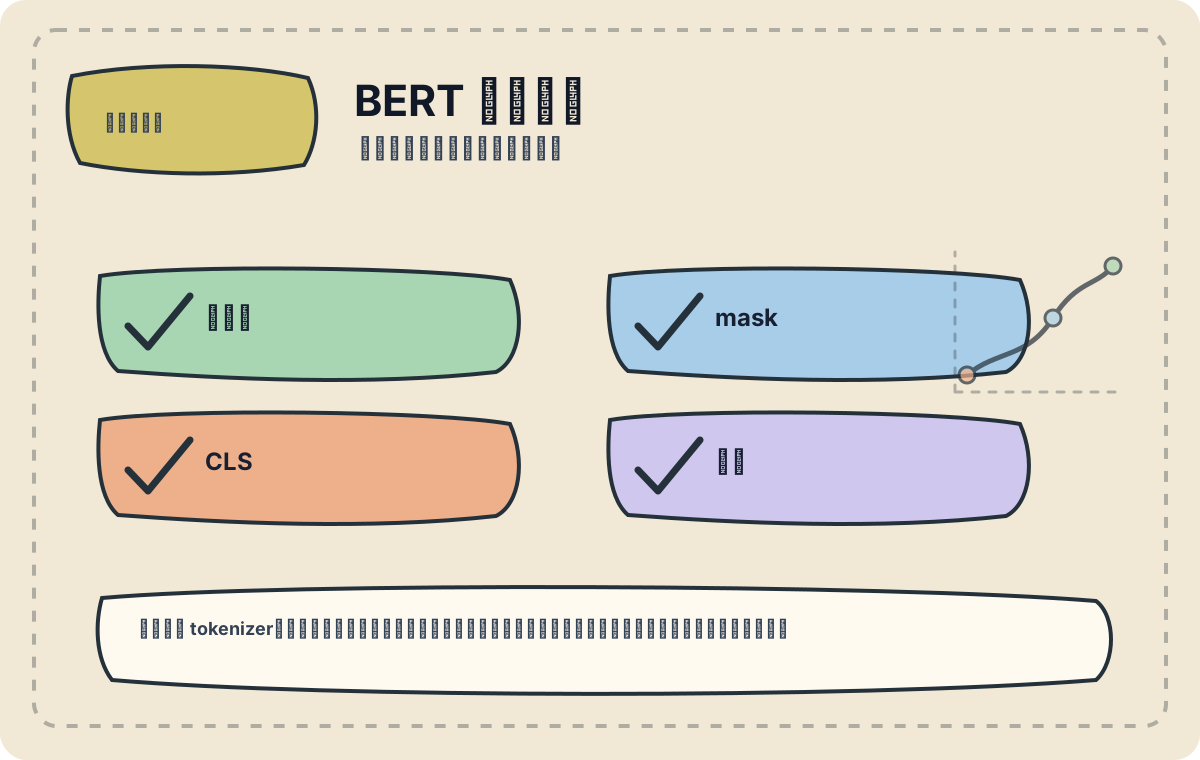
I will verify the tokenizer, maximum sequence length, truncation strategy, and output of the task head. In text-based tasks, poor performance is often not due to weak models—but rather incorrect input preprocessing.
In the previous article, we explored BERT’s architectural characteristics—its bidirectional encoding capability and pretraining mechanism. In this article, we focus specifically on practical training techniques for fine-tuning BERT to improve performance on downstream tasks—and lay the groundwork for the next article on ResNet’s network architecture.
Data Preparation
Data preparation is a critical step before training BERT. Generally, the following preprocessing steps should be followed:
When learning BERT training techniques, start by examining data construction, masking strategies, batch size, and learning rate. These training details directly impact language understanding capability.
- Text Cleaning: Remove extraneous whitespace characters, special symbols, etc.
- Tokenization: Use BERT’s built-in tokenizer to convert raw text into token IDs. During this process, pay attention to WordPiece tokenization—which splits words into subword units—to robustly handle out-of-vocabulary (OOV) tokens.
from transformers import BertTokenizer

tokenizer = BertTokenizer.from_pretrained('bert-base-uncased')

# Example text
text = "Hello, BERT! Let's fine-tune you."
tokens = tokenizer.encode(text, add_special_tokens=True)
print("Tokens:", tokens)
Training Strategies
1. Pretraining vs. Fine-tuning
When reading “BERT Training Techniques”, first examine the figures—highlighting tasks, core concepts, exercises, and decision points—then return to the main text to fill in technical details. This approach helps quickly assess where the content fits within real-world applications.
BERT training typically consists of two phases: pretraining and fine-tuning.
-
Pretraining: BERT is pretrained on large-scale corpora using two self-supervised objectives:
- Masked Language Modeling (MLM): Randomly mask some tokens in the input and train the model to predict them. For example, the sentence “BERT is a powerful model” might become “BERT is a [MASK] model.”
- Next Sentence Prediction (NSP): Given two sentences, predict whether the second sentence logically follows the first. This encourages modeling inter-sentence relationships.
-
Fine-tuning: Adapt the pretrained model to specific downstream tasks (e.g., text classification, question answering). Fine-tuning usually employs a smaller learning rate, since the model has already learned rich linguistic features from large-scale pretraining.
2. Hyperparameter Tuning
Several key hyperparameters require careful tuning during BERT training:
- Learning Rate: A warmup schedule (e.g., linear warmup + decay) is recommended. Typical initial learning rates range from
5e-5to3e-5. - Batch Size: Adjust according to GPU memory capacity—common values are
16or32. Due to BERT’s large parameter count, excessively large batches may cause out-of-memory errors.
from transformers import AdamW

optimizer = AdamW(model.parameters(), lr=5e-5)
- Number of Training Epochs: Typically set between
3and5, depending on the task. Monitor validation loss closely to prevent overfitting.
3. Data Augmentation and Regularization
- Data Augmentation: Techniques such as random dropout or synthetic data generation (e.g., synonym replacement, back-translation) can improve generalization.
- Regularization: Apply
L2 weight decayto mitigate overfitting. Additionally, consider aggressive early stopping during fine-tuning.
Case Study
Here’s an example demonstrating how BERT improves performance on a binary text classification task:
from transformers import BertForSequenceClassification, Trainer, TrainingArguments

model = BertForSequenceClassification.from_pretrained('bert-base-uncased', num_labels=2)

training_args = TrainingArguments(
    output_dir='./results',
    num_train_epochs=3,
    per_device_train_batch_size=16,
    per_device_eval_batch_size=64,
    warmup_steps=500,
    weight_decay=0.01,
    logging_dir='./logs',
)

trainer = Trainer(
    model=model,
    args=training_args,
    train_dataset=train_dataset,
    eval_dataset=eval_dataset,
)

trainer.train()
In this snippet, we load a pretrained BERT model configured for sequence classification, define training arguments—including epoch count, batch sizes, warmup steps, and weight decay—and use Hugging Face’s Trainer API to streamline training and evaluation.
After completing “BERT Training Techniques”, try applying it to your own scenario—pay close attention to whether inputs, preprocessing steps, and outputs align coherently.
To apply “BERT Training Techniques” to your own task, begin by narrowing the scope—validate only one critical decision point first.
Conclusion
In this article, we examined BERT training techniques—from data preparation and tokenization to core training strategies and hyperparameter configuration. These methods significantly enhance BERT’s performance on downstream tasks while ensuring model stability and generalization. In the next article, we will delve into ResNet’s network architecture—continuing our exploration of foundational deep learning models.
Apply This Lesson
Turn this article into AI software, model, API, and security decisions.
English Article FAQ
Use this article as evidence before choosing AI tools
How should I use this AI Tutorials article?
Use it as the implementation or learning layer, then connect the idea to AI software buyer guides, tool comparisons, benchmarks, API choices, and security checks before making a production decision.
Is this English article different from the Chinese original?
The English edition is localized for global AI readers while preserving the original diagrams, screenshots, prompts, code examples, and source context from the Chinese article.
What should I read after Example text?
Continue with AI Software Buyer Guides, AI Tools Workbench, Best AI Coding Agents, AI Model Benchmarks, OpenAI vs Anthropic API, or LLM Security Tools depending on the decision you need to make.
Can this article alone choose an AI product or model?
No. Treat the article as evidence and context, then validate fit with pricing, privacy requirements, integration effort, benchmark results, workflow tests, and fallback planning.
Continue