English translation
Use Dify’s API to generate text
AI Article Decision Snapshot
Turn the lesson into workflow, model, budget, and security checks before choosing tools.
Use this quick snapshot before leaving the article. It keeps the next search tied to practical AI software, model/API, cost, privacy, and implementation questions.
Workflow fit
Identify the real job behind the article: coding, research, document review, support, analytics, content, or internal automation.
Model or tool decision
Decide whether the next step is a software shortlist, an AI tool comparison, an API platform choice, or a model benchmark.
Budget and usage signal
Estimate seats, API calls, prompt volume, retries, review time, and fallback work before assuming the workflow is cheap.
Security and privacy review
Check whether source code, customer data, private documents, prompts, logs, or embeddings will enter the AI workflow.
When evaluating Dify’s advantages, avoid focusing solely on feature checklists. Instead, ask whether it shortens the path from initial user interviews to a working demo—and whether it enables product, operations, and engineering teams to collaborate effectively using a single, shared workflow diagram.
A simple litmus test: implement the same customer service Q&A scenario using three approaches—custom scripting, a conventional chatbot platform, and Dify—then compare them across three dimensions:
- Modification cost (effort required to update logic or content),
- Log visibility (how easily you can trace, debug, and audit interactions), and
- Pre-launch verification items (number and complexity of checks before going live).
In the previous tutorial, we introduced Dify’s background and core capabilities, exploring how this generative AI application innovation engine empowers users with robust functionality. Next, we’ll dive deeper into Dify’s distinct market advantages—and how it stands out in an increasingly competitive landscape.
1. Powerful Generative Capabilities
Dify leverages state-of-the-art generative models to help users effortlessly produce high-quality content—not only text, but also images, audio, and other modalities. In marketing, for instance, users can rapidly generate campaign copy, dramatically accelerating time-to-output.

To compare Dify’s market advantage objectively, break down a real-world workflow into four phases: entry, configuration, execution/flow, and review. A feature’s true value lies in its ability to reduce repetitive manual effort within one or more of these phases.
Case Study: A marketing team used Dify to generate social media content. By inputting just a topic and target audience, Dify delivered multiple tweet drafts in seconds. The team saved significant time—and simultaneously increased content variety and freshness.
2. Enhanced Natural Language Processing (NLP)
Dify delivers advanced natural language processing capabilities, enabling sophisticated language understanding and generation tasks. This gives it a clear edge in customer support automation, conversational AI, and intelligent assistant applications.
Before diving into “Dify’s Market Advantages”, quickly scan the accompanying visuals:
- What question is each image prompting?
- Which key concepts need to be clearly distinguished?
- At which step should you start experimenting hands-on?
- And finally—what criteria will validate success?
Case Study: A tech company integrated Dify-powered chatbots into its customer support system. The bot could parse multi-intent user queries and respond with precise, context-aware answers. For example, when asked “How do I reset my password?”, it not only listed steps—but also checked the user’s account status in real time and offered personalized guidance (e.g., “Your account is locked; please contact support first”). This adaptability significantly boosted customer satisfaction scores.
3. Usability and Extensibility
Dify features an intuitive, low-code interface—making it accessible even to non-technical users. Its well-documented, RESTful APIs also enable seamless integration with existing tools and platforms, supporting rapid functional expansion and use-case diversification.
Code Example:
import requests

# Use Dify’s API to generate text
api_url = 'https://api.dify.com/generate'
payload = {
    "prompt": "Write an article about the future of artificial intelligence",
    "max_tokens": 500
}
response = requests.post(api_url, json=payload)
generated_text = response.json().get('text', '')
print(generated_text)
With just a few lines of code, users can integrate Dify’s generative power into their own applications. This flexibility allows Dify to serve diverse user needs—from individual creators to enterprise engineering teams.
4. Cost Efficiency
Dify offers a transparent, tiered pricing model designed to scale with organizations of all sizes. Compared to traditional content creation methods—such as hiring full-time writers or building custom ML pipelines—Dify delivers substantial cost savings without compromising quality, while dramatically increasing output velocity.
Case Study: A fast-growing startup expanded its market reach by adopting Dify instead of hiring dedicated copywriters. It reduced content production costs by nearly 40%, while maintaining editorial standards and gaining agility to pivot messaging in response to real-time market feedback.
5. Community and Support Ecosystem
Dify is more than a tool—it’s a collaborative ecosystem. Users actively share implementation patterns, troubleshooting tips, and best practices in the official community. Crucially, user feedback directly informs Dify’s roadmap—enabling rapid iteration and alignment with evolving real-world needs.
After completing “Dify’s Market Advantages”, try adapting it to your own use case. Pay close attention to whether inputs, processing logic, and outputs align coherently end-to-end.
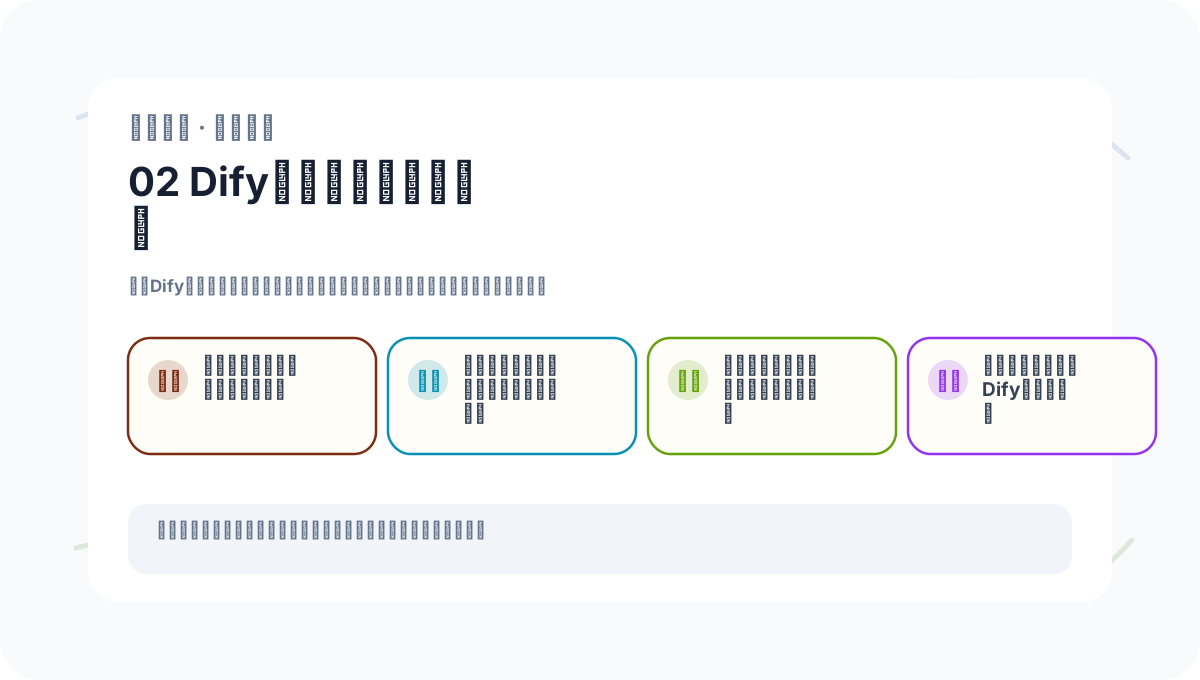
To apply “Dify’s Market Advantages” to your work, start small: isolate one critical decision point, then rigorously test Dify against your current approach.
Summary
As demonstrated above, Dify holds clear, differentiated advantages in the generative AI application space. Whether through its powerful multimodal generation, industry-leading NLP, intuitive yet extensible design, compelling cost-performance ratio, or vibrant, co-evolving community—Dify delivers unique, tangible value. In the next tutorial, we’ll explore Dify’s practical use cases, uncovering its broad applicability across industries and functions.
Apply This Lesson
Turn this article into AI software, model, API, and security decisions.
English Article FAQ
Use this article as evidence before choosing AI tools
How should I use this AI Tutorials article?
Use it as the implementation or learning layer, then connect the idea to AI software buyer guides, tool comparisons, benchmarks, API choices, and security checks before making a production decision.
Is this English article different from the Chinese original?
The English edition is localized for global AI readers while preserving the original diagrams, screenshots, prompts, code examples, and source context from the Chinese article.
What should I read after Use Dify’s API to generate text?
Continue with AI Software Buyer Guides, AI Tools Workbench, Best AI Coding Agents, AI Model Benchmarks, OpenAI vs Anthropic API, or LLM Security Tools depending on the decision you need to make.
Can this article alone choose an AI product or model?
No. Treat the article as evidence and context, then validate fit with pricing, privacy requirements, integration effort, benchmark results, workflow tests, and fallback planning.
Continue