English translation
Define coefficient matrix A
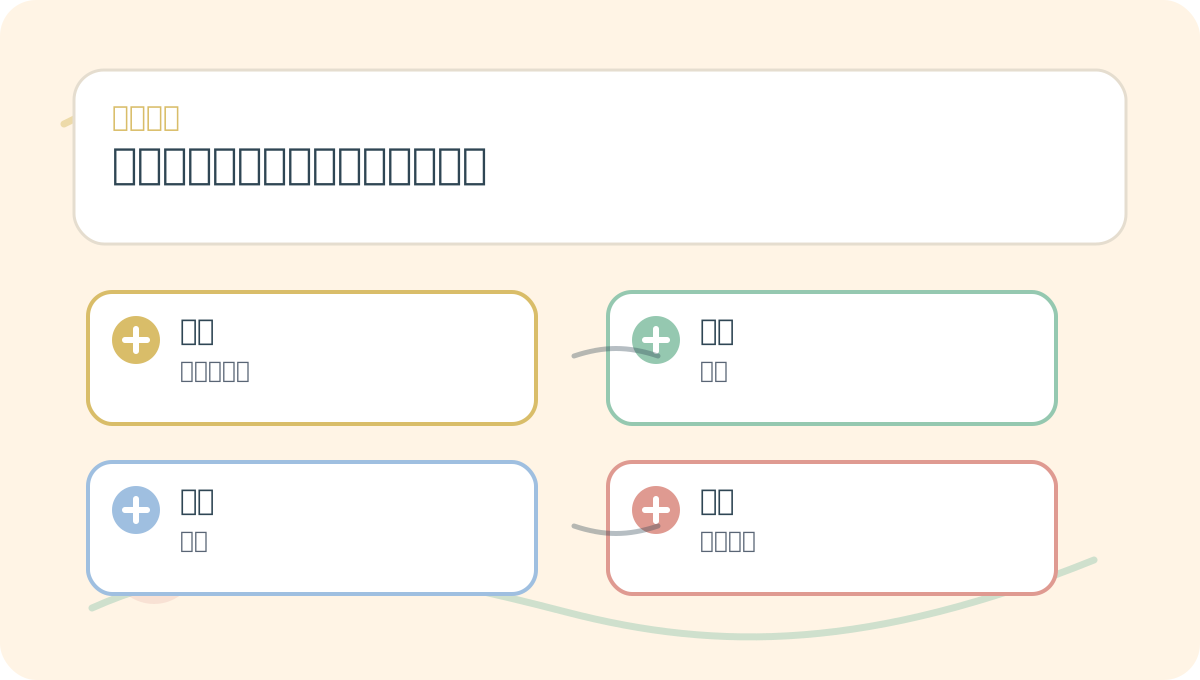
AI Article Decision Snapshot
Turn the lesson into workflow, model, budget, and security checks before choosing tools.
Use this quick snapshot before leaving the article. It keeps the next search tied to practical AI software, model/API, cost, privacy, and implementation questions.
Workflow fit
Identify the real job behind the article: coding, research, document review, support, analytics, content, or internal automation.
Model or tool decision
Decide whether the next step is a software shortlist, an AI tool comparison, an API platform choice, or a model benchmark.
Budget and usage signal
Estimate seats, API calls, prompt volume, retries, review time, and fallback work before assuming the workflow is cheap.
Security and privacy review
Check whether source code, customer data, private documents, prompts, logs, or embeddings will enter the AI workflow.

A homogeneous system always has the trivial (zero) solution. For a nonhomogeneous system, we must first determine whether a solution exists. If a solution exists, the general solution is typically expressed as a particular solution plus the general solution to the associated homogeneous system.

I begin by checking whether the right-hand side is the zero vector; then I use rank to analyze the solution space. Do not conflate conclusions applicable to one type of system with those for the other.
In the previous article, we learned Gaussian elimination—a powerful and systematic method for solving linear systems. This article explores the two fundamental types of linear systems: homogeneous systems and nonhomogeneous systems. Understanding their structural properties and solution strategies is essential for advancing in linear algebra—and for applying it effectively in artificial intelligence.
1. Homogeneous Systems
Definition
A linear system whose constant terms on the right-hand side are all zero is called a homogeneous system. It can be written in matrix form as:

When comparing homogeneous and nonhomogeneous systems, consider: constant terms, existence of the zero solution, number of free variables, rank, and structure of the general solution.
where is the coefficient matrix, is the vector of unknowns, and is the zero vector.
Example
Consider the following homogeneous system:
This system can be expressed in matrix form as , where:
Solution Properties
The solution set of any homogeneous system always includes the trivial solution . If nonzero solutions exist, they are called nontrivial solutions. Using Gaussian elimination, we can determine the parametric form of the solution set. When the number of free variables exceeds zero, the system admits infinitely many solutions.
Python Example
Below is a NumPy-based example for solving a homogeneous system:
import numpy as np

# Define coefficient matrix A
A = np.array([[2, 3, -1],
              [4, 6, -2],
              [-1, 1, 2]])

# Solve Ax = 0 using singular value decomposition (SVD)
u, s, vt = np.linalg.svd(A)  # Singular value decomposition

# The dimension of the nullspace equals the number of near-zero singular values
rank = np.sum(s > 1e-10)  # Count nonzero singular values
null_space_dim = A.shape[1] - rank  # Dimension of the nullspace

print(f"Dimension of the solution space for the homogeneous system: {null_space_dim}")
2. Nonhomogeneous Systems
Definition
A linear system whose constant terms on the right-hand side are not all zero is called a nonhomogeneous system, and takes the form:
Read “Homogeneous and Nonhomogeneous Linear Systems” through the lens of scenario, concept, action, and outcome. First align these four dimensions—then revisit the parameters, code, or workflow described in the main text.
where is a nonzero vector.
Example
Consider the following nonhomogeneous system:
Its matrix representation is:
Solution Properties
A nonhomogeneous system may have a unique solution, no solution, or infinitely many solutions—depending on the relationship between the coefficient matrix and the augmented matrix . Gaussian elimination—or other numerical methods—can be used to determine which case applies and to compute solutions when they exist.
Python Example
Below is a NumPy-based example for solving a nonhomogeneous system:
import numpy as np

# Define coefficient matrix A and constant vector b
A = np.array([[2, 3, -1],
              [4, 6, -2],
              [-1, 1, 2]])
b = np.array([5, 10, 3])

# Solve Ax = b using NumPy's linear algebra solver
x = np.linalg.solve(A, b)

print(f"Solution to the nonhomogeneous system: x = {x}")
After studying “Homogeneous and Nonhomogeneous Linear Systems,” try adapting it to your own scenario. Pay special attention to whether inputs, processing steps, and outputs align coherently.
To apply “Homogeneous and Nonhomogeneous Linear Systems” to your own task, start small: isolate and validate just one critical decision point.
Conclusion
In this article, we introduced the definitions and solution properties of homogeneous and nonhomogeneous linear systems, and demonstrated how to solve them computationally using Python. In the next article, we will explore eigenvalues and eigenvectors—stay tuned!
Apply This Lesson
Turn this article into AI software, model, API, and security decisions.
English Article FAQ
Use this article as evidence before choosing AI tools
How should I use this AI Tutorials article?
Use it as the implementation or learning layer, then connect the idea to AI software buyer guides, tool comparisons, benchmarks, API choices, and security checks before making a production decision.
Is this English article different from the Chinese original?
The English edition is localized for global AI readers while preserving the original diagrams, screenshots, prompts, code examples, and source context from the Chinese article.
What should I read after Define coefficient matrix A?
Continue with AI Software Buyer Guides, AI Tools Workbench, Best AI Coding Agents, AI Model Benchmarks, OpenAI vs Anthropic API, or LLM Security Tools depending on the decision you need to make.
Can this article alone choose an AI product or model?
No. Treat the article as evidence and context, then validate fit with pricing, privacy requirements, integration effort, benchmark results, workflow tests, and fallback planning.
Continue