English translation
Generate synthetic data
AI Article Decision Snapshot
Turn the lesson into workflow, model, budget, and security checks before choosing tools.
Use this quick snapshot before leaving the article. It keeps the next search tied to practical AI software, model/API, cost, privacy, and implementation questions.
Workflow fit
Identify the real job behind the article: coding, research, document review, support, analytics, content, or internal automation.
Model or tool decision
Decide whether the next step is a software shortlist, an AI tool comparison, an API platform choice, or a model benchmark.
Budget and usage signal
Estimate seats, API calls, prompt volume, retries, review time, and fallback work before assuming the workflow is cheap.
Security and privacy review
Check whether source code, customer data, private documents, prompts, logs, or embeddings will enter the AI workflow.

Many computations in AI can be expressed in terms of linear algebra: inputs are vectors, parameters are matrices, and training amounts to finding better directions in high-dimensional space.

I’ll decompose each algorithm into three components—input, parameters, and output—and identify which vectors or matrices correspond to each.
In the previous tutorial, we introduced fundamental concepts of linear algebra—including vectors, matrices, and their relationships. This article delves deeper into why linear algebra matters, especially in artificial intelligence (AI) and machine learning.
Understanding the Importance of Linear Algebra
Linear algebra serves as a foundational pillar across modern science and engineering. In particular, it provides powerful tools for modeling and solving problems in data science, computer science, and AI.
To apply “Introduction to Linear Algebra: Why It Matters” to your own task, begin by narrowing the scope—focus on validating just one critical decision point.
After completing “Introduction to Linear Algebra: Why It Matters,” try adapting it to a scenario of your own—pay close attention to whether the input, processing, and output align cleanly with vector/matrix representations.
1. Data Representation
In AI and machine learning, data is commonly stored as vectors and matrices. For instance, a user’s features—such as age, income, and interests—can be represented as a vector:
This representation enables efficient data processing and analysis.
2. Linear Models
Many machine learning algorithms—including linear regression—are built upon linear models. These models aim to find an optimal linear combination that minimizes the error between predicted and actual values.
The linear regression model can be written as:
where is the prediction, is the weight vector, is the input feature vector, and is the bias term. Linear algebra helps us understand how to compute predictions efficiently using matrix operations.
3. Efficiency of Matrix Computations
Linear algebra provides highly efficient methods for large-scale data computation. Using matrix operations, we can rapidly perform calculations over multidimensional data. For example, when computing predictions for multiple samples simultaneously, we can stack all sample features into a matrix and apply matrix multiplication.
Suppose we have a feature matrix , where each row corresponds to a sample and each column to a feature. Given a weight vector , we compute predictions for all samples as:
This approach not only boosts computational efficiency but also enables effective use of backpropagation for training neural networks.
4. Feature Extraction and Dimensionality Reduction
Linear algebra plays a vital role in high-dimensional datasets—such as images or text—through techniques like Principal Component Analysis (PCA) for feature extraction and dimensionality reduction. These methods help reduce dimensionality, suppress noise, and improve model performance.

When grasping why linear algebra matters, first connect four core ideas: data representation, matrix transformations, parameter updates, and dimensionality compression. Linear algebra isn’t an isolated math course—it’s the underlying language of many model architectures.
PCA seeks a new feature space that maximizes variance in the data. Using eigenvalue decomposition from linear algebra, we can identify this optimal set of basis vectors.
5. Optimization in Machine Learning
Optimization lies at the heart of many machine learning algorithms—and linear algebra supplies essential tools for tackling these problems. For example, gradient descent—a standard method for training linear models—relies heavily on linear algebra concepts such as gradients and the Hessian matrix.
Case Study: Linear Regression in Python
Below is a simple example demonstrating how to implement linear regression using Python’s NumPy library—leveraging linear algebra to compute the best-fit line.
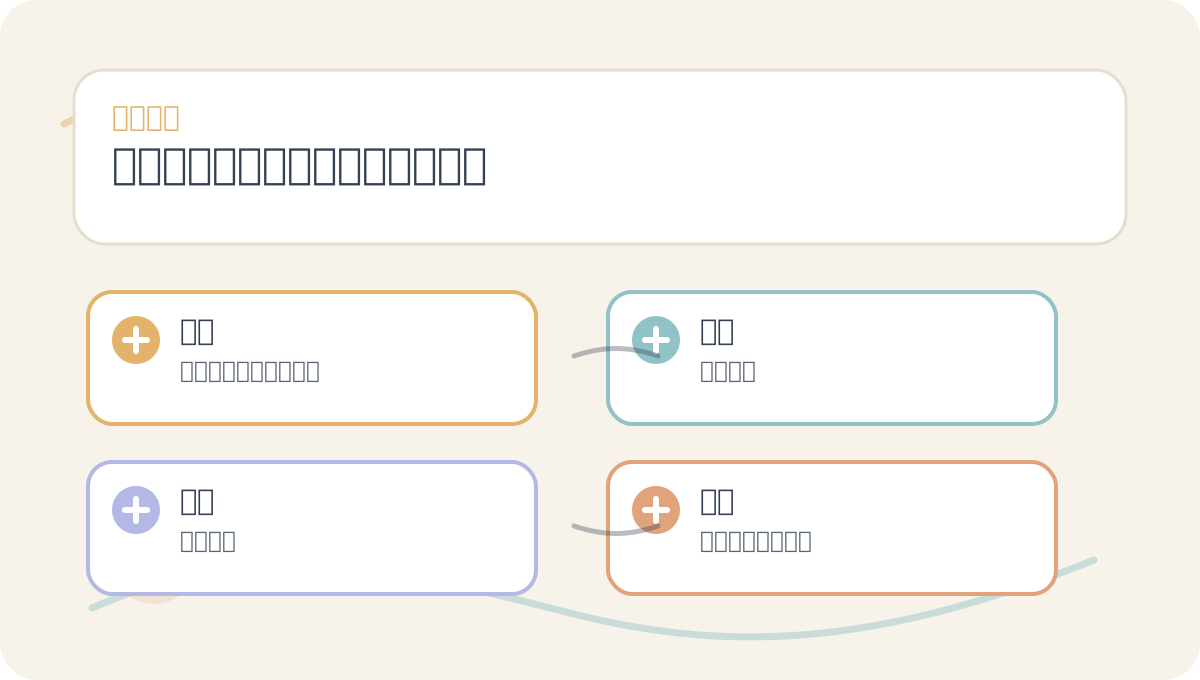
Content like “Introduction to Linear Algebra: Why It Matters” can easily get lost in technical details. First, follow the main conceptual thread shown in the diagram; then return to the text to verify context, inputs, outputs, and evaluation criteria.
import numpy as np
import matplotlib.pyplot as plt

# Generate synthetic data
np.random.seed(0)
X = 2 * np.random.rand(100, 1)
y = 4 + 3 * X + np.random.randn(100, 1)

# Add bias column
X_b = np.c_[np.ones((100, 1)), X]  # prepend a column of ones

# Solve for optimal weights via the normal equation
theta_best = np.linalg.inv(X_b.T.dot(X_b)).dot(X_b.T).dot(y)

# Make predictions
X_new = np.array([[0], [2]])
X_new_b = np.c_[np.ones((2, 1)), X_new]  # add bias column
y_predict = X_new_b.dot(theta_best)

# Plot results
plt.plot(X_new, y_predict, "r-", label="Predicted linear regression")
plt.plot(X, y, "b.")
plt.xlabel("X")
plt.ylabel("y")
plt.title("Linear Regression Example")
plt.legend()
plt.show()
Summary
Linear algebra is indispensable in AI. It underpins data representation, model construction, computational efficiency, feature extraction, and optimization strategies. Mastering its core concepts and applications will significantly deepen your ability to research, develop, and deploy machine learning and deep learning systems.
Next, we’ll explore foundational knowledge of vectors and matrices—including definitions and representations—key stepping stones toward fluency in linear algebra and its practical application.
Apply This Lesson
Turn this article into AI software, model, API, and security decisions.
English Article FAQ
Use this article as evidence before choosing AI tools
How should I use this AI Tutorials article?
Use it as the implementation or learning layer, then connect the idea to AI software buyer guides, tool comparisons, benchmarks, API choices, and security checks before making a production decision.
Is this English article different from the Chinese original?
The English edition is localized for global AI readers while preserving the original diagrams, screenshots, prompts, code examples, and source context from the Chinese article.
What should I read after Generate synthetic data?
Continue with AI Software Buyer Guides, AI Tools Workbench, Best AI Coding Agents, AI Model Benchmarks, OpenAI vs Anthropic API, or LLM Security Tools depending on the decision you need to make.
Can this article alone choose an AI product or model?
No. Treat the article as evidence and context, then validate fit with pricing, privacy requirements, integration effort, benchmark results, workflow tests, and fallback planning.
Continue