English translation
Extract TF-IDF vectors for the first and second documents
AI Article Decision Snapshot
Turn the lesson into workflow, model, budget, and security checks before choosing tools.
Use this quick snapshot before leaving the article. It keeps the next search tied to practical AI software, model/API, cost, privacy, and implementation questions.
Workflow fit
Identify the real job behind the article: coding, research, document review, support, analytics, content, or internal automation.
Model or tool decision
Decide whether the next step is a software shortlist, an AI tool comparison, an API platform choice, or a model benchmark.
Budget and usage signal
Estimate seats, API calls, prompt volume, retries, review time, and fallback work before assuming the workflow is cheap.
Security and privacy review
Check whether source code, customer data, private documents, prompts, logs, or embeddings will enter the AI workflow.

Inner product spaces bring geometric notions—such as distance, angle, and projection—into algorithmic design. Recommendation systems, search engines, and regression models all rely heavily on them.

I assess whether a task fundamentally requires magnitude information or directional information. Different similarity measures—each rooted in inner products—can significantly alter ranking outcomes.
In the previous article, we introduced the concepts of orthogonal vectors and orthogonal bases, and saw how they simplify many problems in linear algebra. Next, we continue exploring applications of inner product spaces—especially their critical role in data analysis and machine learning.
Fundamental Concepts of Inner Product Spaces
In an inner product space, any pair of vectors yields a scalar via the inner product operation. For real-valued vectors, the standard inner product is defined as:

When interpreting applications of inner product spaces, first consider: vector representation; distance or similarity metrics; projection computations; orthogonal decomposition; and roles in recommendation, retrieval, or dimensionality reduction.
where and are -dimensional vectors. Geometrically, the inner product supports two key interpretations:
-
Length (Norm): The square root of the inner product of a vector with itself gives its length:
. -
Angle: The inner product enables computing the angle between two vectors:
, revealing directional relationships.
Application: Vector Comparison in Data Analysis
In practice—particularly in machine learning and data analysis—the inner product serves as a powerful tool for measuring similarity between feature vectors. For instance, in information retrieval, document similarity is often quantified by computing the inner product of their corresponding vector representations.
Example: Computing Text Similarity
Suppose we wish to compare the similarity of two texts. First, we convert each text into a vector representation—here using Term Frequency–Inverse Document Frequency (TF-IDF):
from sklearn.feature_extraction.text import TfidfVectorizer

documents = [
    "This is the first document.",
    "This is the second document.",
    "This is the third document.",
]

vectorizer = TfidfVectorizer()
tfidf_matrix = vectorizer.fit_transform(documents)

# Extract TF-IDF vectors for the first and second documents
doc1 = tfidf_matrix[0].toarray()[0]
doc2 = tfidf_matrix[1].toarray()[0]

# Compute the inner product
inner_product = sum(d1 * d2 for d1, d2 in zip(doc1, doc2))
print("Inner-product similarity between Document 1 and Document 2:", inner_product)
In this example, the computed inner product serves as a similarity score: the larger the value, the more similar the two texts.
Orthogonality in Signal Processing
In signal processing, orthogonality is widely used to suppress noise and enhance signal fidelity. If two signals are orthogonal, they are—in a precise mathematical sense—"independent"; their orthogonality can be directly verified via the inner product operator. Specifically, signals and are orthogonal if:
This property ensures that orthogonal signals do not interfere with one another during transmission or storage—making them ideal for robust communication and compression schemes.
Having read this article, consolidate “Inner Product and Orthogonality: Applications of Inner Product Spaces” into a review table: first clarify the central thread, then validate it using a small concrete task.
After reading “Inner Product and Orthogonality: Applications of Inner Product Spaces”, pick a small example and walk through the full workflow end-to-end. Then identify which steps you can now execute independently.
Conclusion
By leveraging inner products and orthogonality, we achieve strong performance across diverse domains—including data analysis and signal processing. In upcoming sections, we will delve deeper into Singular Value Decomposition (SVD), further reinforcing our understanding of inner product spaces and their practical applications.
Mastering inner products and orthogonality not only deepens theoretical insight but also delivers effective, real-world solutions. Through this tutorial series, we hope to help you appreciate—and confidently apply—the foundational importance of linear algebra in artificial intelligence.
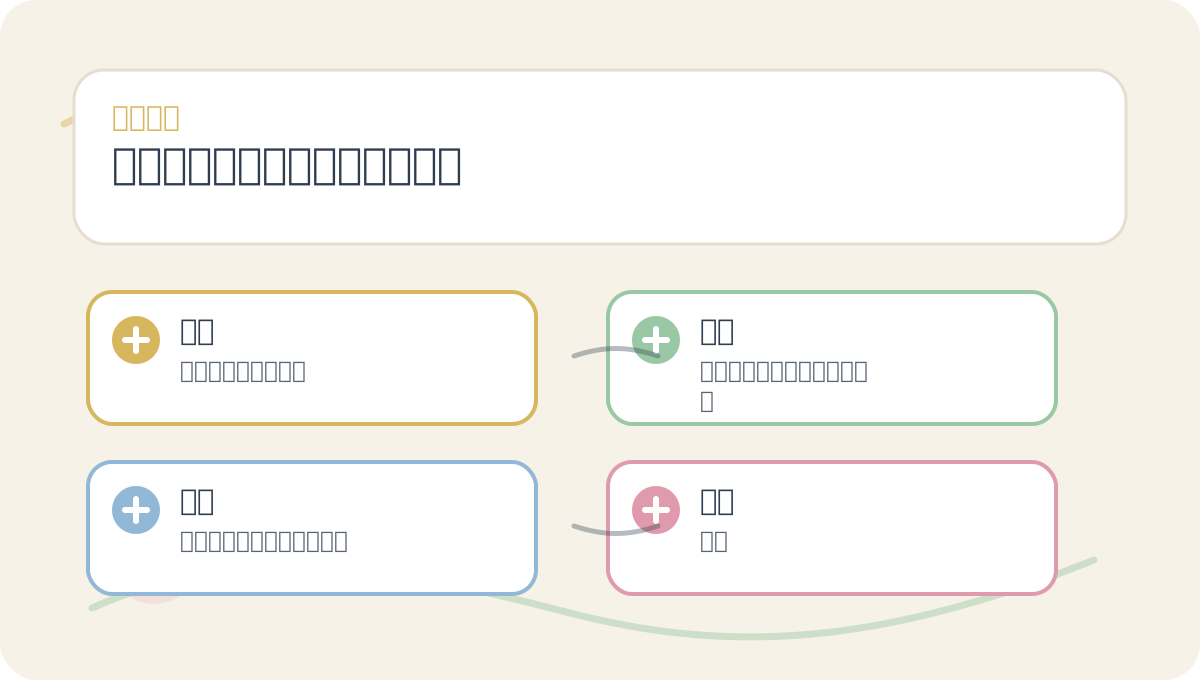
While reading “Inner Product and Orthogonality: Applications of Inner Product Spaces”, first align the diagram’s questions, keywords, operations, and acceptance criteria with the content—then proceed to the main text for greater efficiency. After finishing, try re-explaining the material using your own project as context.
Apply This Lesson
Turn this article into AI software, model, API, and security decisions.
English Article FAQ
Use this article as evidence before choosing AI tools
How should I use this AI Tutorials article?
Use it as the implementation or learning layer, then connect the idea to AI software buyer guides, tool comparisons, benchmarks, API choices, and security checks before making a production decision.
Is this English article different from the Chinese original?
The English edition is localized for global AI readers while preserving the original diagrams, screenshots, prompts, code examples, and source context from the Chinese article.
What should I read after Extract TF-IDF vectors for the first and second documents?
Continue with AI Software Buyer Guides, AI Tools Workbench, Best AI Coding Agents, AI Model Benchmarks, OpenAI vs Anthropic API, or LLM Security Tools depending on the decision you need to make.
Can this article alone choose an AI product or model?
No. Treat the article as evidence and context, then validate fit with pricing, privacy requirements, integration effort, benchmark results, workflow tests, and fallback planning.
Continue