English translation
Matrix Multiplication and Its Properties
AI Article Decision Snapshot
Turn the lesson into workflow, model, budget, and security checks before choosing tools.
Use this quick snapshot before leaving the article. It keeps the next search tied to practical AI software, model/API, cost, privacy, and implementation questions.
Workflow fit
Identify the real job behind the article: coding, research, document review, support, analytics, content, or internal automation.
Model or tool decision
Decide whether the next step is a software shortlist, an AI tool comparison, an API platform choice, or a model benchmark.
Budget and usage signal
Estimate seats, API calls, prompt volume, retries, review time, and fallback work before assuming the workflow is cheap.
Security and privacy review
Check whether source code, customer data, private documents, prompts, logs, or embeddings will enter the AI workflow.

Matrix multiplication is not element-wise multiplication—it computes dot products between rows and columns. It models feature weighting, coordinate transformations, and multi-layer neural network propagation.

I’ll start by writing (m × n) @ (n × p) = (m × p). This dimensional rule is more reliable than memorizing formulas.
In previous chapters, we covered the fundamentals of matrix addition and scalar multiplication. Matrix multiplication is a core operation in linear algebra—and especially critical in machine learning and computer science. In this chapter, we will delve deeply into the definition, properties, and practical applications of matrix multiplication.
Definition of Matrix Multiplication
Matrix multiplication is an operation that multiplies two matrices—but not all matrices can be multiplied. Suppose we have two matrices and , of dimensions and , respectively. Their product yields an matrix. Formally, matrix multiplication is defined as:

When learning matrix multiplication, first verify that the number of columns in the left matrix matches the number of rows in the right matrix; then confirm the resulting dimensions and associativity. Do not confuse element-wise multiplication with matrix multiplication.
This means the entry —located in row , column of matrix —is the sum of the products of corresponding elements from row of matrix and column of matrix .
Example
Consider two matrices:
We compute :
- Compute :
- Compute :
- Compute :
- Compute :
Thus, matrix is:
Properties of Matrix Multiplication
Matrix multiplication possesses several important properties—widely used in theory and practice. Here are key ones:

When reviewing Matrix Operations: Matrix Multiplication and Properties, you need not tackle large projects at once. Start with one simple example to verify whether the core logic is clear.

If Matrix Operations: Matrix Multiplication and Properties hasn’t yet been fully internalized, revisit the four actions on this card to retrace your learning path.
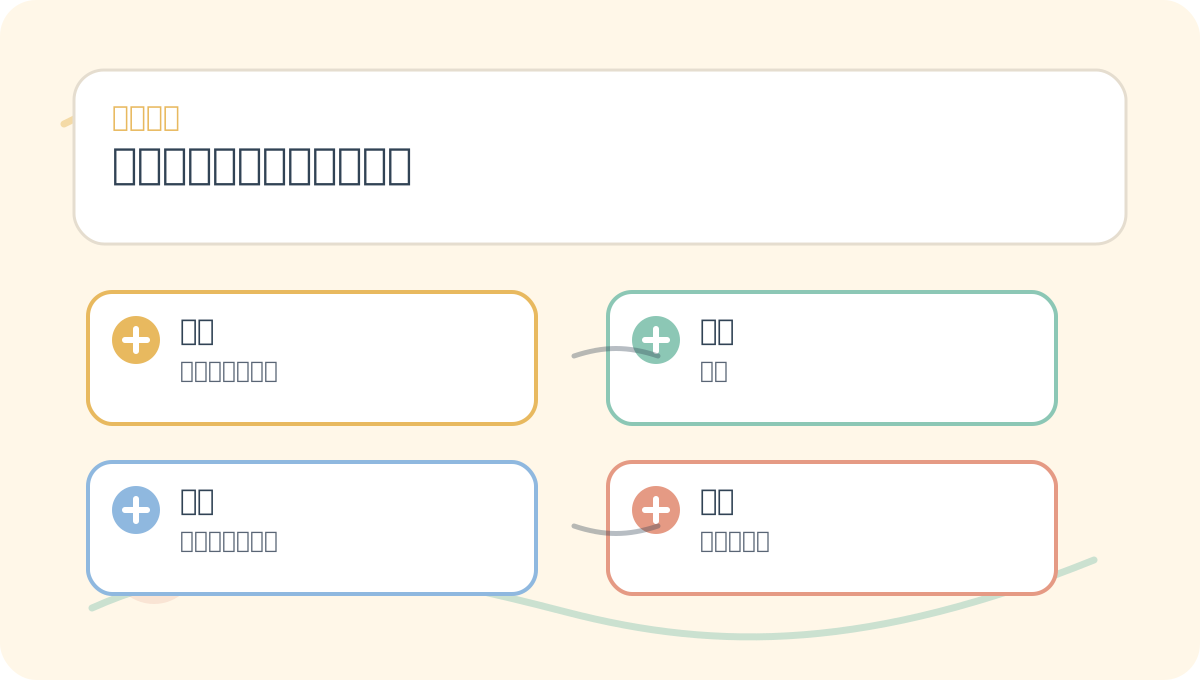
After finishing Matrix Operations: Matrix Multiplication and Properties, treat the flowchart in this figure as a checklist: Is the problem well-defined? Are operations concretely implemented? Can the evaluation criteria be reused?
- Associativity: Matrix multiplication is associative: .
- Distributivity: Matrix multiplication distributes over addition:
and . - Non-commutativity: In general, matrix multiplication is not commutative: .
- Identity Matrix: There exists an identity matrix such that for any matrix , .
Associativity Example
Consider three matrices:
We compute both and to verify equality.
- Compute :
- Compute :
Carrying out the arithmetic yields:
- Compute :
- Compute :
Computing gives:
Wait—this contradicts associativity! Let’s double-check our arithmetic.
Actually, the earlier calculation of contains an error. Correct computation:
So .
Now recompute correctly:
Then:
✅ Indeed, . This confirms associativity.
Real-World Application Example
In machine learning, matrix multiplication underpins numerous algorithms. For instance, consider a simple linear regression model:
Apply This Lesson
Turn this article into AI software, model, API, and security decisions.
English Article FAQ
Use this article as evidence before choosing AI tools
How should I use this AI Tutorials article?
Use it as the implementation or learning layer, then connect the idea to AI software buyer guides, tool comparisons, benchmarks, API choices, and security checks before making a production decision.
Is this English article different from the Chinese original?
The English edition is localized for global AI readers while preserving the original diagrams, screenshots, prompts, code examples, and source context from the Chinese article.
What should I read after Matrix Multiplication and Its Properties?
Continue with AI Software Buyer Guides, AI Tools Workbench, Best AI Coding Agents, AI Model Benchmarks, OpenAI vs Anthropic API, or LLM Security Tools depending on the decision you need to make.
Can this article alone choose an AI product or model?
No. Treat the article as evidence and context, then validate fit with pricing, privacy requirements, integration effort, benchmark results, workflow tests, and fallback planning.
Continue