English translation
Determinants: Definition and Intuition
AI Article Decision Snapshot
Turn the lesson into workflow, model, budget, and security checks before choosing tools.
Use this quick snapshot before leaving the article. It keeps the next search tied to practical AI software, model/API, cost, privacy, and implementation questions.
Workflow fit
Identify the real job behind the article: coding, research, document review, support, analytics, content, or internal automation.
Model or tool decision
Decide whether the next step is a software shortlist, an AI tool comparison, an API platform choice, or a model benchmark.
Budget and usage signal
Estimate seats, API calls, prompt volume, retries, review time, and fallback work before assuming the workflow is cheap.
Security and privacy review
Check whether source code, customer data, private documents, prompts, logs, or embeddings will enter the AI workflow.

A determinant can be understood as the scaling factor by which a linear transformation changes the volume of space. When the determinant equals zero, space is flattened—information is lost, and the matrix is non-invertible.

I will connect determinants to geometric transformations. Merely computing numerical values without grasping their meaning makes retention difficult later on.
In the previous section, we discussed matrix transpose and inverse—foundational operations essential for understanding determinants. Next, we delve deeper into the definition of determinants. A determinant is a fundamental concept associated with square matrices, playing a central role across numerous mathematical and engineering domains—especially in solving systems of linear equations, computing matrix inverses, and analyzing eigenvalue problems.
Basic Concept of Determinants
A determinant is a function that maps a square matrix (an n × n matrix) to a scalar (a single number). We denote the determinant of a square matrix A as det(A) or |A|. The value of the determinant encodes rich information about the matrix—for instance, whether the matrix is invertible, or how it scales volumes under linear transformation.

When learning the definition of determinants, begin with area in 2D, volume in 3D, and orientation (sign), then link these ideas to matrix invertibility and linear dependence.
Determinant of a 2×2 Matrix
Consider a simple 2×2 square matrix:
Its determinant, det(A) or |A|, is defined as:
This result represents the area of the parallelogram spanned by the column vectors of matrix A in two-dimensional space. This formula can be intuitively derived through geometric visualization.
Example
Suppose we have the following matrix:
Then its determinant is:
This indicates that the parallelogram formed by applying transformation A has area 2.
Determinant of a 3×3 Matrix
Computing the determinant of a 3×3 matrix is slightly more involved. Let matrix B be:
Its determinant is defined as:
Example
Consider the matrix:
Compute its determinant:
Geometric Interpretation of Determinants
Determinants not only reflect algebraic properties of matrices but also carry profound geometric meaning. Under a linear transformation, the determinant acts as the volume scaling factor: it quantifies how much the transformation expands or contracts n-dimensional volume. In particular, if a matrix’s determinant is 0, the transformation collapses the entire space into a lower-dimensional subspace.
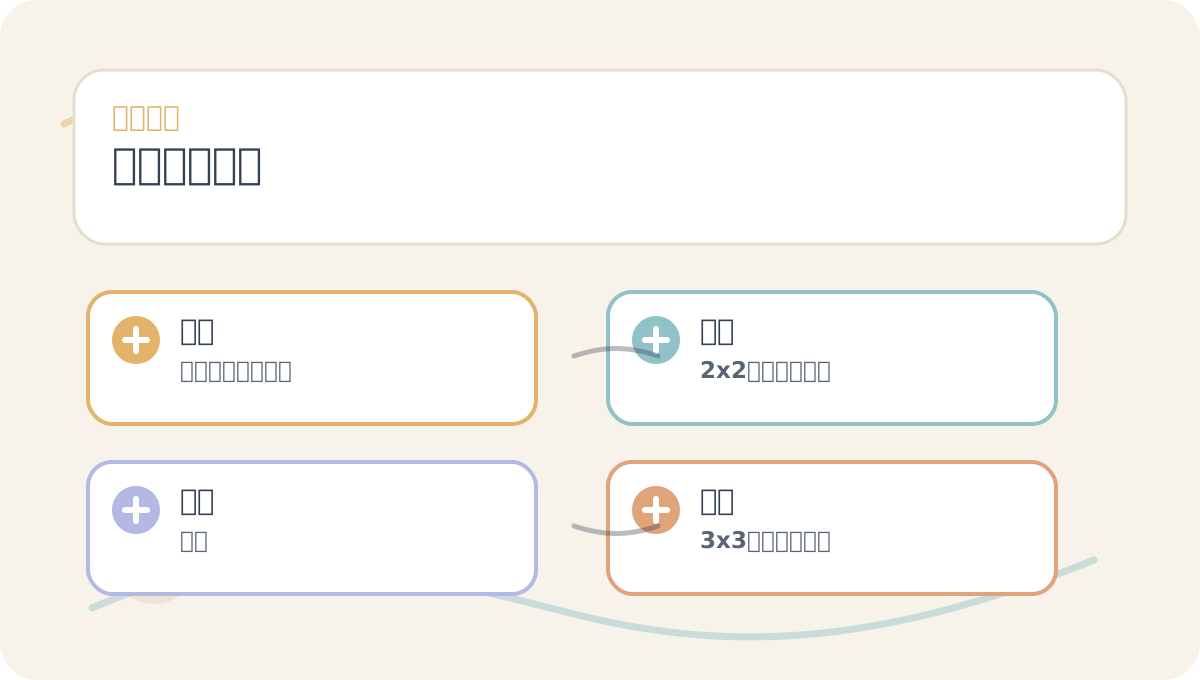
Before reading “Definition of Determinants”, first examine the visual path in the diagram—from problem to outcome. After reading, revisit the main text and verify whether you can reconstruct the reasoning step-by-step.

When reviewing “Definition of Determinants”, consolidate key concepts, procedural steps, and observable outcomes onto a single page for efficient revision.

When practicing “Definition of Determinants”, write down input conditions, computational actions, and resulting outputs together—making future review straightforward.
Summary
In this section, we formally defined determinants and explored their computation for 2×2 and 3×3 matrices, along with their geometric interpretation. Next, we will examine key properties of determinants—insights that deepen our understanding of their significance across diverse applications. Though determinant calculations may appear intricate at first, consistent practice and case-based analysis will solidify mastery of this essential tool.
In the next section, we’ll explore determinant properties in depth—laying a robust foundation for subsequent applications.
Apply This Lesson
Turn this article into AI software, model, API, and security decisions.
English Article FAQ
Use this article as evidence before choosing AI tools
How should I use this AI Tutorials article?
Use it as the implementation or learning layer, then connect the idea to AI software buyer guides, tool comparisons, benchmarks, API choices, and security checks before making a production decision.
Is this English article different from the Chinese original?
The English edition is localized for global AI readers while preserving the original diagrams, screenshots, prompts, code examples, and source context from the Chinese article.
What should I read after Determinants: Definition and Intuition?
Continue with AI Software Buyer Guides, AI Tools Workbench, Best AI Coding Agents, AI Model Benchmarks, OpenAI vs Anthropic API, or LLM Security Tools depending on the decision you need to make.
Can this article alone choose an AI product or model?
No. Treat the article as evidence and context, then validate fit with pricing, privacy requirements, integration effort, benchmark results, workflow tests, and fallback planning.
Continue