English translation
Compute partial derivatives
AI Article Decision Snapshot
Turn the lesson into workflow, model, budget, and security checks before choosing tools.
Use this quick snapshot before leaving the article. It keeps the next search tied to practical AI software, model/API, cost, privacy, and implementation questions.
Workflow fit
Identify the real job behind the article: coding, research, document review, support, analytics, content, or internal automation.
Model or tool decision
Decide whether the next step is a software shortlist, an AI tool comparison, an API platform choice, or a model benchmark.
Budget and usage signal
Estimate seats, API calls, prompt volume, retries, review time, and fallback work before assuming the workflow is cheap.
Security and privacy review
Check whether source code, customer data, private documents, prompts, logs, or embeddings will enter the AI workflow.

Multivariable calculus enables us to model situations where multiple inputs jointly influence an output. Both loss surfaces and gradient descent in machine learning rely fundamentally on it.

I’ll annotate the meaning of each variable beside it. The more variables involved, the less effective it is to focus solely on formulas.
In the previous article, we explored computing multiple integrals in multivariable calculus. Today, we continue this theme by diving deeper into real-world application cases—illustrating not only how to compute multiple integrals but also why multivariable calculus matters in solving practical problems.
Application Case: Multiple Integrals in Physics
Case 1: Computing the Mass of a Uniform-Density Sphere

When analyzing applications of multivariable calculus, first identify:
- the physical meaning of each variable,
- the objective function,
- partial derivatives,
- gradient direction,
- constraints, and
- interpretation of results.
Suppose we have a solid sphere of radius ( R ) with uniform density ( \rho ). We can compute its total mass using a triple integral.
1. Modeling Setup
We adopt spherical coordinates for modeling. In this system, a point’s position is described by radial distance ( r ), polar angle ( \theta ), and azimuthal angle ( \phi ), related to Cartesian coordinates as follows:
- ( x = r \sin \theta \cos \phi )
- ( y = r \sin \theta \sin \phi )
- ( z = r \cos \theta )
The infinitesimal volume element is:
2. Computing Mass
The sphere’s mass ( M ) equals the integral of density over its volume:
3. Evaluating the Integrals
First, integrate with respect to ( r ):
Next, integrate with respect to ( \theta ):
Finally, integrate with respect to ( \phi ):
Thus, the total mass becomes:
This case demonstrates how multiple integrals solve concrete physical problems.
Application Case: Optimization of Multivariable Functions in Economics
Case 2: Profit Maximization Problem
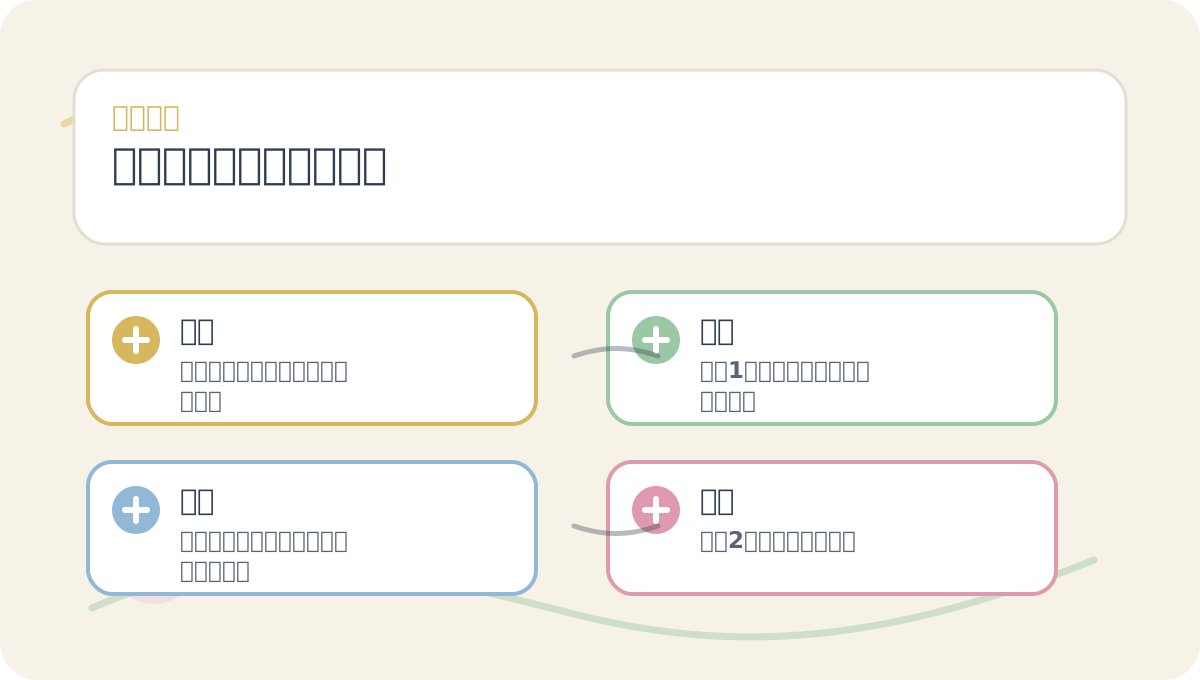
Before reading Applications of Multivariable Calculus, align the questions, keywords, actions, and success criteria shown in the diagram with the text—this makes reading more efficient. After finishing, try re-explaining the concepts using your own project.
In economics, corporate profit often depends on several interrelated factors. Suppose a firm produces two goods, ( x ) and ( y ), with profit function:
Our goal is to find the production levels ( (x, y) ) that maximize profit.
1. Compute Partial Derivatives
To locate critical points, compute the first-order partial derivatives:
- With respect to ( x ):
- With respect to ( y ):
2. Set Up and Solve the System
Set both partial derivatives equal to zero:
Solve this linear system using substitution or elimination to obtain the optimal ( (x, y) ).
3. Computation Using Python
We can implement this efficiently in Python using the sympy library:
import sympy as sp

x, y = sp.symbols('x y')
P = 100*x + 150*y - 5*x**2 - 10*y**2 - 20*x*y

# Compute partial derivatives
dP_dx = sp.diff(P, x)
dP_dy = sp.diff(P, y)

# Solve the system
solutions = sp.solve((dP_dx, dP_dy), (x, y))
print(solutions)
Running this code yields the optimal production quantities ( x ) and ( y ) that maximize profit.

After studying Applications of Multivariable Calculus, try adapting the framework to your own scenario—pay close attention to whether inputs, processing steps, and outputs align coherently.

To apply Applications of Multivariable Calculus to your own task, start small: isolate and validate just one key decision point.
Summary
Today’s discussion showcased multivariable calculus in action—from physics to economics. Concepts like multiple integrals and partial derivatives provide powerful, practical tools for tackling real-world problems. Through concrete case studies, we’ve seen both the utility and necessity of calculus beyond abstract theory.
In our next article, we’ll introduce the fundamentals of differential equations—and explore how they model and solve problems involving dynamic change. Stay tuned!
Apply This Lesson
Turn this article into AI software, model, API, and security decisions.
English Article FAQ
Use this article as evidence before choosing AI tools
How should I use this AI Tutorials article?
Use it as the implementation or learning layer, then connect the idea to AI software buyer guides, tool comparisons, benchmarks, API choices, and security checks before making a production decision.
Is this English article different from the Chinese original?
The English edition is localized for global AI readers while preserving the original diagrams, screenshots, prompts, code examples, and source context from the Chinese article.
What should I read after Compute partial derivatives?
Continue with AI Software Buyer Guides, AI Tools Workbench, Best AI Coding Agents, AI Model Benchmarks, OpenAI vs Anthropic API, or LLM Security Tools depending on the decision you need to make.
Can this article alone choose an AI product or model?
No. Treat the article as evidence and context, then validate fit with pricing, privacy requirements, integration effort, benchmark results, workflow tests, and fallback planning.
Continue