English translation
A minimal example: model input is time t and current state y
AI Article Decision Snapshot
Turn the lesson into workflow, model, budget, and security checks before choosing tools.
Use this quick snapshot before leaving the article. It keeps the next search tied to practical AI software, model/API, cost, privacy, and implementation questions.
Workflow fit
Identify the real job behind the article: coding, research, document review, support, analytics, content, or internal automation.
Model or tool decision
Decide whether the next step is a software shortlist, an AI tool comparison, an API platform choice, or a model benchmark.
Budget and usage signal
Estimate seats, API calls, prompt volume, retries, review time, and fallback work before assuming the workflow is cheap.
Security and privacy review
Check whether source code, customer data, private documents, prompts, logs, or embeddings will enter the AI workflow.

Differential equations are well-suited for modeling systems whose states evolve continuously over time. In AI, they help us understand time-series data, control problems, and continuous-depth models.

I begin by asking: What are the state variables? What determines their rates of change? And how can observational data validate the model?
In the previous article, we discussed standard solution techniques for common differential equations—such as first-order linear and second-order linear ODEs—and became familiar with their fundamental forms. In this article, we explore how differential equations are applied in artificial intelligence (AI), particularly in modeling and solving machine learning problems.
Fundamental Concepts of Differential Equations
A differential equation is an equation involving an unknown function and its derivatives. A typical first-order ordinary differential equation takes the form:

When analyzing applications of differential equations in AI, consider: state variables, rates of change, boundary/initial conditions, numerical solvers, stability properties, and model interpretability.
Here, is an unknown function of the independent variable , and is a known function of and . Differential equations describe diverse phenomena across physics, economics, ecology, and many other domains.
Applications of Differential Equations in AI
1. Modeling Dynamical Systems
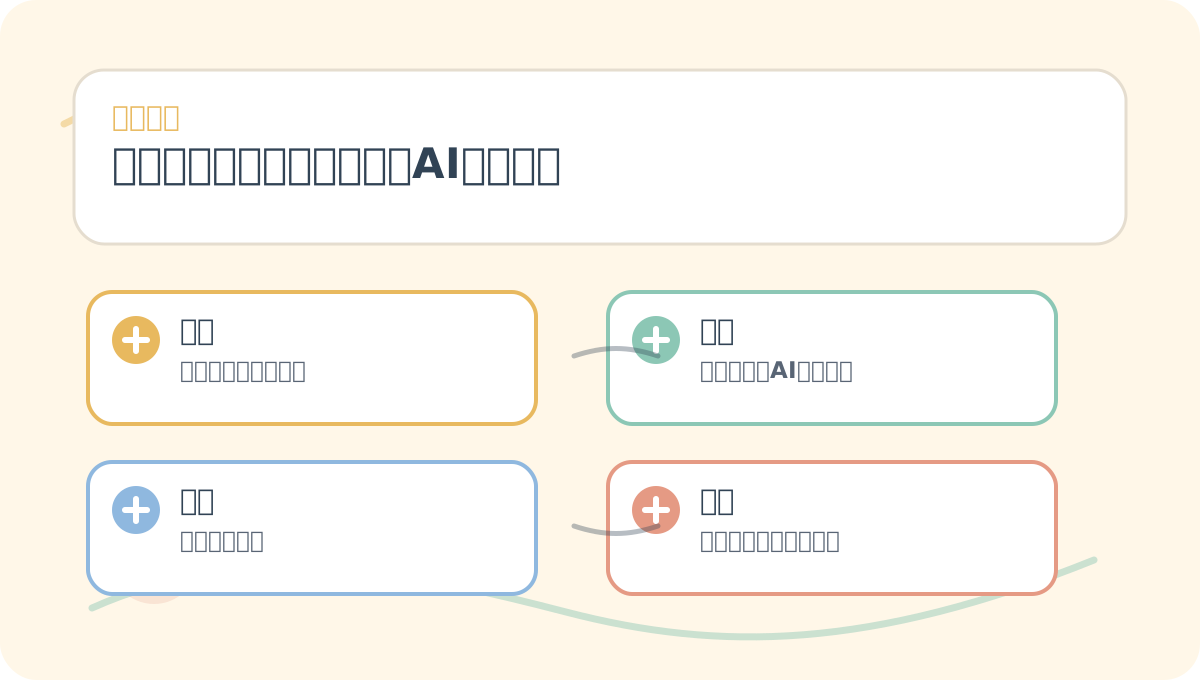
After reading A Brief Introduction to Differential Equations: Applications in AI, spend one minute reviewing: Are key concepts clearly distinguished? Can practice steps be reproduced? Can conclusions be restated in your own words?
In AI, modeling dynamical systems is often essential for forecasting future states. Differential equations naturally encode the evolution rules governing such systems. For instance, in a classic ecological model—the Lotka–Volterra predator–prey system—we use coupled ODEs to describe population dynamics:
Here, denotes the prey population, the predator population, and are positive constants. Such systems are typically solved numerically (e.g., using Euler’s method or Runge–Kutta methods) to predict population trajectories over time.
2. Differential Equations in Deep Learning
Many heuristic algorithms and neural architectures in deep learning admit natural interpretations as differential equations. For example, certain variants of recurrent neural networks (RNNs) correspond to continuous-time dynamical systems. A simple RNN update can be approximated by the following ODE:
Here, is the hidden state at time , is the current input, and , are learnable weight matrices. This perspective enables mapping models—including SVMs and other architectures—into frameworks from control theory, facilitating principled optimization and analysis.
3. Differential Equations in Reinforcement Learning
In reinforcement learning (RL), differential equations can formalize how value functions evolve over continuous time. For instance, the rate of change of a state-value function may be modeled as:
where is the value of state , is the immediate reward, is the discount factor, and is the next state resulting from action . Such formulations support continuous-time policy improvement and macroscopic dynamical analysis.
4. Deep Learning Methods for Solving Differential Equations
Recent advances have introduced deep learning approaches to solve differential equations. A prominent example is Neural ODEs—a novel framework that integrates neural networks with ordinary differential equations. In Neural ODEs, a neural network parameterizes the derivative function in an ODE , enabling flexible, differentiable, and memory-efficient modeling of continuous dynamics:
import torch
import torch.nn as nn

class ODEFunc(nn.Module):
    def __init__(self):
        super(ODEFunc, self).__init__()
        self.linear = nn.Linear(2, 2)

    def forward(self, t, y):
        return self.linear(y)

# A minimal example: model input is time `t` and current state `y`
Here, ODEFunc learns the vector field governing state evolution via a linear layer; the full ODE is then solved numerically (e.g., using an adaptive ODE solver) to produce predictions.
When reviewing A Brief Introduction to Differential Equations: Applications in AI, place key concepts, procedural steps, and observable outcomes on the same page for efficient reflection.
When practicing A Brief Introduction to Differential Equations: Applications in AI, write down input conditions, transformation steps, and observable outputs together—making future review straightforward.
Conclusion
The examples above illustrate the breadth and depth of differential equations’ utility in AI—from modeling dynamical systems and designing continuous-depth neural networks to analyzing reinforcement learning policies and developing new learning paradigms like Neural ODEs. Understanding differential equations equips practitioners with powerful mathematical tools to design more expressive, interpretable, and physically grounded AI models. In the next article, we’ll explore practical numerical methods for solving complex differential equations—stay tuned!
Apply This Lesson
Turn this article into AI software, model, API, and security decisions.
English Article FAQ
Use this article as evidence before choosing AI tools
How should I use this AI Tutorials article?
Use it as the implementation or learning layer, then connect the idea to AI software buyer guides, tool comparisons, benchmarks, API choices, and security checks before making a production decision.
Is this English article different from the Chinese original?
The English edition is localized for global AI readers while preserving the original diagrams, screenshots, prompts, code examples, and source context from the Chinese article.
What should I read after A minimal example: model input is time t and current state y?
Continue with AI Software Buyer Guides, AI Tools Workbench, Best AI Coding Agents, AI Model Benchmarks, OpenAI vs Anthropic API, or LLM Security Tools depending on the decision you need to make.
Can this article alone choose an AI product or model?
No. Treat the article as evidence and context, then validate fit with pricing, privacy requirements, integration effort, benchmark results, workflow tests, and fallback planning.
Continue