English translation
17. Bayesian Updating: Priors and Posteriors
AI Article Decision Snapshot
Turn the lesson into workflow, model, budget, and security checks before choosing tools.
Use this quick snapshot before leaving the article. It keeps the next search tied to practical AI software, model/API, cost, privacy, and implementation questions.
Workflow fit
Identify the real job behind the article: coding, research, document review, support, analytics, content, or internal automation.
Model or tool decision
Decide whether the next step is a software shortlist, an AI tool comparison, an API platform choice, or a model benchmark.
Budget and usage signal
Estimate seats, API calls, prompt volume, retries, review time, and fallback work before assuming the workflow is cheap.
Security and privacy review
Check whether source code, customer data, private documents, prompts, logs, or embeddings will enter the AI workflow.

Bayesian updating is not a one-time formula—it is an ongoing process of assimilating evidence. Today’s posterior can serve as tomorrow’s prior.

I record which evidence was used in each update. If the source or reliability of the evidence is unclear, even a mathematically precise posterior remains untrustworthy.
In the previous article, we explored the foundational understanding of Bayes’ Theorem, which provides a framework for adjusting our belief about the probability of an event after observing new evidence. This article delves deeper into the concept of Bayesian updating, and how to reason using prior probabilities and posterior probabilities. Finally, we illustrate these ideas through concrete examples.
1. Bayesian Updating and Core Concepts
Bayesian updating refers to the process of revising our beliefs—represented by a prior probability—in light of newly observed data, resulting in a posterior probability. Its essence lies in how we integrate new information into our existing knowledge.
When performing Bayesian updating, first write down the prior probability, likelihood of the evidence, marginal probability, and posterior result—and then explain what changed in your belief due to the new evidence.
- Prior Probability: Your initial belief about an event before seeing new data.
- Posterior Probability: Your updated belief about the event after incorporating the new data.
Bayes’ Formula
The core of Bayesian updating is Bayes’ Theorem, expressed mathematically as:
Here,
- is the posterior probability: the probability that hypothesis is true, given evidence .
- is the likelihood: the probability of observing evidence , assuming hypothesis is true.
- is the prior probability: your belief in before observing .
- is the marginal likelihood: the total probability of observing across all possible hypotheses (i.e., the weighted average of and ).
2. Case Study: COVID-19 Testing
Let’s ground Bayesian updating in a concrete scenario: a diagnostic test for SARS-CoV-2.
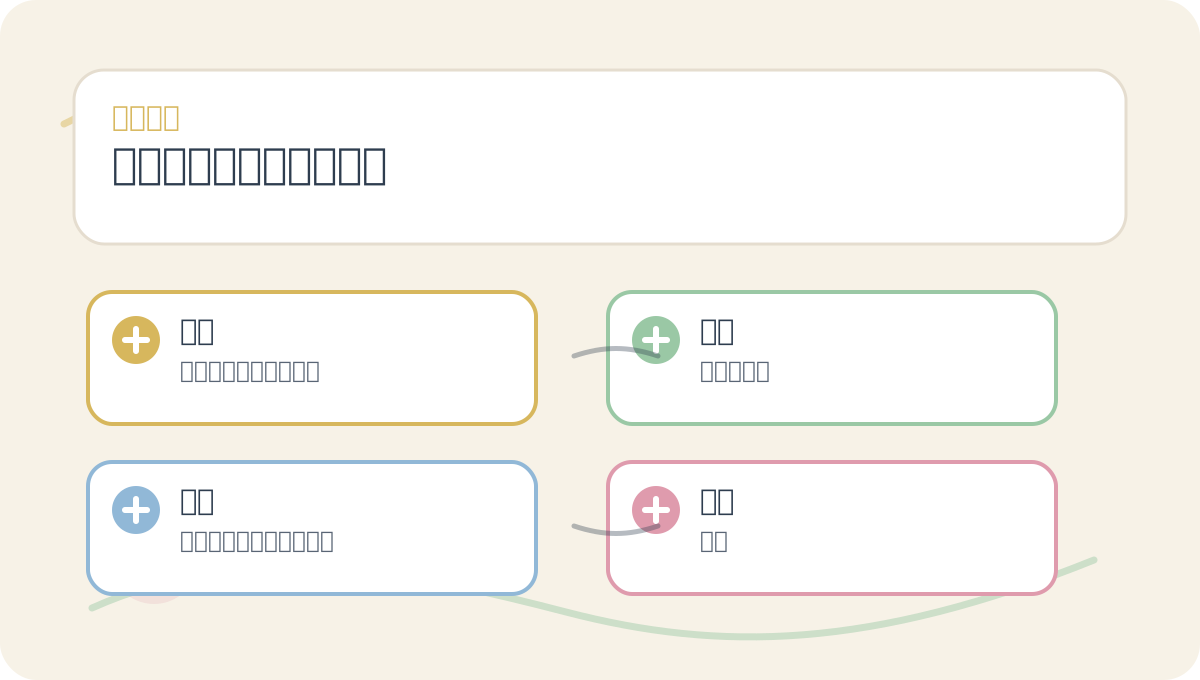
Before reading “Bayesian Updating, Priors, and Posteriors”, align the questions, keywords, actions, and acceptance criteria shown in the diagram—this makes reading the main text significantly more efficient. After reading, try re-explaining the concepts using your own project as an example.
Assumptions
- Prior probability of disease: The baseline probability that a randomly selected person is infected before testing is (i.e., a 1% prevalence in the population).
- Test accuracy:
- True positive rate (sensitivity): If infected, the test returns positive with probability .
- False positive rate: If not infected, the test still returns positive with probability .
Computing the Posterior Probability
We want to compute : the probability that a person is truly infected given a positive test result.
-
Compute — the overall probability of a positive test result:
where . Substituting values:
-
Compute the posterior:
Thus, despite a positive test result, the actual probability that the person is infected is only ~15.38%. This highlights a crucial insight: test results alone cannot definitively confirm infection—especially when the prior probability (baseline prevalence) is low.
When reviewing “Bayesian Updating, Priors, and Posteriors”, place key concepts, procedural steps, and observable outcomes on the same page for efficient revision.
When practicing “Bayesian Updating, Priors, and Posteriors”, write input conditions, computational steps, and resulting outputs together—making future review straightforward.
3. Summary
Through Bayesian updating, we see how to begin with a prior probability, incorporate new evidence (e.g., a test result), apply Bayes’ Theorem, and arrive at a posterior probability. In practice, grasping the relationship between priors and posteriors is essential for sound inference.
The next article will explore real-world case studies, demonstrating how Bayesian reasoning supports practical data analysis. Stay tuned!
Apply This Lesson
Turn this article into AI software, model, API, and security decisions.
English Article FAQ
Use this article as evidence before choosing AI tools
How should I use this AI Tutorials article?
Use it as the implementation or learning layer, then connect the idea to AI software buyer guides, tool comparisons, benchmarks, API choices, and security checks before making a production decision.
Is this English article different from the Chinese original?
The English edition is localized for global AI readers while preserving the original diagrams, screenshots, prompts, code examples, and source context from the Chinese article.
What should I read after 17. Bayesian Updating: Priors and Posteriors?
Continue with AI Software Buyer Guides, AI Tools Workbench, Best AI Coding Agents, AI Model Benchmarks, OpenAI vs Anthropic API, or LLM Security Tools depending on the decision you need to make.
Can this article alone choose an AI product or model?
No. Treat the article as evidence and context, then validate fit with pricing, privacy requirements, integration effort, benchmark results, workflow tests, and fallback planning.
Continue