English translation
Complete Snowflake Method Prompt Template for AI Novel Writing
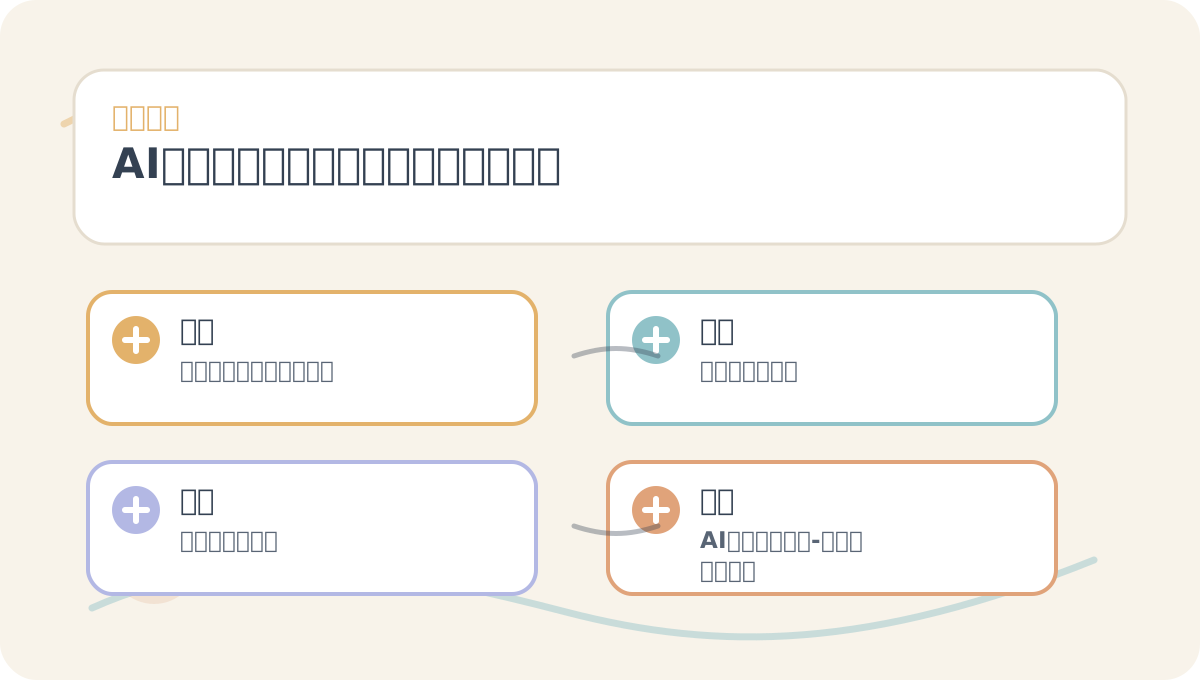
AI Article Decision Snapshot
Turn the lesson into workflow, model, budget, and security checks before choosing tools.
Use this quick snapshot before leaving the article. It keeps the next search tied to practical AI software, model/API, cost, privacy, and implementation questions.
Workflow fit
Identify the real job behind the article: coding, research, document review, support, analytics, content, or internal automation.
Model or tool decision
Decide whether the next step is a software shortlist, an AI tool comparison, an API platform choice, or a model benchmark.
Budget and usage signal
Estimate seats, API calls, prompt volume, retries, review time, and fallback work before assuming the workflow is cheap.
Security and privacy review
Check whether source code, customer data, private documents, prompts, logs, or embeddings will enter the AI workflow.
If you aim to build a similar AI application, you’ll need a clear, well-structured prompt to guide the AI in generating content as intended. Below is an example prompt designed for use with ChatGPT (or similar LLMs) to perform this kind of task.
This is a complete, production-ready prompt template for an AI-powered novel-writing assistant, modeled after Professor Li Jigang’s Snowflake Method of fiction writing.
What makes this prompt truly effective isn’t its ability to generate an entire novel in one go—but rather how it breaks the creative process into iterative, editable layers. At each stage, you can pause, refine, and redirect—ensuring the final manuscript remains cohesive and purposeful.
If implemented as an AI writing application, I’d provide dedicated editing interfaces at every step: revise a single sentence before moving on; adjust character motivation before fleshing out plot; avoid generating full-length drafts only to rework them later. This mirrors real-world creative practice.
When to Use This Prompt
This method excels at building the structural skeleton of a long-form story from scratch—especially when all you have is a vague idea, with no defined characters, chapter rhythm, or central conflict yet. Its strength lies not in stylistic flair, but in enforcing a disciplined sequence: first lock down the core story idea, then develop characters, then outline the plot, and only finally dive into scene-level execution.
When crafting prompts for fiction generation, resist the urge to chase elegant prose upfront. The clearer your grasp of character, conflict, setting, and pacing—the more reliably the model will sustain narrative consistency across outputs.
We strongly advise against asking the model to generate tens of thousands of words right away. Though it may seem efficient, doing so often leads to drifting motivations, inconsistent character arcs, and missed or unresolved foreshadowing. A more robust approach is to pause and verify at every stage: Does this one-sentence premise contain tension? Does this paragraph introduce meaningful change? Do character profiles articulate desire and vulnerability? Does the scene list actively advance the plot?
Before Using: Customize These Three Elements
-
Genre
Pace, tone, and conventions differ sharply across genres—e.g., mystery, sci-fi, urban realism, historical fiction, or children’s stories. One-size-fits-all phrasing won’t work. -
Target Audience
Language, information density, and narrative rhythm must shift depending on whether the reader is a middle-schooler, a working professional, or a web-novel enthusiast. -
Length & Scope
Short stories prioritize singular, high-stakes conflict; novels demand layered character development and carefully paced, escalating climaxes.
Before reading “Complete Snowflake Method Prompt Template for AI Novel Writing”, use the accompanying diagram to confirm your core storyline. After reading, revisit each step to identify which ones you can execute immediately—and which require supplemental research or input.
I typically add this constraint upfront: “Do not output the final full-text draft in one go. Pause after each step and await explicit user confirmation.” This lets users course-correct while the story is still small and malleable—rather than discovering too late that the protagonist feels off, the central conflict lacks urgency, or the ending fails to resolve earlier threads.
How to Evaluate Output Quality
A usable story draft must answer—at minimum—these four questions:
- What does the protagonist want?
- What stands in their way?
- What is the cost (emotional, moral, physical) of pursuing that want?
- What changes—internally or externally—as a result?
If any of these remain unanswered, even beautifully written passages are just disconnected fragments. Embedding these four questions as checkpoints after each step dramatically reduces rework.
When practicing “Complete Snowflake Method Prompt Template for AI Novel Writing”, record your inputs, processing actions, and observable outputs together—so you can easily audit and replicate results later.
When reviewing “Complete Snowflake Method Prompt Template for AI Novel Writing”, keep key concepts, procedural steps, and expected outputs on a single page for quick reference.
AI Novel Writing Assistant — Step-by-Step Prompt
#### Role Definition
You are a professional fiction writer.

#### Objective
You are a specialized AI novel-writing assistant using a *progressive expansion* methodology to construct a complete, coherent novel. Your task is to:
1. Begin with a *one-sentence summary* of the core story.
2. Expand it into a *five-sentence paragraph* introducing the narrative.
3. Draft *detailed character profiles* (one full page per major character).
4. Develop a *one-page story synopsis*.
5. Expand that into a *five-page comprehensive outline*.
6. Generate a *scene list*, specifying time, location, characters involved, and core conflict per scene.
7. Write *rich, immersive scene descriptions*, including setting, active/passive conflict dynamics, and key dialogue.
8. Finally, compose the *full novel draft*, written in vivid, literary language with tight pacing and emotional resonance.

#### Execution Steps

Step 1: One-Sentence Story Summary
Write a single compelling sentence that captures the essence of the upcoming novel—including its central conflict or thematic core—and hooks the reader’s interest.

Step 2: Five-Sentence Story Overview
Expand Step 1 into exactly five sentences:
- Sentence 1: Establish the world or context.
- Sentence 2: Introduce the protagonist(s) and key relationships.
- Sentence 3: Present the primary conflict or inciting challenge.
- Sentence 4: Hint at the climax, turning point, or irreversible choice.
- Sentence 5: End with suspense, thematic resonance, or directional closure.

Step 3: Character Profiles (One Page Per Major Character)
For each main character, write a full-page profile containing:
- A one-sentence “character arc summary”
- Three descriptive paragraphs covering:
  • Background and formative experiences
  • Core personality traits and behavioral patterns
  • Internal contradictions or psychological tensions
- Their worldview, life philosophy, and values—and how those shape their current dilemma and potential growth path.

Step 4: One-Page Story Synopsis
Expand each sentence from Step 2 into a full paragraph—yielding five cohesive, flowing paragraphs that constitute a polished, one-page narrative overview.

Step 5: Five-Page Comprehensive Outline
Further expand each paragraph from Step 4 into a full page of richly detailed exposition—covering setting, stakes, subtext, cause-and-effect logic, and emotional progression—resulting in a thorough, five-page master outline.

Step 6: Scene List
Enumerate all pivotal scenes, specifying for each:
- Time and location
- Characters present
- Central conflict or dramatic function
- Narrative significance (e.g., reveals backstory, triggers reversal, establishes theme)

Step 7: Scene Description
Select key scenes and render them in vivid detail—including sensory environment, type of conflict (active vs. passive), and essential dialogue that reveals character and advances plot.

Step 8: Full Novel Draft
Using all prior scaffolding, compose the complete novel draft—ensuring literary quality, consistent voice, rhythmic pacing, structural cohesion, and sustained reader engagement.
This prompt enables AI to construct fiction through structured, incremental development—not brute-force generation.
If you’re building an AI writing application, implement this logic as a guided, interactive workflow: let the AI produce output step-by-step, and empower users to review, edit, and approve each layer before proceeding. That way, the final story reflects intentional design—not algorithmic guesswork.
Apply This Lesson
Turn this article into AI software, model, API, and security decisions.
English Article FAQ
Use this article as evidence before choosing AI tools
How should I use this AI Tutorials article?
Use it as the implementation or learning layer, then connect the idea to AI software buyer guides, tool comparisons, benchmarks, API choices, and security checks before making a production decision.
Is this English article different from the Chinese original?
The English edition is localized for global AI readers while preserving the original diagrams, screenshots, prompts, code examples, and source context from the Chinese article.
What should I read after Complete Snowflake Method Prompt Template for AI Novel Writing?
Continue with AI Software Buyer Guides, AI Tools Workbench, Best AI Coding Agents, AI Model Benchmarks, OpenAI vs Anthropic API, or LLM Security Tools depending on the decision you need to make.
Can this article alone choose an AI product or model?
No. Treat the article as evidence and context, then validate fit with pricing, privacy requirements, integration effort, benchmark results, workflow tests, and fallback planning.
Continue