Realtime AI News
WAIC 2026 Preview: Post-Scaling Paradigm Shift as Chinese AI Agents March Toward Production Deployment
WAIC 2026, scheduled for July 17-20 in Shanghai, will focus on the post-scaling era paradigm restructuring, with AI agents as the core driver of industrial deployment. The conference will showcase China's indigenous tech stack including MemTensor memory architecture and the Harness engineering framework, marking a shift from model competition to agent productivity.
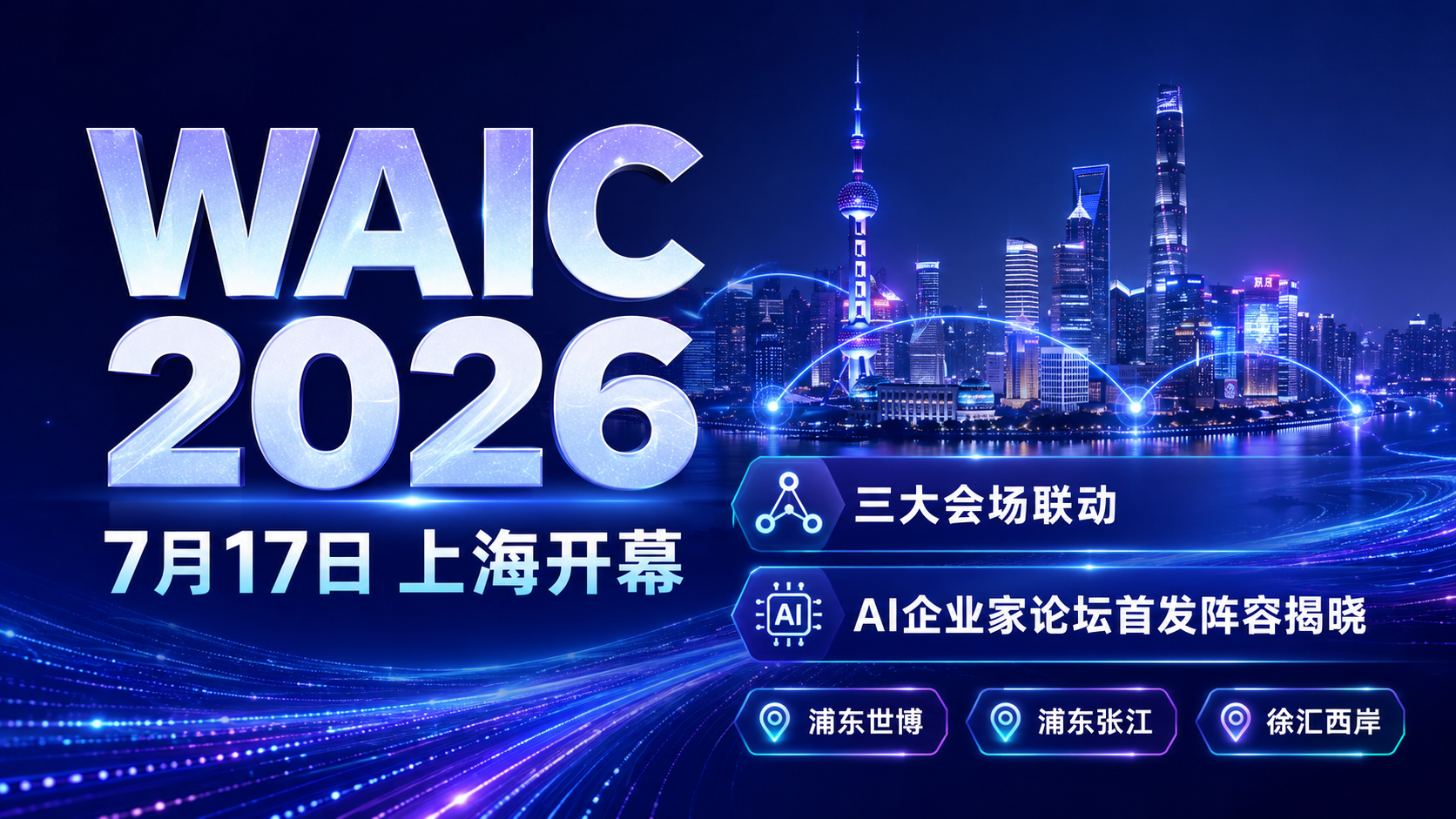
The World Artificial Intelligence Conference (WAIC) 2026 is set to take place from July 17 to 20 in Shanghai, China. According to advance coverage from QbitAI, this year's edition centers on a "post-scaling era paradigm restructuring," marking the industry's transition from brute-force model competition to an agent-driven productivity era.
Organizers note that the traditional model of scaling through compute power and parameter expansion is experiencing diminishing marginal returns. WAIC 2026 will articulate a three-dimensional scaling upgrade path spanning pre-training, post-training, and inference-time computation, providing clarity on the technical evolution trajectory for the global AI industry.
On the technology exhibition front, the conference will debut China's indigenous tech matrix centered on the MemTensor memory architecture, the Harness engineering framework, and the Hermes agent scheduling system. The MemTensor open-source memory OS (MemOS) reportedly demonstrates significant improvements in memory efficiency compared to OpenAI's global memory solution, addressing critical shortcomings in persistent state and self-iteration capabilities of traditional large models.
Multiple Chinese AI companies will unveil new products at WAIC 2026. Baidu will showcase its universal agent "DuMate," integrating search, coding, and deep research capabilities. iFlytek will present office agents covering full-spectrum document processing. Other exhibitors will demonstrate Agent Swarm multi-agent cluster systems, collaborative deduction systems for government-enterprise decision-making, and specialized agent matrices for intellectual property, biomedicine, and materials science verticals.
The conference will also feature dedicated forums including "Memory Tensor: From One-Shot Agent to Memory-Native Intelligence Era" and "AI TIME: Eve of AGI," which will include live head-to-head benchmark demonstrations comparing native models against the Harness engineering framework. Harness, functioning as a middleware operating system bridging large models and business applications, emphasizes intent correction, task decomposition, and exception handling — capabilities seen as critical for moving agents from demo to production deployment.
From an ecosystem perspective, Shanghai has cultivated a cluster of AI enterprises including MiniMax, SenseTime, StepFun, and United Imaging. This year's WAIC will present China's differentiated post-scaling approach — centered on memory innovation, engineering enablement, and scenario orientation — driving agent deployment in real economy sectors.
Notably, the conference will debut a new academic forum segment, bringing together global research talent to support foundational AGI theory innovation. Overall, WAIC 2026 represents a pivotal moment for China's AI agent ecosystem as it transitions from technology validation to industrial-scale productivity deployment, offering a window into how China's AI industry is moving beyond parametric competition toward real-economy value creation.
Why it matters
WAIC 2026 signals a strategic pivot for China's AI industry from parameter competition to agent productivity, with indigenous technologies like MemTensor demonstrating a differentiated post-scaling AGI development path.
Nearby Updates
All07/06, 08:48
ByteDance's Doubao and Alibaba's Tongyi Qianwen to Remove Agent Features
ByteDance's AI assistant Doubao and Alibaba's Tongyi Qianwen are both planning to remove their agent functionality, ending support for third-party agent creation and operation on their platforms. The move signals a significant strategic shift in how China's major AI assistants approach their agent ecosystems.
07/06, 10:45
Meituan Releases LongCat-2.0 Trillion-Parameter Model, Joining China's Mega-Model Race
Meituan has officially launched LongCat-2.0, a trillion-parameter large language model, marking the company's entry into the ultra-large-scale AI model competition. The release signals accelerated strategic investment in AI infrastructure and in-house model development by the food delivery and local services giant.
07/06, 10:45
Beijing No. 1 Token Factory Phase 1 Begins Production in Yizhuang, Marking a New Era for AI Infrastructure
Phase 1 of the Beijing No. 1 Token Factory has commenced production in the Yizhuang district, marking a significant milestone in China's AI infrastructure development. The facility is designed to provide efficient, low-cost token processing capabilities for large-scale model training and inference.
07/06, 10:54
China's LLM Weekly Token Usage Hits 23.45 Trillion, DeepSeek-V4-Flash Leads for Seventh Consecutive Week
China's large language model market recorded 23.45 trillion tokens in weekly usage, maintaining high momentum for the tenth straight week. DeepSeek-V4-Flash topped the rankings for the seventh consecutive week, while Zhipu AI's GLM-5.2 broke into the top five. Chinese model vendors swept the top six spots.