Realtime AI News
Salesforce launches Koa, its first CRM reasoning model, built on NVIDIA Nemotron 3 Super
Salesforce and NVIDIA used Dreamforce to unveil Koa, the company's first CRM reasoning model for Agentforce, post-trained from NVIDIA Nemotron 3 Super on nearly three decades of CRM data and run entirely inside Salesforce's own infrastructure. Koa is already powering an internal Slack agent, with customer pilots starting in October and general availability expected in U.S. regions in winter 2026.
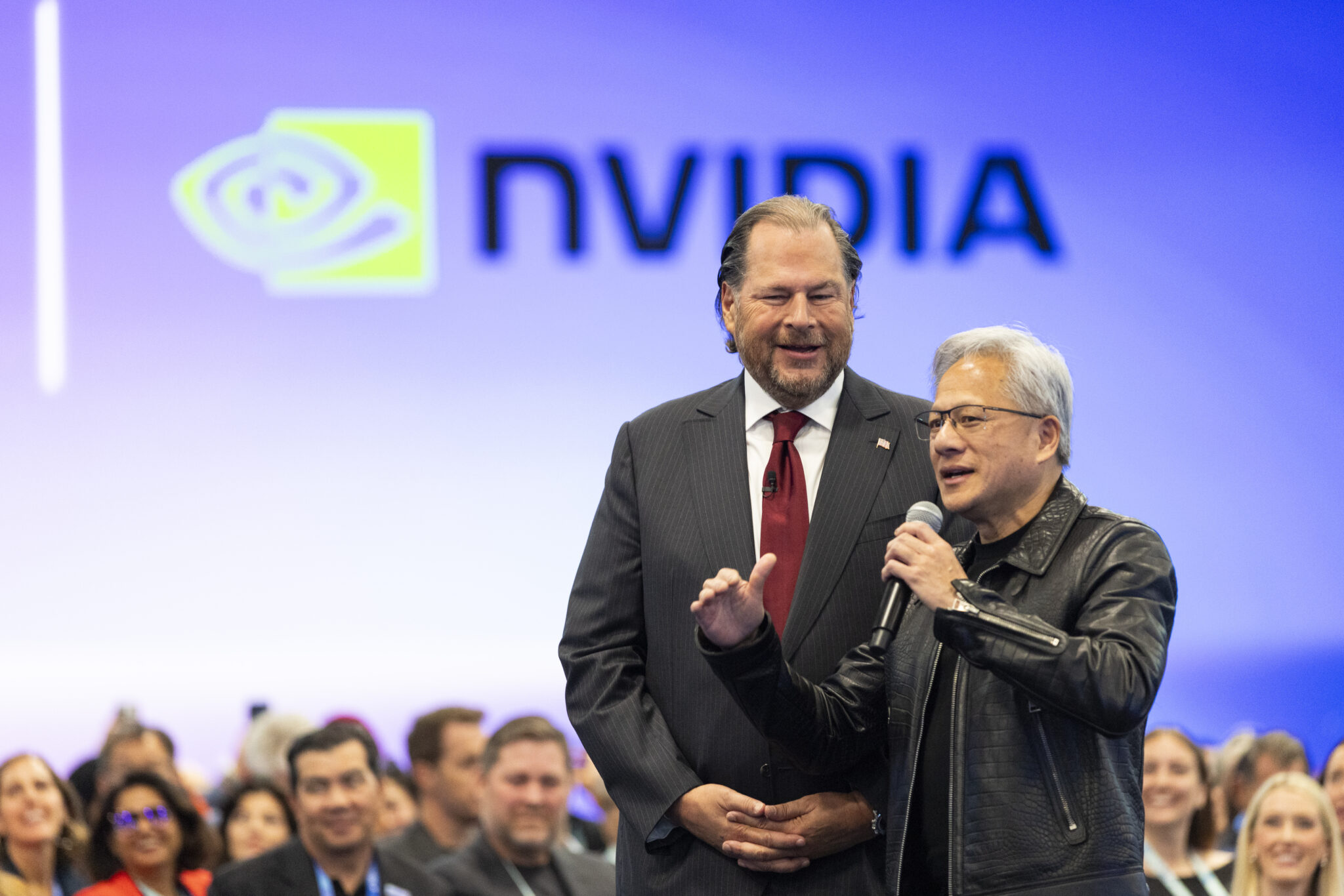
Salesforce and NVIDIA used Dreamforce in San Francisco to announce Koa, which Salesforce calls its first CRM reasoning model for Agentforce. The model was built by post-training NVIDIA Nemotron 3 Super on a proprietary synthetic dataset drawn from nearly three decades of enterprise CRM deployments.
NVIDIA founder and CEO Jensen Huang joined Salesforce CEO Marc Benioff onstage at the Moscone Center and walked through the audience with a microphone in hand. "With electricity, we could power everything. With the internet, you can find anything. And now, with artificial intelligence as an infrastructure layer across the planet, we can know everything and do anything," Huang said, framing AI as the next general-purpose infrastructure layer.
Koa was trained with supervised fine-tuning and reinforcement learning using NVIDIA NeMo RL, NeMo Gym, and NeMo AutoModel, and its training corpus covers synthetic enterprise scenarios across more than 14 industries, including manufacturing, financial services, healthcare, and travel. Because NVIDIA Nemotron is open, Salesforce was able to fine-tune and run the model entirely within its own infrastructure, controlling the weights. "Not a single byte of customer data was used," said Rohan Kumar, Salesforce's president of platform and engineering.
Salesforce says that in its own CRM Bench, a benchmark of real-world tasks such as updating an opportunity, routing a case, or scheduling a follow-up, Koa already matches or exceeds leading model performance on CRM actions while making three times fewer errors.
Koa is already running inside Salesforce, powering an employee agent in Slack, and it moves into customer pilots in October as a customer-selectable model in Agentforce. The first named pilot customers are Formula 1, UChicago Medicine, Baxter Credit Union, 1-800Accountant, Engine, and Xero. General availability is expected in winter 2026 in U.S. regions.
Asked about AI safety, Huang called it job one but framed it as an engineering problem: if you build a product or service and you are not confident in its functionality, capability, or safety, then don't release it. He rejected the idea that speed and safety are a trade-off, telling companies to run as fast as they can but to pause and get things right if a product is not going to be safe.
Huang also said open models have grown from roughly 30 percent of usage at the start of last year to about 70 percent today, arguing that companies are adopting closed models at exponential rates while also building their own custom AI, because every software company is an AI company and every enterprise is becoming an agentic one. NVIDIA is a case in point, running Salesforce across sales, service, marketing, and operations and piloting Agentforce for customer-support workflows.
The announcement matters because CRM vendors are starting to bake their own domain data into the model layer instead of wrapping a general-purpose model in workflow software. The open-weight approach also gives Salesforce a direct answer to the compliance concern that stalls so many enterprise AI deployments. What to watch next: how the October pilots report back, whether third-party benchmarks confirm the CRM Bench numbers, and how far Koa spreads beyond U.S. regions after general availability.
Why it matters
Salesforce gets a self-hosted, domain-trained reasoning model it can sell as compliant by design, while NVIDIA gains another proof point that open Nemotron weights pull enterprises deeper into its training and inference stack.
Nearby Updates
All09/16, 06:44
AI agent certification startup AIUC raises $40M to start auditing frontier models
AIUC, the startup formally known as Artificial Intelligence Underwriting Company, has raised $40 million to extend its agent certification and insurance work up to frontier AI models. Its AIUC-1 standard puts each agent through roughly 5,000 tailored risk and attack combinations and recertifies it every quarter, addressing what the company calls a security-review bottleneck rather than a capability gap.
09/16, 05:47
The AI data center boom is colliding with cities scarred by big industry
TechCrunch reported on September 15 that the national outcry against AI data center construction has spread to Philadelphia, where officials raised the possibility of building in a neighborhood already impacted by a now-defunct oil refinery. The story frames the AI infrastructure boom as a collision with communities that still carry the scars of earlier heavy industry.
09/16, 07:41
Google's new speech model Gemini 3.8 Live supports real-time reasoning
Google has launched Gemini 3.8 Live and Gemini 3.8 Live Extended Thinking, two voice models it says can reason in near real time and handle speech and thought simultaneously. The Extended Thinking model claims a new high of 82.6 on the Artificial Analysis Speech to Speech Quality Index, and both are available through the Gemini API and Google AI Studio.
09/16, 04:47
Spain's data watchdog publicises its first AI agent-linked data breach report
Spain's data protection watchdog has publicised the country's first data breach report tied to an AI agent, saying it received the first notification of a personal data breach allegedly carried out by an artificial intelligence agent. The case pushes autonomous agent behaviour into the regulatory frame, raising immediate questions about attribution, logging and oversight.