Realtime AI News
European Cities Deploy NVIDIA-Powered AI Agents for Urban Operations
Cities across the EMEA region are working with local software and integration partners to build physical AI agents and digital twins on NVIDIA accelerated computing, using them to anticipate maintenance needs, guide planning and make public services more responsive. NVIDIA says the projects span Belgium, Finland, France, Italy, the Netherlands, Poland, Sweden and the UK, with partners including Akila, Galene AI, K2K and ThinkDeep.
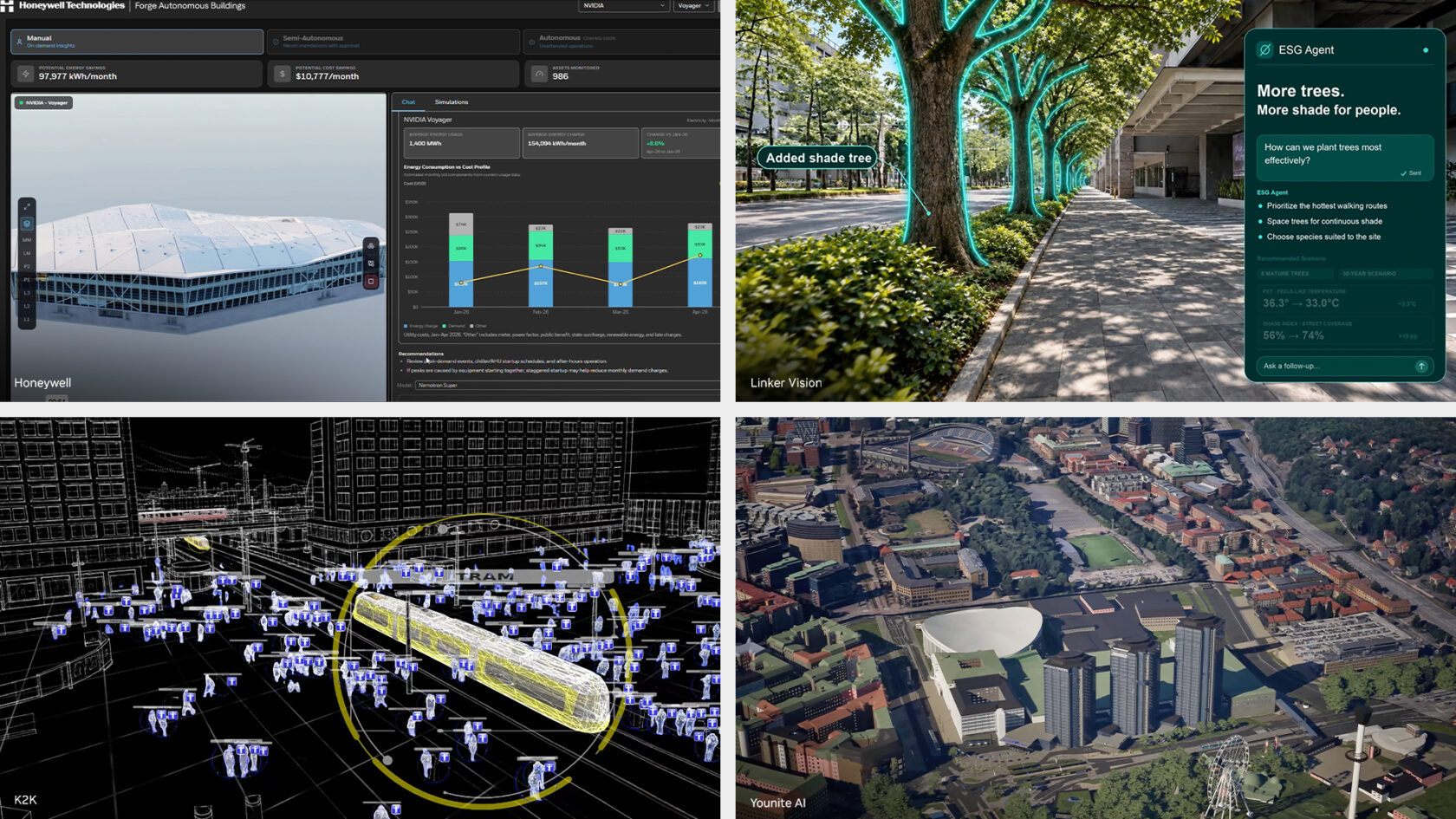
Cities across Europe, the Middle East and Africa are working with local software, infrastructure and integration partners to build physical AI agents and digital twins on NVIDIA accelerated computing, helping operations teams decide everything from when to repair a road to how to use energy more efficiently, according to a post on NVIDIA's blog.
The company says those applications can anticipate maintenance needs, guide urban planning and make public services more responsive. Software partners involved include ABA Technology, Akila, Galene AI, Honeywell Technologies, K2K, Linker Vision, Milestone, Onetera, ThinkDeep and Younite, with projects spanning Belgium, Finland, France, Italy, the Netherlands, Poland, Sweden, the UK and elsewhere.
On the technology side, NVIDIA Cosmos open models and the Metropolis blueprint for video search and summarization (VSS) help agents interpret video and spot conditions that need attention, such as traffic congestion, equipment condition, underused spaces and safety hazards. Nemotron open models let developers build agents that reason over information and respond in natural language, and Omniverse libraries are used to deploy digital twins.
The most quantified case comes from France's Cote-d'Or department, where Akila and ThinkDeep built operations agents that combine sensor, infrastructure and historical data in a sovereign digital twin using Nemotron, Omniverse and accelerated computing, with Cosmos adoption planned for video data. Across more than 500 public buildings the agents support energy, compliance, safety and climate resilience, cutting document search time from weeks to minutes and reducing total operating costs by 10%, with a target of 30% at scale. Port Sud de France in Sete is also working with ThinkDeep's agentic platform, which uses Cosmos and Nemotron to analyze cargo and safety data.
In Italy's Milan region, Galene.AI, Dell Technologies and TD Synnex are deploying an NVIDIA-powered, locally operated AI factory, starting with Cinisello Balsamo and planning expansion to four additional municipalities. Services include real-time translation, citizen chatbots and help with procurement and funding, aiming to cut the time needed to reach municipal data from hours to seconds while keeping governance local.
In the UK, the Liverpool City Region and K2K are exploring AI factories built on accelerated computing, Cosmos and the VSS blueprint to support urban planning and public services, testing applications for mobility and safety. The Island of Jersey is working with K2K on decision-making, mobility and urban planning alongside clean energy and public services, and Innovation City Belfast is exploring a K2K pilot focused on smart mobility, transport systems, citizen safety and event and response management. Belgium's Port of Antwerp-Bruges appears in the list as well.
Taken together, the notable development is less any single city deployment than the way urban operations are becoming a scale scenario for physical AI and agents. It requires video understanding, reasoning and digital twins at once, and it raises the bar for local data governance, which is exactly where sovereign-AI messaging and compute vendors now meet.
The next question is whether these projects move from pilots to recurring budgets. Most of the efforts NVIDIA lists are still described as explorations or pilots, and only a few, such as Cote-d'Or, come with cost and efficiency numbers; whether those measurable results can be replicated will decide if city agents become a short-lived showcase or long-term infrastructure.
Why it matters
Urban operations bundle video understanding, reasoning and digital twins into one scenario, giving physical AI agents a replicable deployment path. Most projects remain pilots, though, so quantified cost and efficiency gains will decide whether the approach endures.
Nearby Updates
All10/14, 14:04
NVIDIA Commits $250M of UK Compute Over Five Years and Joins the Earthshot Prize
NVIDIA says it will commit $250 million of compute over five years to strengthen the UK's agentic safety and security research, delivering $50 million in accelerated computing access annually through BOLD at Oxford and SOFAIR at UCL and Imperial College London. It is also joining the Earthshot Prize as a Global Alliance Founding Partner, alongside UK deployments in healthcare, finance, energy and local government.
10/14, 12:51
PHANES AI Launches SeePhys Hub to Capture Whole-Body Motion and Touch for Ego Data
On October 14, PHANES AI, the robotics data company founded by Harbin Institute of Technology (Shenzhen) professor Yang Shuo, and Tianlong Mobile released SeePhys Hub, a whole-body multimodal data capture system. The rig combines a four-camera headband, wrist bands, waist and calf trackers and an optional haptic glove to recover full-body pose and hand contact pressure that first-person video alone misses.
10/14, 12:09
Scheduling Efficiency Up 80%: SenseTime Platform Backs First Agents in Shanghai Quantum City
SenseTime's large-scale computing platform has supported the first batch of AI agents deployed in Shanghai's Quantum City initiative, with scheduling efficiency improving by roughly 80%, according to QbitAI. The report frames the shift as agents moving from understanding space to actually getting work done.
10/14, 16:00
A Jailbroken PlayStation 5 Is Now Running a 27-Billion-Parameter AI Model
An open source project called PS5LM has turned a jailbroken PlayStation 5 into a working local AI server, with no cloud bill and no gaming PC required. It ports llama.cpp onto the console and runs Alibaba's Qwen3.8-27B on the PS5 GPU at roughly 20 tokens per second.