Realtime AI News
NVIDIA's RTX Spark laptops gain new models, local AI models and agent GPU controls
NVIDIA says RTX Spark Windows laptops are now shipping from ASUS, Dell, HP, Lenovo, Microsoft and MSI, starting at $2,599 with up to 128GB of unified memory. Alongside the hardware, NVIDIA added the open-weight Nemotron 3.5 Transcribe speech model, GPU resource controls for background agents in the NVIDIA App, and DLSS 4.5 support for Phantom Blade Zero.
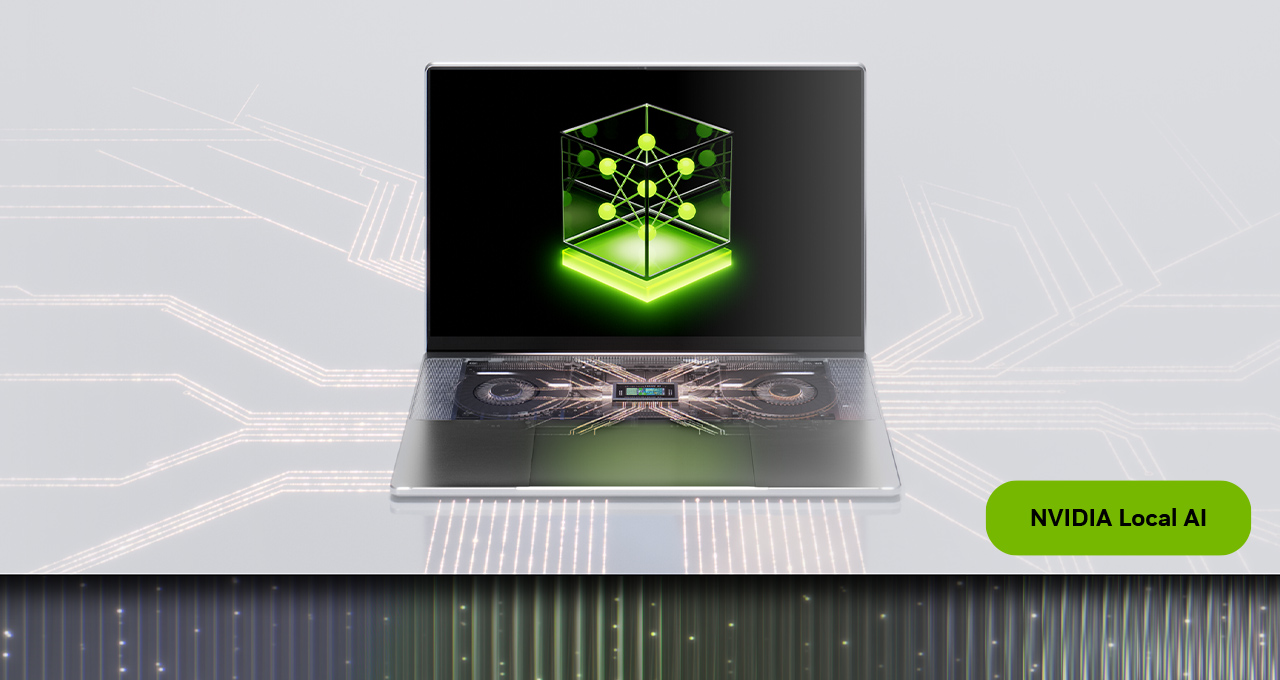
NVIDIA used an October 28 blog post to widen its RTX Spark line: Windows laptops built around the chip are now shipping from ASUS, Dell, HP, Lenovo, Microsoft and MSI, starting at $2,599, with 128GB unified-memory configurations already on shelves. The announcement paired the hardware with new local AI models, GPU controls for background agents and a batch of game updates.
On the hardware side, RTX Spark puts a Blackwell RTX GPU and a Grace CPU on a single superchip with up to 128GB of unified memory and up to 1 petaflop of FP4 AI performance. NVIDIA says the machines are as thin as 14mm and as light as three pounds, and because CPU, GPU and memory draw from one pool, a laptop can take on creative and model workloads that previously called for a desktop workstation.
The most substantive model update is Nemotron 3.5 Transcribe, an open-weight speech model that handles transcription, speaker attribution and translation from a single prompt across 40 languages, seven of them Indic. NVIDIA says it runs on roughly 4.3 billion active parameters, 80% fewer than the top open-weight model, ranks first on Hugging Face's Open ASR leaderboard and second among open-weight models on Artificial Analysis. Weights are on Hugging Face in BF16, FP8 and NVFP4 formats, with support for RTX Spark, DGX Spark, Jetson AGX Thor and GeForce RTX 5090.
The agent-related change lands in the NVIDIA App. A new resource management control lets users decide how the GPU is shared: prioritize the foreground application for smooth performance, or give more compute to an agent running in the background so it finishes sooner. The feature lives under System > Advanced and requires hardware-accelerated GPU scheduling to be enabled in Windows.
NVIDIA also gave Liquid AI's LFM3 family day-zero support. The line spans text, vision, audio, omni and decision models on one shared backbone, released as open weights, and NVIDIA claims the new 1.7-billion-parameter base model outperforms its previous 2.6-billion-parameter base. Developers can run the models on RTX Spark through llama.cpp and vLLM, and fine-tune them locally.
On the gaming side, S-GAME's Phantom Blade Zero launches October 28 at 7 p.m. PT on Steam and the Epic Games Store with ray-traced effects added in collaboration with NVIDIA, plus DLSS 4.5 dynamic multi frame generation at up to 6x. RTX Remix 1.6, released the previous week, brings path tracing and DLSS to Minecraft Java Edition 1.21.1 and adds native RTX Spark support along with agent-assisted modding workflows.
Taken together, the pitch is no longer just a laptop that can run models locally, but a personal workstation where agents can live for long stretches. When a background agent and a foreground app compete for the same GPU, allocating compute stops being a technical detail and becomes a product decision, which is why NVIDIA is now putting that switch in front of users.
Three things are worth watching: real street prices and supply for the 128GB configurations, battery life and thermals once agents run persistently, and whether local models like Nemotron 3.5 Transcribe and LFM3 hold their leaderboard accuracy in actual meetings and customer-service work.
Sources
Why it matters
For PC makers, RTX Spark pushes local AI workstations into mainstream thin-and-light pricing; for developers, open-weight models plus schedulable resident agents mark the point where local inference becomes a product category.
Nearby Updates
All10/28, 22:58
NVIDIA open-sources Nemotron 3.5 Transcribe with a promptable speech stack
NVIDIA published Nemotron 3.5 Transcribe on October 28, an open-weight model that folds transcription, speaker attribution, translation and audio question answering into one checkpoint covering 40 languages. The release ships with the Granary v2 data pipeline and fine-tuning recipes, and NVIDIA reports first place among open-weight models on the Hugging Face English ASR leaderboard at 5.33% word error rate.
10/28, 22:57
Diffusion Intelligence's Clover-35B takes diffusion models into agent work
Diffusion Intelligence released Clover-35B-A3B-Preview on October 28, a 35-billion-parameter diffusion language model with roughly 3 billion active parameters aimed at coding and agent tasks. On the 49-task WindTunnel web-agent benchmark its median execution time was 1.52 seconds against 3.21 seconds for a Jev plus Mercury 2.5 combination, with a 98.6% success rate.
10/28, 23:41
South Korea's financial sector hit by fresh cyberattacks as AI pentest tool draws scrutiny
Daishin Securities, Mirae Asset Global Investments and crypto exchange Bithumb reported cybersecurity incidents this week, with Daishin confirming that data on 38,490 customers was exposed. The wave comes a month after earlier attacks on South Korean financial firms that researchers linked to a suspected China-based hacker using an AI penetration testing tool called Artex.
10/28, 22:01
BotGauge launches AI agent red-teaming platform with 200+ attack strategies
BotGauge AI has launched an AI agent red-teaming platform that puts attacking, tracing, evaluating and governing agents into a single system spanning development through production. It ships with more than 200 adversarial and real-world attack strategies and connects to OpenAI, LangChain, CrewAI and other stacks through a lightweight SDK.