Realtime AI News
NVIDIA leans on Korea's manufacturing base to push physical AI into production
NVIDIA's blog outlines how South Korea's physical AI ecosystem is advancing, with local industry leaders applying accelerated computing, AI and simulation across semiconductor manufacturing, robotics and autonomous vehicles. Samsung's semiconductor engineering work is placed at the front of the story.
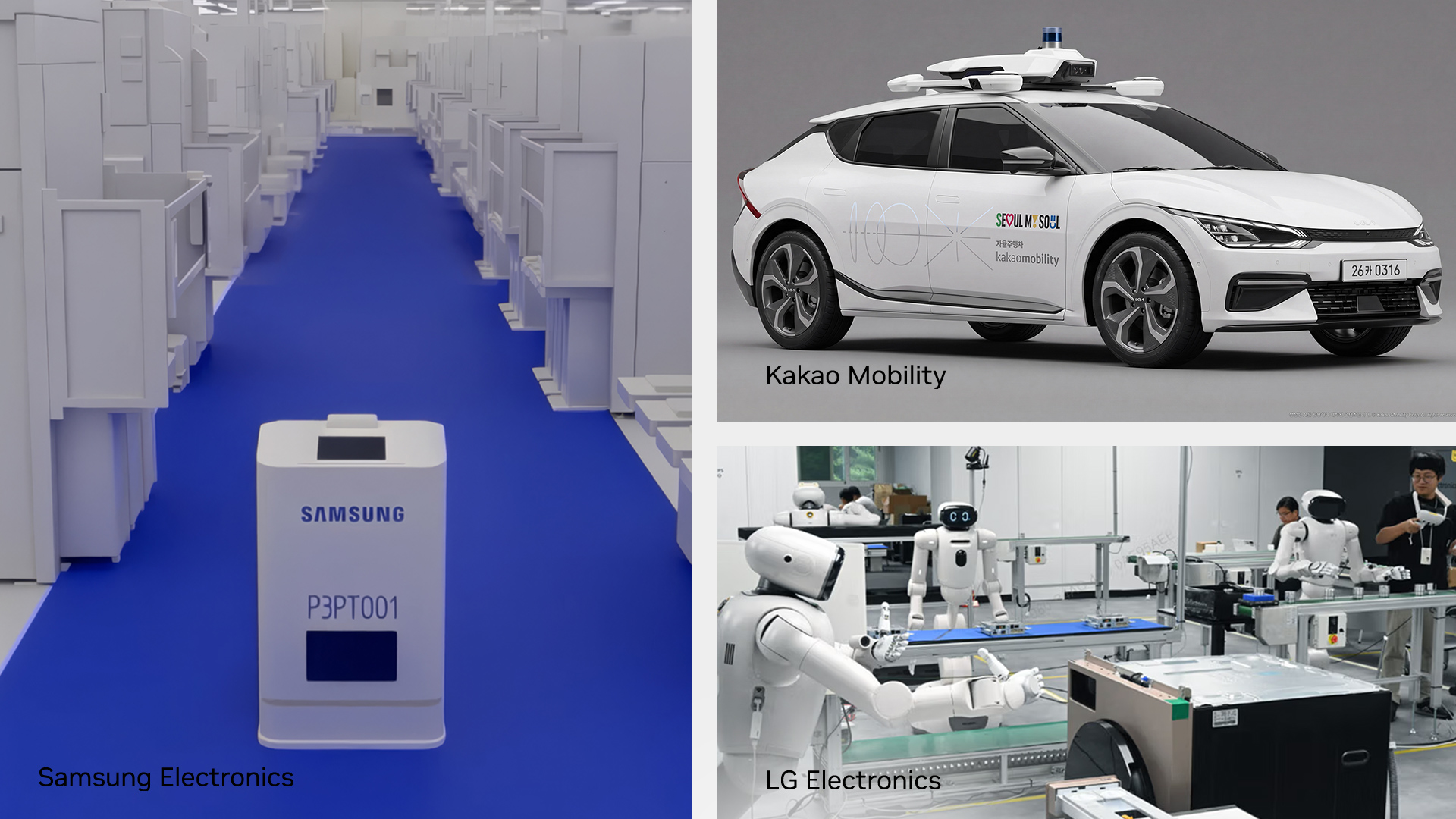
NVIDIA used an official blog post to describe how South Korea's physical AI ecosystem is moving forward. The company frames the country's manufacturing and engineering base as the foundation, and says local industry leaders are combining accelerated computing, AI and simulation in real production settings.
The applications named in the post span semiconductor manufacturing, robotics and autonomous vehicles. What they share is a move away from lab demonstrations: physical AI is being tested where process tolerances and yield pressure decide whether a system is actually useful.
Samsung is highlighted early in the piece, under the heading "Samsung Advances Semiconductor Engineering With ..." — the summary cuts off before naming the specific work. Putting a chipmaker near the top suggests semiconductor engineering is treated as one of the first places physical AI pays off.
The operative phrase in the post is the shift "from development into real-world production." Getting there requires simulation, accelerated computing and a working data loop at the same time, and the blog presents Korea as a place where those pieces already sit close together.
The ecosystem angle matters as much as any single deployment. When semiconductor, robotics and automotive supply chains adopt the same simulation and acceleration tooling, engineering lessons can travel between industries and shorten validation for new use cases.
The post does not give production timelines or deployment volumes. What to watch next is whether these efforts scale from individual pilots into standard processes across factories and companies, and whether Samsung and its peers publish harder numbers.
Why it matters
The post positions Korea's manufacturing base as a proving ground for physical AI at scale. If the semiconductor and robotics cases hold up, NVIDIA's simulation and acceleration stack has a clearer path into other industrial sectors.
Nearby Updates
All11/09, 13:00
Hyundai and AIM Intelligence build secure agents on NVIDIA OpenShell
NVIDIA's blog argues that as AI agents take on more work, capable open models and security have to advance together. Hyundai Motor Group is exploring NVIDIA NemoClaw blueprints and the OpenShell runtime, while AIM Intelligence is integrating its Starfort platform with OpenShell.
11/09, 13:02
NVIDIA, Rebellions and SK Telecom announce collaboration
NVIDIA, Korean chip designer Rebellions and telecom operator SK Telecom have announced a collaboration. The available summary stops at the headline, with no stated scope, technical detail, investment size or timeline.
11/09, 13:06
NVIDIA Dynamo Recipes target production use for Korea's leading open models
A short NVIDIA blog item says Dynamo Recipes can bring South Korea's leading open models into production. The point is the deployment path rather than a new model, and the source gives no model list or performance figures.
11/09, 09:18
LG AI Research opens K-EXAONE 2.5 API for free, claims 70% overall gain over August model across 24 metrics
LG AI Research said on November 9 that it is opening the API for K-EXAONE 2.5 free of charge, announcing the move at NVIDIA AI Day Seoul 2026. The model is a technology-validation build created by further training the second-generation model released in August, and LG says combined performance across 24 metrics rose more than 70%.