Realtime AI News
Cisco CEO says every employee inside the company will get a personal AI agent
Cisco's chief executive told CNBC that every single employee inside the company will get a personal AI agent. The remark moves enterprise agents from team-level pilots toward company-wide rollout, raising questions about permissions, governance and cost at scale.
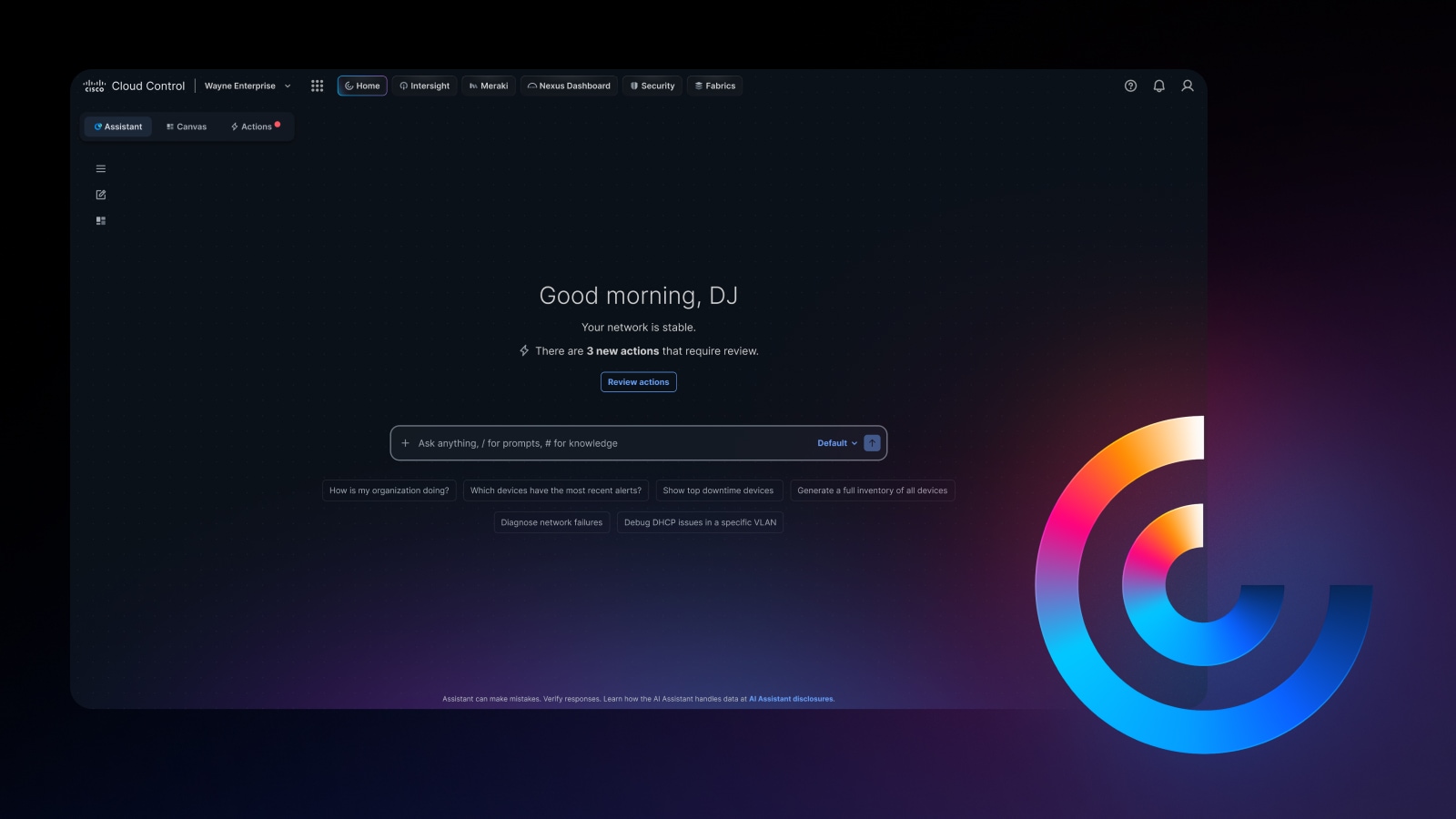
Cisco's CEO said in a CNBC interview that every single employee inside the company will get a personal AI agent, according to the network's report. The statement frames agents not as a tool for selected teams but as standard-issue equipment for the whole workforce.
Beyond that directional commitment, the report does not spell out a deployment timeline, the models or vendors behind the agents, or the specific tasks they will be allowed to handle. Those gaps matter, because the distance between a demo and a daily habit usually lives in exactly those details.
The word every is the signal. For the past two years most enterprise agent work has been scoped by function — support queues, code review, data analysis — with each team running its own pilot before asking for budget. Company-wide provisioning flips the buying logic from choosing a tool per role to issuing an assistant per head.
Cisco is an unusually instructive company to make this claim. It sells much of the networking and collaboration plumbing that enterprise IT runs on, and it operates a large internal IT estate of its own. How it hands out agents, partitions access and audits usage could become a reference design for its own customers.
The hard part is governance, not model capability. A personal agent that is genuinely useful usually needs reach into mail, calendars, documents and ticketing systems; too much access creates new exfiltration paths, too little makes the assistant useless. Identity, data boundaries, logging and accountability for actions taken on an employee's behalf all become IT problems.
The cost profile shifts as well. Seat-based agents imply continuous inference spend, so finance teams will want to weigh subscription and token costs against hours saved. The report gives no budget figures for Cisco's program.
The announcement lands in a crowded field of similar promises. Model vendors have made the per-employee agent a centerpiece of enterprise pitches, while hardware and software suppliers hope agent demand pulls through their own platforms. Retention a year from now will be the real test, not the attention on launch day.
Three things to watch: whether Cisco publishes rollout numbers and a timeline, which model or platform stack powers the agents, and whether it shares a reusable permission model. Those specifics will say more about enterprise AI maturity than the headline promise.
Why it matters
The competitive question for enterprise agents is shifting from feature demos to company-wide provisioning, where permission governance and inference cost decide whether rollouts stick.
Nearby Updates
All11/14, 01:33
Anthropic sued for trademark infringement over its Mythos model
Reuters reports that Anthropic has been sued for trademark infringement over the name of its Mythos model. The case turns an overlooked product decision — what a model is called — into a legal question with brand and distribution consequences.
11/14, 02:40
Study finds Blackwell fingerprints in China's leading open-weight models
A new analysis claims that leading open-weight models from DeepSeek, Moonshot AI, MiniMax and Ant Group carry traces of training on Nvidia Blackwell chips, which U.S. rules bar from export to China. If the finding holds up, it sharpens the question of whether export controls are actually keeping the most powerful GPUs away from Chinese labs.
11/14, 00:40
LexisNexis launches an AI-agent detection tool
LexisNexis, part of RELX, has launched a tool for detecting AI agents, according to a November 13 report from ad-hoc-news.de that also framed the news around RELX's share price. The report does not detail the technical approach, coverage or pricing, leaving the launch as an extension of LexisNexis's legal, identity and compliance lines.
11/14, 00:03
Gemini 4 Hydrogen costs 76% less per task than 3.8 Flash
An analysis by FourWeekMBA puts Gemini 4 Hydrogen 76% cheaper per completed task than Gemini 3.8 Flash. For agentic workloads that make many calls per job, cost per task says more about a model generation than a benchmark score does.