Realtime AI News
NVIDIA RTX Spark compact desktops go on sale with up to 128GB of unified memory
NVIDIA's RTX Spark compact desktops are now on sale, with ASUS, Dell and MSI shipping systems that carry up to 128GB of unified memory. The machines target local AI agents, image and video generation and model fine-tuning, turning a build-it-yourself workflow into an off-the-shelf Windows PC.
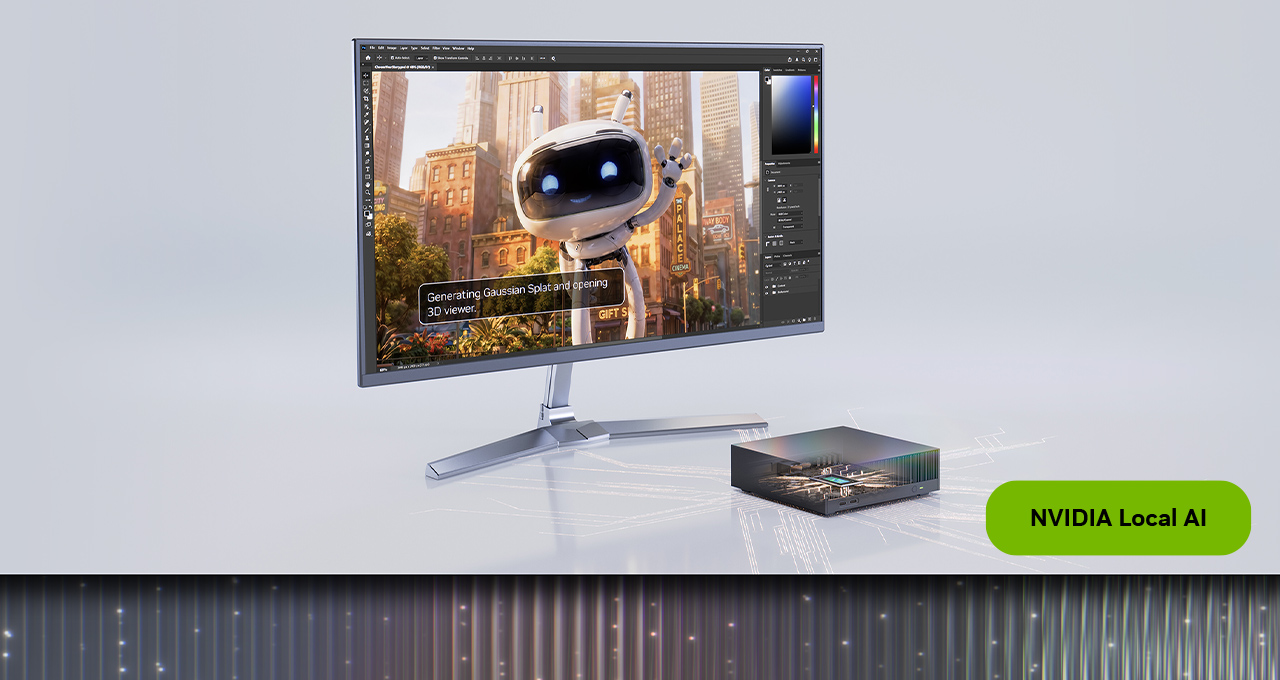
NVIDIA's blog updated on November 18 with a straightforward availability notice: the RTX Spark compact desktops are now on sale, and the first systems on the shelf come from ASUS, Dell and MSI.
The pitch is local AI on a dedicated Windows PC rather than in a browser tab or a cloud endpoint. NVIDIA lists local AI agents, image and video generation, and model fine-tuning as the workloads these boxes are built for.
The headline specification is memory. Configurations scale up to 128GB of unified memory, which NVIDIA says leaves room for larger local models to stay resident while RTX-accelerated creative and development tools run alongside them.
That combination matters more than any single spec: one machine covering both inference and rendering, so users no longer shuttle weight files between devices. For anyone running agent loops on a desk for hours at a time, the all-in-one shape is the part that changes day-to-day work.
Coverage of individual machines tracks the same framing. Notebookcheck describes the ASUS ProArt GR1X as a silent 128GB local AI powerhouse, positioning it closer to a workstation than a gaming tower, which suggests OEMs are now segmenting products explicitly around local AI capacity.
Why it matters is the category shift. Running agents and generative models locally has mostly been a build-it-yourself project, with parts selection, drivers and inference frameworks all on the user. An OEM-blessed, warranty-covered desktop that ships with a vendor AI stack is a different category from a self-built rig.
What to watch next is concrete: how mature NVIDIA's AI software stack proves under real enterprise workloads, how those 128GB are actually divided between CPU and GPU, whether throughput holds up when an agent makes repeated calls to a large model, and whether more manufacturers beyond ASUS, Dell and MSI join the category.
Why it matters
Local AI is moving from hobbyist builds to purchasable OEM systems, which puts vendor software stacks and memory topology under real scrutiny. How these 128GB configurations perform on large models will decide whether they replace cloud endpoints for everyday work.
Nearby Updates
All11/18, 22:34
Vero Security raises $11M to govern AI agents at runtime
Vero Security, a New York-based cybersecurity startup, said on November 18 that it raised $11 million led by TLV Partners, with GTM Capital, Maple Capital and angels participating. Founded in 2025, the company is building an AI Runtime Governance platform that continually reassesses what agents can access and do, then proposes fixes for security teams to approve.
11/18, 23:00
IBM's time-series foundation models now run natively inside Confluent
IBM Research and Confluent have put IBM's Granite time-series foundation models directly inside Confluent, callable as built-in SQL functions in the cloud or on premises. IBM says the model family has passed 50 million downloads and runs on CPUs, pushing forecasts and anomaly detection into the stream itself.
11/18, 23:01
signageOS taps Anthropic's Claude Mythos to secure 180,000 screens
Digital signage device-management company signageOS has joined Anthropic's Cyber Verification Program, gaining access to the Claude Mythos model for defensive security work. The company is applying it to the cloud services, APIs and software behind more than 180,000 connected devices across over 50 hardware platforms.
11/18, 21:00
OpenAI signs four independent evaluators to audit models inside its labs
OpenAI has signed agreements with four independent evaluators, Apollo Research, METR, Transluce and Goodfire, giving them deep access to internal models, source code, training data and monitoring systems. The arrangement is the first phase of an assessment program announced amid scrutiny over rogue-agent incidents and a newly filed lawsuit from California.