English translation
Load data
AI Article Decision Snapshot
Turn the lesson into workflow, model, budget, and security checks before choosing tools.
Use this quick snapshot before leaving the article. It keeps the next search tied to practical AI software, model/API, cost, privacy, and implementation questions.
Workflow fit
Identify the real job behind the article: coding, research, document review, support, analytics, content, or internal automation.
Model or tool decision
Decide whether the next step is a software shortlist, an AI tool comparison, an API platform choice, or a model benchmark.
Budget and usage signal
Estimate seats, API calls, prompt volume, retries, review time, and fallback work before assuming the workflow is cheap.
Security and privacy review
Check whether source code, customer data, private documents, prompts, logs, or embeddings will enter the AI workflow.

Beginners should not treat AutoML as magic; experts should not dismiss it as mere toy. Its true value lies in controllably improving experimental efficiency.

I encourage beginners to first run a small, end-to-end task; I ask experts to systematically document the time savings and new risks introduced by automation.
In this tutorial series, we have thoroughly examined automatic machine learning (AutoML) — from foundational concepts to implementation details — exploring how AutoML can enhance data analysis efficiency and streamline model development. Yet as the technology rapidly evolves and application scenarios diversify, tailored guidance for both newcomers and seasoned practitioners becomes increasingly vital. This article offers practical, actionable advice for users at all levels, helping them apply and understand AutoML more effectively.
Advice for Beginners
For those new to AutoML, the learning curve can feel steep. Here are some practical recommendations:
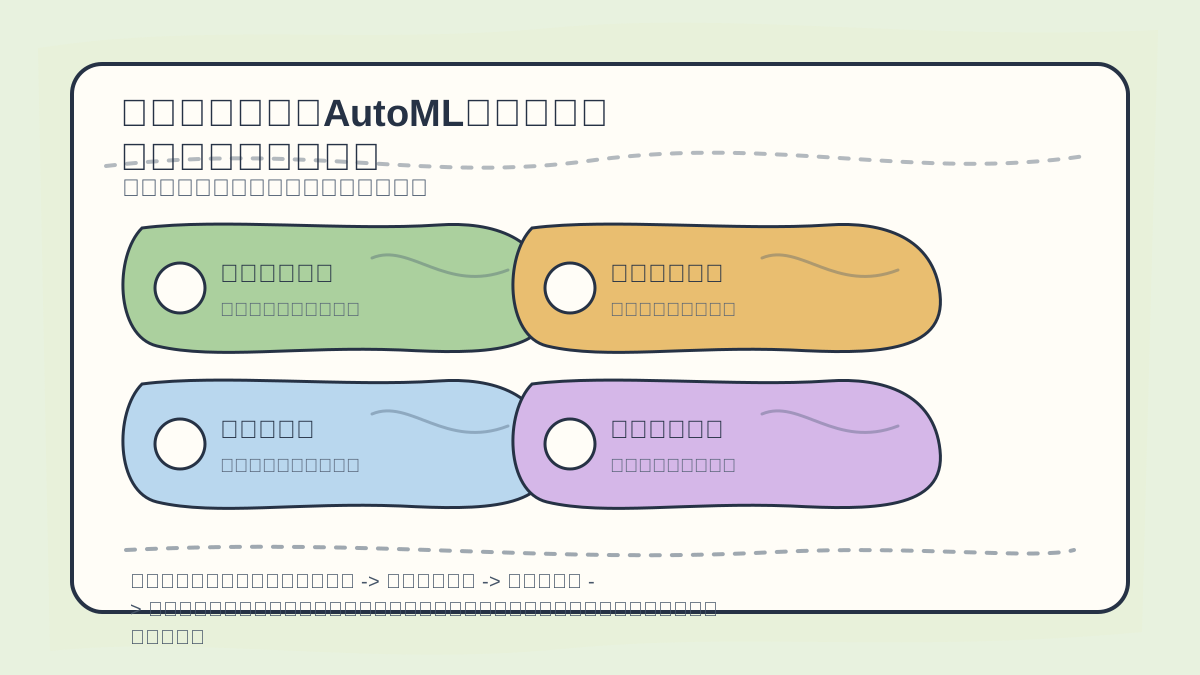
While reading this article, treat the sequence “Advice for Beginners → Understand Core Concepts → Start Simple → Prioritize Model Interpretability” as a verification checklist: First align the object, steps, and evidence; then revisit concrete examples, code snippets, or evaluation metrics for validation.
1. Understand Core Concepts
Before diving into AutoML tools, build a solid foundation in key concepts such as feature engineering, model selection, and hyperparameter tuning. Supplement your learning with online courses or video tutorials to establish conceptual clarity.
2. Start Simple
Begin with a straightforward task—for example, practicing on the Iris dataset from scikit-learn. Then use AutoML libraries like TPOT or Auto-sklearn to automatically construct models, observing their workflow and outputs.
Example implementation:
from tpot import TPOTClassifier
from sklearn.datasets import load_iris
from sklearn.model_selection import train_test_split

# Load data
data = load_iris()
X = data.data
y = data.target

# Split data
X_train, X_test, y_train, y_test = train_test_split(X, y, train_size=0.75, random_state=42)

# Train model
tpot = TPOTClassifier(verbosity=2)
tpot.fit(X_train, y_train)

# Evaluate model
print(tpot.score(X_test, y_test))
3. Prioritize Model Interpretability
AutoML tools may obscure internal model mechanics—so it’s critical to learn how to interpret models. Tools like LIME or SHAP help demystify decision logic and foster trust in predictions.
4. Experiment and Iterate
One of AutoML’s greatest strengths is rapid experimentation and iteration. Beginners should embrace trial-and-error: try different datasets, task types, and configuration settings. Hands-on practice builds intuition and confidence.
Advice for Experts
For experienced ML practitioners, AutoML is a powerful productivity accelerator—but its effective adoption requires thoughtful attention to several dimensions:
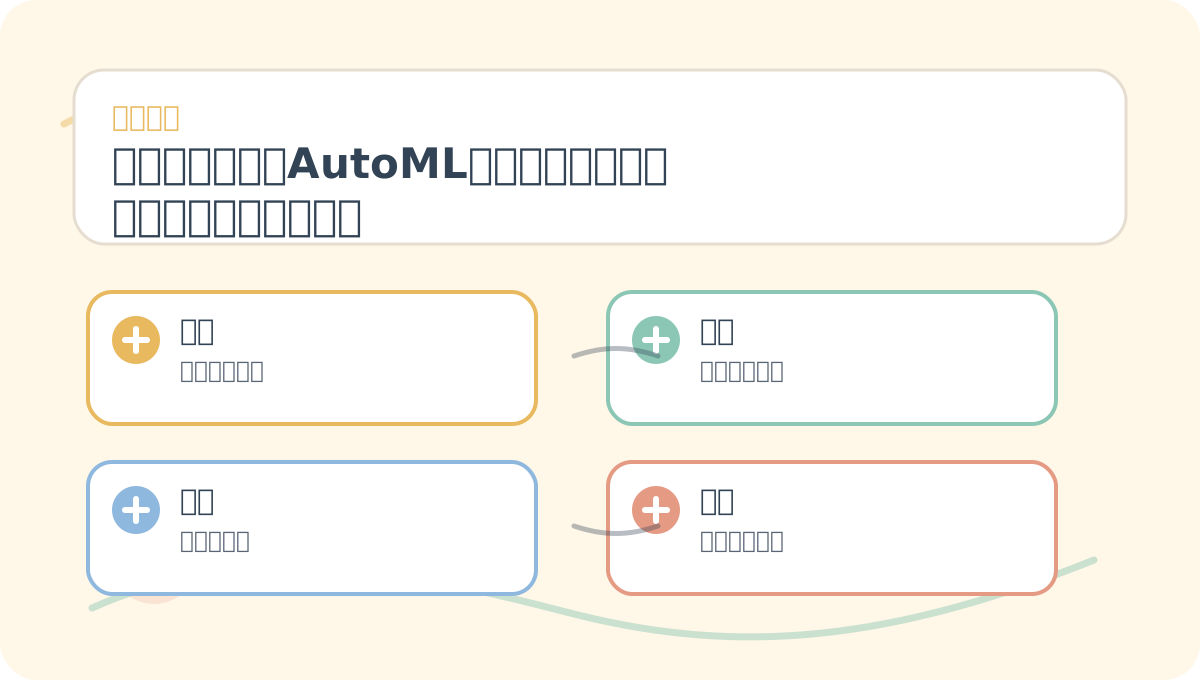
When finishing “AutoML Summary & Future Outlook: Advice for Beginners and Experts”, use the flowchart above as a structured checklist: Is the problem well-defined? Are actions concretely implemented? Can the evaluation criteria be reused across projects?
1. Prioritize Model Interpretability
Even when leveraging AutoML, ensure selected models remain interpretable and transparent. Experts must deeply understand the underlying models—and verify that outputs are credible, explainable, and trustworthy to end users.
2. Optimize Resource Allocation Strategically
Although AutoML automates model and hyperparameter selection, experts retain responsibility for optimizing computational resources and time budgets. Striking the right balance between automation capability and resource efficiency is especially crucial for large-scale or production-critical projects.
3. Align Business Needs with Model Performance
When evaluating AutoML-generated models, go beyond technical metrics (e.g., accuracy). Ask: Does this model truly serve the business objective? Collaborate closely with domain stakeholders during experiment design to ensure practical utility—not just statistical performance.
4. Stay Current with AutoML Advancements
AutoML is a fast-moving field. Experts should actively track cutting-edge research, emerging tools, and best practices—by attending conferences, reading recent papers, and engaging with the community—to maintain technical relevance and integrate innovations effectively.
When reviewing “AutoML Summary & Future Outlook: Advice for Beginners and Experts”, place key concepts, procedural steps, and observable outcomes side-by-side on a single page for holistic reflection.
When practicing “AutoML Summary & Future Outlook: Advice for Beginners and Experts”, explicitly write down the input conditions, processing actions, and observable outcomes together—making future review and replication straightforward.
Closing Thoughts
Whether you’re just starting out or an experienced practitioner, AutoML opens new avenues for efficiency, scalability, and insight. In today’s rapidly evolving landscape, continuous learning and deliberate practice are essential. By deepening our understanding and refining our skills, we harness AutoML not merely as a tool—but as a catalyst for advancing data science and enabling more robust, data-driven decision-making.
In upcoming installments, we’ll explore real-world AutoML case studies and strategies for diagnosing and resolving common pitfalls—stay tuned!
Apply This Lesson
Turn this article into AI software, model, API, and security decisions.
English Article FAQ
Use this article as evidence before choosing AI tools
How should I use this AI Tutorials article?
Use it as the implementation or learning layer, then connect the idea to AI software buyer guides, tool comparisons, benchmarks, API choices, and security checks before making a production decision.
Is this English article different from the Chinese original?
The English edition is localized for global AI readers while preserving the original diagrams, screenshots, prompts, code examples, and source context from the Chinese article.
What should I read after Load data?
Continue with AI Software Buyer Guides, AI Tools Workbench, Best AI Coding Agents, AI Model Benchmarks, OpenAI vs Anthropic API, or LLM Security Tools depending on the decision you need to make.
Can this article alone choose an AI product or model?
No. Treat the article as evidence and context, then validate fit with pricing, privacy requirements, integration effort, benchmark results, workflow tests, and fallback planning.
Continue