English translation
Generate synthetic data
AI Article Decision Snapshot
Turn the lesson into workflow, model, budget, and security checks before choosing tools.
Use this quick snapshot before leaving the article. It keeps the next search tied to practical AI software, model/API, cost, privacy, and implementation questions.
Workflow fit
Identify the real job behind the article: coding, research, document review, support, analytics, content, or internal automation.
Model or tool decision
Decide whether the next step is a software shortlist, an AI tool comparison, an API platform choice, or a model benchmark.
Budget and usage signal
Estimate seats, API calls, prompt volume, retries, review time, and fallback work before assuming the workflow is cheap.
Security and privacy review
Check whether source code, customer data, private documents, prompts, logs, or embeddings will enter the AI workflow.
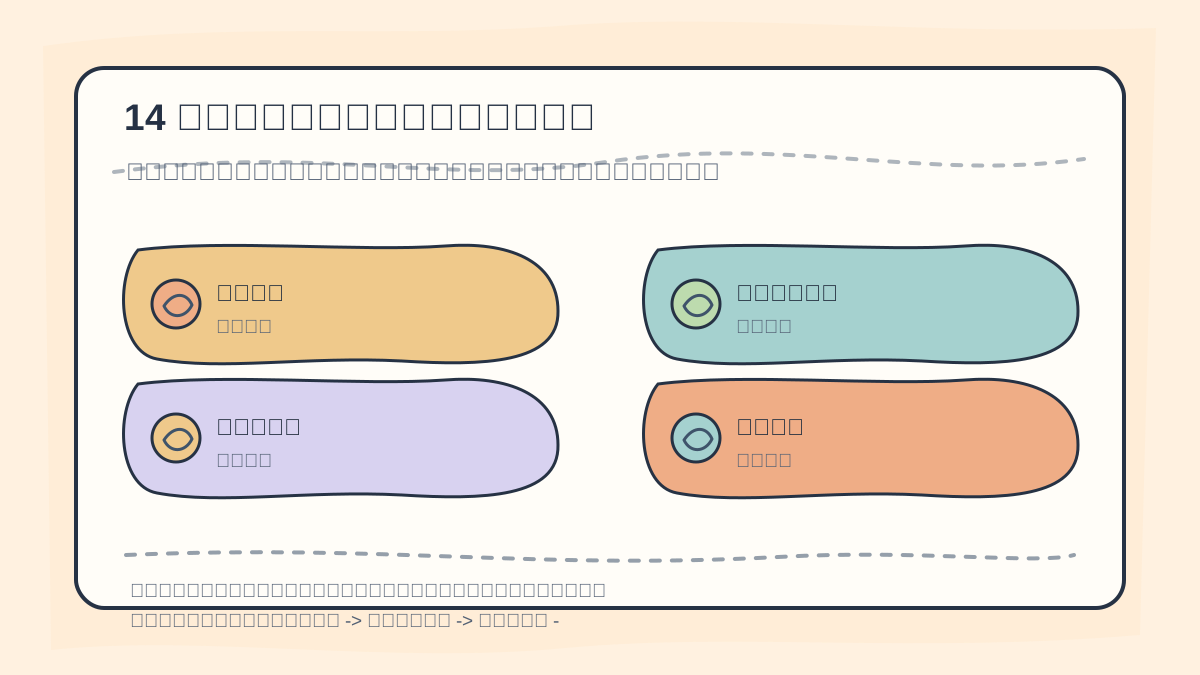
The core of Bayesian learning lies in coherently combining prior beliefs with new evidence while explicitly representing uncertainty. While reading, structure your understanding around the sequence: “Prior Selection → Non-informative Priors → Informative Priors → Posterior Analysis”, then return to the code snippets, case studies, or evaluation metrics in the main text for verification.
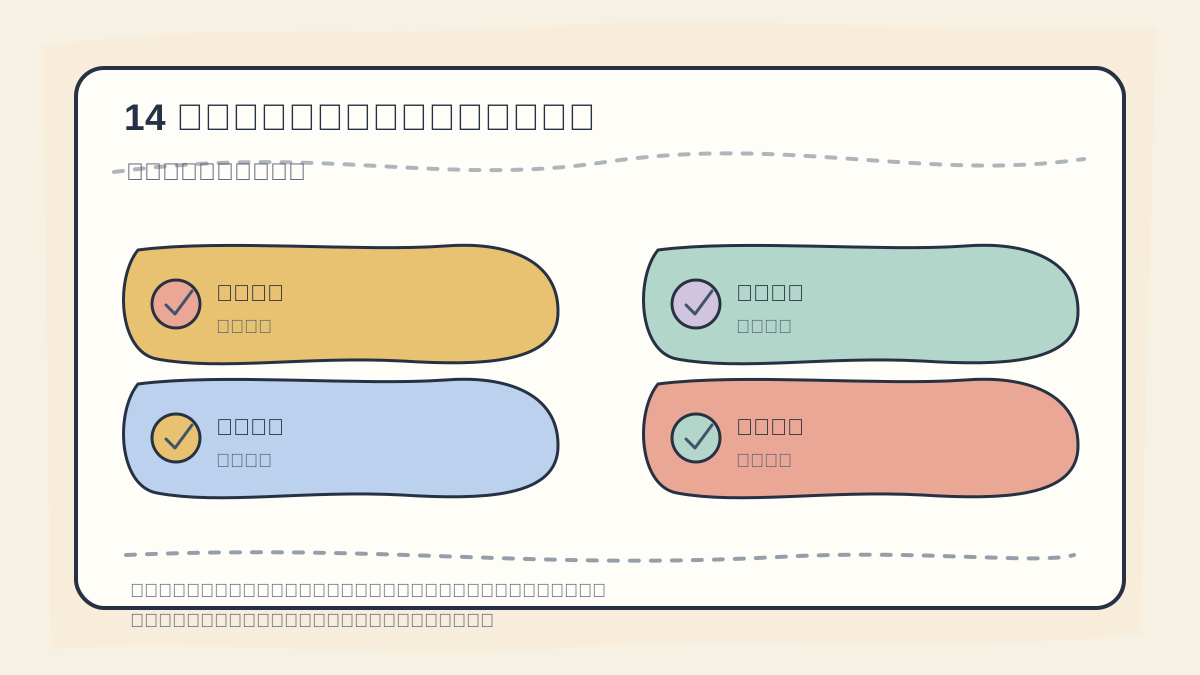
After reading, validate your understanding using a small real-world task: identify what the inputs are, where the processing steps occur, and whether the outputs are verifiable and actionable. If the analysis fails, first inspect the prior selection, then examine the non-informative prior assumptions.
In the previous article, we explored the linear regression model under the Bayesian framework, covering its theoretical foundations and practical applications. In this article, we focus on prior selection and posterior analysis in Bayesian regression, helping you better understand how the model behaves under different priors—and how to conduct rigorous posterior inference.
Prior Selection
In Bayesian statistics, selecting an appropriate prior distribution is a critical step. The prior encodes our beliefs—or lack thereof—about model parameters before observing the data. We will compare two fundamental types of priors: non-informative priors and informative priors.
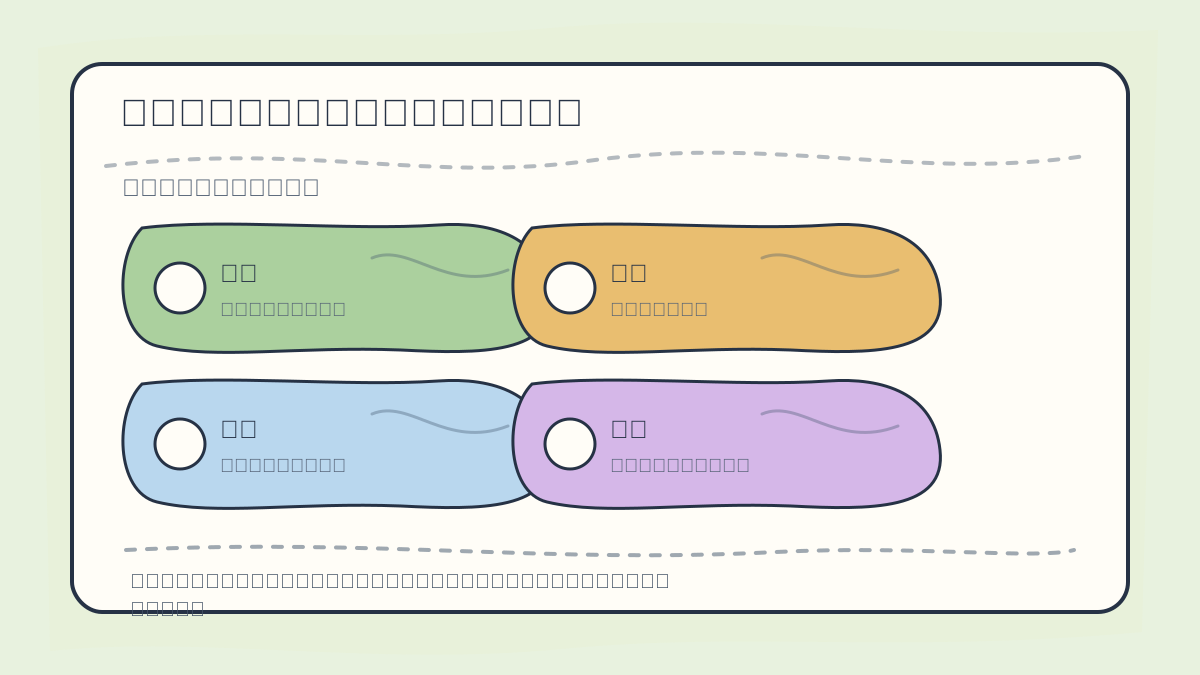
When conducting prior–posterior analysis in Bayesian regression, always assess the following components:
- Prior assumptions
- Likelihood function
- Posterior distribution
- Credible intervals
- Sensitivity comparisons
Non-informative Priors
Non-informative priors (also called diffuse or vague priors) express maximal impartiality toward parameter values—i.e., minimal influence on the posterior. For example, for regression coefficients in a linear model, we might adopt:
where is chosen to be large, ensuring the prior variance dominates and thus exerts little influence on the posterior. This reflects a theoretical stance of “no prior information.”
Informative Priors
Informative priors incorporate substantive domain knowledge about plausible parameter values. For instance, if we believe a particular regression coefficient should center near 0.5 with moderate certainty, we could specify:
Here, represents our informed belief (e.g., ), and quantifies our confidence in that belief (e.g., small implies high confidence).
Case Study
Suppose we have economic data aiming to estimate consumer spending as a function of predictors such as income and education level. Using a non-informative prior in Bayesian regression typically yields a broad posterior distribution—highlighting strong dependence on the observed data and limited shrinkage.
By contrast, adopting an informative prior—for example, encoding our prior belief that the income coefficient exceeds 0.5—yields a more concentrated, directionally biased posterior that converges rapidly toward our domain-informed expectation.
Below is a simple Python example demonstrating Bayesian linear regression with PyMC3, illustrating how different priors affect inference:
import numpy as np
import pymc3 as pm
import matplotlib.pyplot as plt

# Generate synthetic data
np.random.seed(42)
X = np.random.rand(100, 1) * 10
y = 2.5 * X.squeeze() + np.random.randn(100) * 2

# Bayesian regression with non-informative priors
with pm.Model() as model_noninformative:
    # Prior specifications
    alpha = pm.Normal('alpha', mu=0, sigma=10)
    beta = pm.Normal('beta', mu=0, sigma=10)
    sigma = pm.HalfNormal('sigma', sigma=1)

    # Linear model
    y_obs = pm.Normal('y_obs', mu=alpha + beta * X.flatten(), sigma=sigma, observed=y)

    # Sample from the posterior
    trace_noninformative = pm.sample(2000, tune=1000)

# Bayesian regression with informative priors
with pm.Model() as model_informative:
    # Prior specifications
    alpha = pm.Normal('alpha', mu=0, sigma=1)
    beta = pm.Normal('beta', mu=0.5, sigma=0.1)  # Informative prior
    sigma = pm.HalfNormal('sigma', sigma=1)

    # Linear model
    y_obs = pm.Normal('y_obs', mu=alpha + beta * X.flatten(), sigma=sigma, observed=y)

    # Sample from the posterior
    trace_informative = pm.sample(2000, tune=1000)

# Compare posterior distributions visually
pm.plot_posterior(trace_noninformative, fig=plt.figure(figsize=(12, 6)), color='blue')
pm.plot_posterior(trace_informative, fig=myfig, color='orange')
plt.title('Posterior Distributions Comparison')
plt.show()
In this code, we fit the same dataset twice—once with non-informative priors and once with informative priors. Visual comparison of the resulting posterior distributions reveals how prior choice directly shapes parameter estimates and uncertainty quantification.
Posterior Analysis
After combining prior knowledge with observed data via Bayes’ theorem, we obtain the posterior distribution:
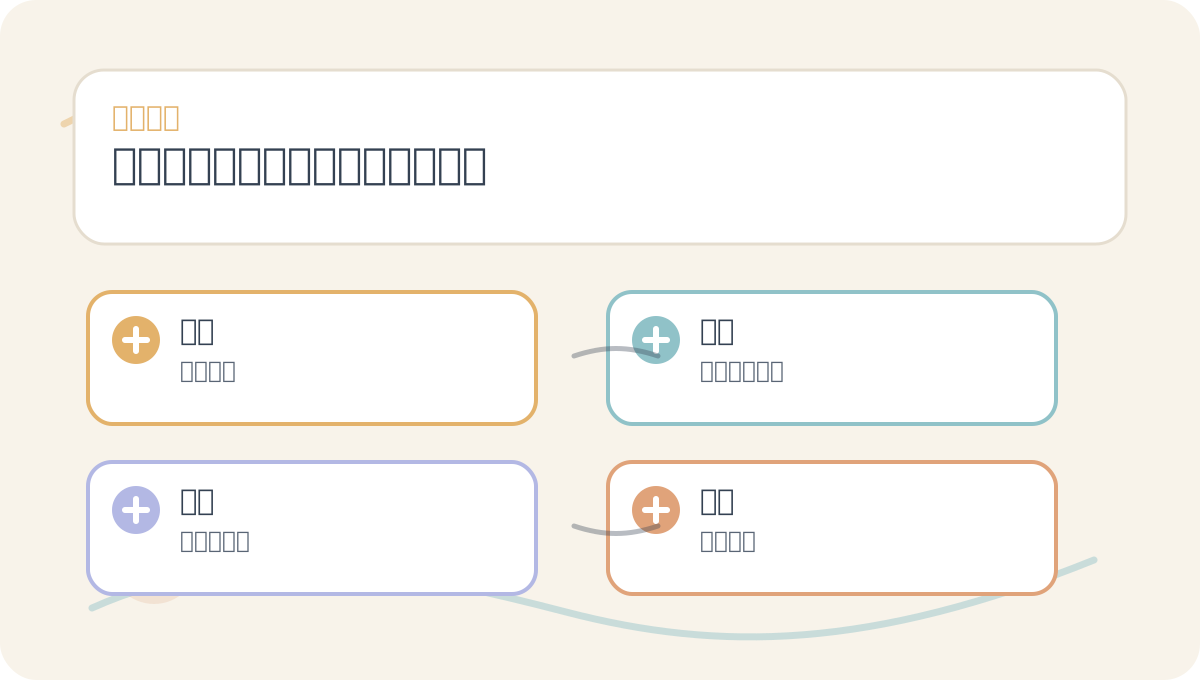
When reading “Prior Selection and Posterior Analysis in Bayesian Regression”, treat the accompanying diagrams as navigational aids:
- First, grasp the overall workflow;
- Then, understand why each step is performed;
- Finally, verify boundary conditions and assumptions.
where is the likelihood, is the prior, and is the marginal likelihood (a normalizing constant).
Posterior Inference
Once the posterior is obtained, we perform inference to extract actionable insights. Key tasks include:
- Point estimation: e.g., posterior mean, mode (MAP), or median.
- Credible intervals: e.g., computing a 95% highest-density interval (HDI) to quantify uncertainty.
- Model evaluation: comparing models via posterior predictive checks or metrics like WAIC/LOO-CV.
Example Analysis
Suppose we wish to estimate a 95% credible interval for the regression coefficient . The following code computes and visualizes it:
import arviz as az

# Extract posterior samples for beta
beta_samples = trace_noninformative['beta']
pm.plot_posterior(trace_noninformative, var_names=['beta'])

# Compute 95% credible interval
ci = np.percentile(beta_samples, [2.5, 97.5])
print(f'95% Credible Interval: {ci}')
This snippet uses ArviZ to visualize the posterior distribution of and compute its 95% credible interval.
After completing “Prior Selection and Posterior Analysis in Bayesian Regression”, try adapting it to your own scenario. Focus especially on whether inputs, processing steps, and outputs align coherently.
To apply “Prior Selection and Posterior Analysis in Bayesian Regression” to your own task, start small: isolate and validate just one critical decision point—e.g., whether your prior adequately reflects domain knowledge or whether your credible intervals behave as expected under perturbation.
Summary
In this article, we examined how prior selection influences posterior analysis in Bayesian regression. Thoughtful prior specification—and rigorous posterior inference—are foundational to effective Bayesian learning. In the next article, we will delve deeper into prediction mechanisms and uncertainty quantification in Bayesian regression, equipping you with essential tools for real-world deployment.
Apply This Lesson
Turn this article into AI software, model, API, and security decisions.
English Article FAQ
Use this article as evidence before choosing AI tools
How should I use this AI Tutorials article?
Use it as the implementation or learning layer, then connect the idea to AI software buyer guides, tool comparisons, benchmarks, API choices, and security checks before making a production decision.
Is this English article different from the Chinese original?
The English edition is localized for global AI readers while preserving the original diagrams, screenshots, prompts, code examples, and source context from the Chinese article.
What should I read after Generate synthetic data?
Continue with AI Software Buyer Guides, AI Tools Workbench, Best AI Coding Agents, AI Model Benchmarks, OpenAI vs Anthropic API, or LLM Security Tools depending on the decision you need to make.
Can this article alone choose an AI product or model?
No. Treat the article as evidence and context, then validate fit with pricing, privacy requirements, integration effort, benchmark results, workflow tests, and fallback planning.
Continue