English translation
Generate synthetic data
AI Article Decision Snapshot
Turn the lesson into workflow, model, budget, and security checks before choosing tools.
Use this quick snapshot before leaving the article. It keeps the next search tied to practical AI software, model/API, cost, privacy, and implementation questions.
Workflow fit
Identify the real job behind the article: coding, research, document review, support, analytics, content, or internal automation.
Model or tool decision
Decide whether the next step is a software shortlist, an AI tool comparison, an API platform choice, or a model benchmark.
Budget and usage signal
Estimate seats, API calls, prompt volume, retries, review time, and fallback work before assuming the workflow is cheap.
Security and privacy review
Check whether source code, customer data, private documents, prompts, logs, or embeddings will enter the AI workflow.

Bayesian learning centers on integrating prior beliefs with new evidence while explicitly quantifying uncertainty. While reading, structure your understanding as follows: “Theoretical Foundations → Parameter Selection → Maximum A Posteriori (MAP) Estimation → Generalized Cross-Validation”, then verify each concept using the code snippets, case studies, or evaluation metrics presented in the main text.

After reading, conduct a reality check using a small, real-world task: identify what the inputs are, where the processing steps occur, and whether the outputs meet acceptance criteria. If the task fails, first revisit the “Theoretical Foundations”, then examine “Parameter Selection”.
In the previous chapter, we compared Bayesian estimation with frequentist estimation, clarifying their respective strengths, weaknesses, and appropriate use cases. This chapter continues our exploration of advanced parameter estimation—specifically, Parameter Selection and Evaluation. Starting from the Bayesian framework, we will explain how to make effective parameter choices and rigorously assess those choices.
Theoretical Foundations
In Bayesian statistics, inference is typically performed over a parameter space. To select appropriate parameters, we must consider several key concepts:

When performing Bayesian parameter selection, first examine the prior specification, likelihood form, posterior distribution, evaluation metrics, and sensitivity to sample size.
-
Posterior Distribution: The probability distribution of the parameter given observed data:
where denotes the observed data and represents the parameter(s).
-
Loss Function: When selecting parameters, we aim to optimize decisions by minimizing some notion of loss or risk. Common examples include squared loss and absolute loss.
-
Bayesian Risk: For a given loss function, the Bayesian risk is the expected loss under the posterior distribution:
where denotes our parameter estimate.
Parameter Selection
Selecting appropriate parameters is critical in practice. Several principled approaches can be used:
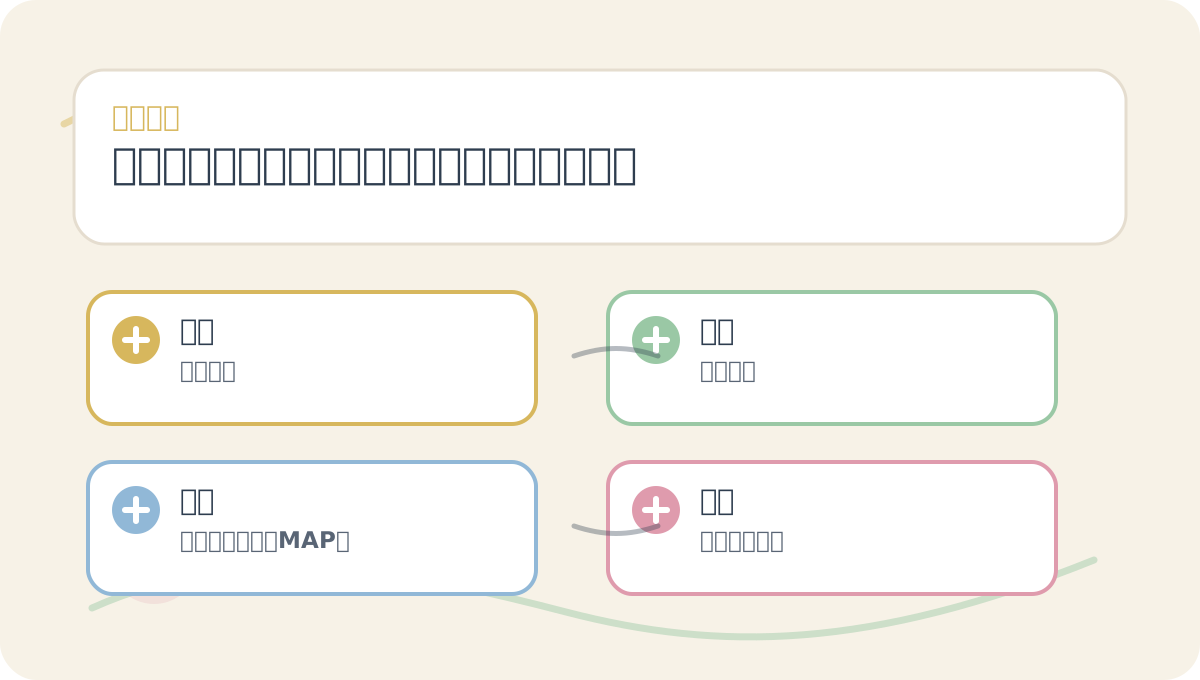
When reading Bayesian Learning and Statistical Inference Tutorial: Parameter Selection and Evaluation, first align the questions, keywords, actions, and acceptance criteria shown in this diagram with the corresponding content in the main text—this makes reading significantly more efficient. After finishing, try re-explaining the material using your own project.
1. Maximum A Posteriori (MAP) Estimation
Choose the parameter value that maximizes the posterior distribution:
As an illustrative example, consider a simple Gaussian model: suppose observations are drawn from a normal distribution with unknown mean and known variance . The posterior distribution for can then be derived analytically via Bayes’ theorem.
2. Generalized Cross-Validation
When selecting model parameters, cross-validation provides a robust way to evaluate model performance. By partitioning the dataset and computing performance across multiple splits, we select the parameter setting that yields the best average performance. When comparing multiple candidate models, computing the average cross-validation error for each model is especially useful.
Parameter Evaluation
Equally important is the rigorous evaluation of selected parameters. Common methods include:
1. Posterior Distribution Analysis
Obtain and analyze the posterior distribution of the parameter(s), e.g., compute its expectation, variance, and credible intervals:
- Expectation:
- Variance:
- Highest Posterior Density (HPD) Interval: e.g., the 95% credible interval
2. Trace Plot
A trace plot visualizes successive samples from the posterior distribution (e.g., from MCMC sampling). It helps diagnose convergence and assess the shape and stability of the posterior.
3. DIC (Deviance Information Criterion)
DIC is a model-comparison metric that balances goodness-of-fit against model complexity. Its formula is:
where is the deviance evaluated at the posterior mean (or mode) of the parameters, and estimates the effective number of parameters (model complexity).
Case Study
Below is a simple Python implementation demonstrating posterior inference using the PyMC3 library:
import pymc3 as pm
import numpy as np
import matplotlib.pyplot as plt

# Generate synthetic data
np.random.seed(42)
true_mu = 5.0
sigma = 1.0
data = np.random.normal(true_mu, sigma, size=100)

# Define Bayesian model
with pm.Model() as model:
    mu = pm.Normal('mu', mu=0, sigma=10)
    sigma = pm.HalfNormal('sigma', sigma=1)

    Y_obs = pm.Normal('Y_obs', mu=mu, sigma=sigma, observed=data)

    # Sample from posterior
    trace = pm.sample(2000, tune=1000)

# Visualize posterior distributions
pm.plot_trace(trace)
plt.show()
In this example, we define a simple Bayesian model to estimate the unknown mean mu and standard deviation sigma. Using posterior sampling, we obtain full posterior distributions for both parameters and can proceed with further analysis—such as computing summary statistics or predictive checks.

When reviewing Bayesian Learning and Statistical Inference Tutorial: Parameter Selection and Evaluation, place key concepts, procedural steps, and observable outcomes on the same page for efficient revision.

When practicing Bayesian Learning and Statistical Inference Tutorial: Parameter Selection and Evaluation, write down input conditions, processing actions, and observable outcomes together—this facilitates future review and troubleshooting.
Summary
Parameter selection and evaluation constitute core components of Bayesian learning and statistical inference. Through techniques such as Maximum A Posteriori (MAP) estimation, cross-validation, and posterior analysis, we can effectively identify optimal parameters and rigorously assess their reliability. In practice, sound parameter selection significantly enhances both predictive accuracy and interpretability of models.
In the next chapter, we will address model selection and complexity, exploring how to balance model fidelity against the risks of overfitting and excessive complexity.
Apply This Lesson
Turn this article into AI software, model, API, and security decisions.
English Article FAQ
Use this article as evidence before choosing AI tools
How should I use this AI Tutorials article?
Use it as the implementation or learning layer, then connect the idea to AI software buyer guides, tool comparisons, benchmarks, API choices, and security checks before making a production decision.
Is this English article different from the Chinese original?
The English edition is localized for global AI readers while preserving the original diagrams, screenshots, prompts, code examples, and source context from the Chinese article.
What should I read after Generate synthetic data?
Continue with AI Software Buyer Guides, AI Tools Workbench, Best AI Coding Agents, AI Model Benchmarks, OpenAI vs Anthropic API, or LLM Security Tools depending on the decision you need to make.
Can this article alone choose an AI product or model?
No. Treat the article as evidence and context, then validate fit with pricing, privacy requirements, integration effort, benchmark results, workflow tests, and fallback planning.
Continue