English translation
Introduction to Neural Networks
AI Article Decision Snapshot
Turn the lesson into workflow, model, budget, and security checks before choosing tools.
Use this quick snapshot before leaving the article. It keeps the next search tied to practical AI software, model/API, cost, privacy, and implementation questions.
Workflow fit
Identify the real job behind the article: coding, research, document review, support, analytics, content, or internal automation.
Model or tool decision
Decide whether the next step is a software shortlist, an AI tool comparison, an API platform choice, or a model benchmark.
Budget and usage signal
Estimate seats, API calls, prompt volume, retries, review time, and fallback work before assuming the workflow is cheap.
Security and privacy review
Check whether source code, customer data, private documents, prompts, logs, or embeddings will enter the AI workflow.
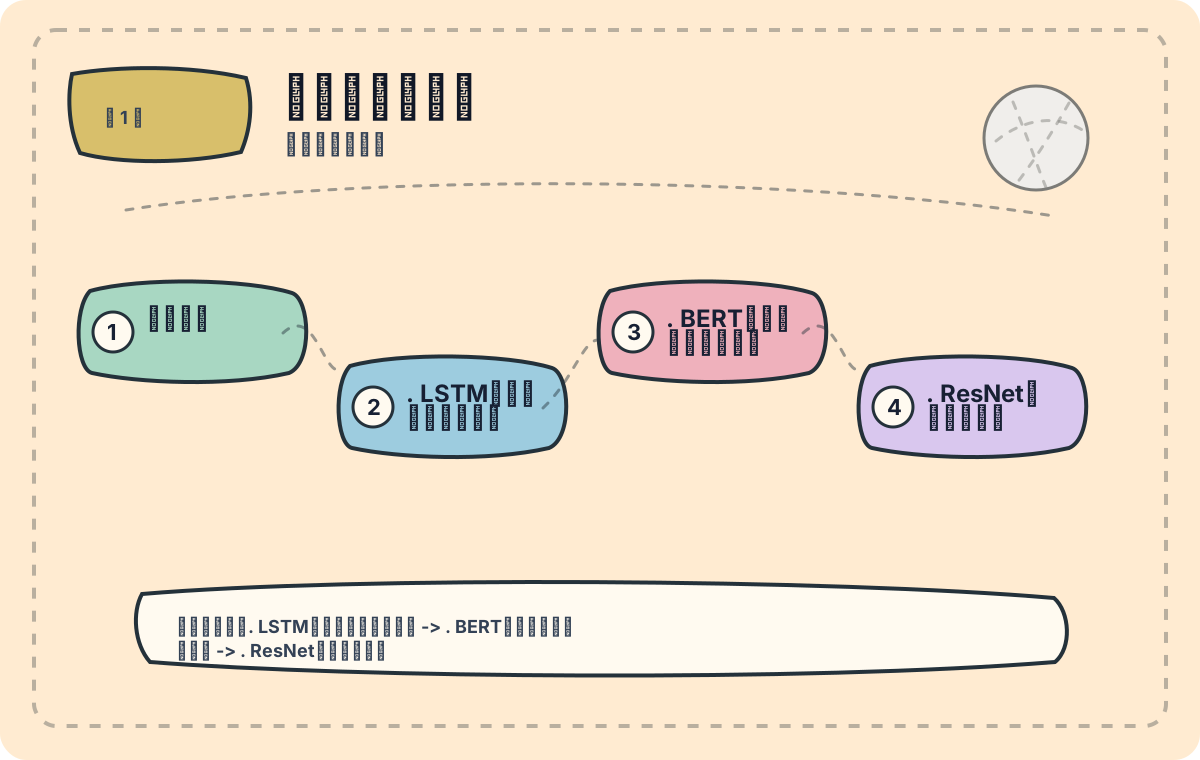
Think of this as a small model you can deconstruct step by step: first clarify what problem it solves, then examine how data flows into the network, and finally inspect the output and evaluation methods. This article lays the foundational map: what problem the network addresses, what its core components are, and which types of tasks it best suits.
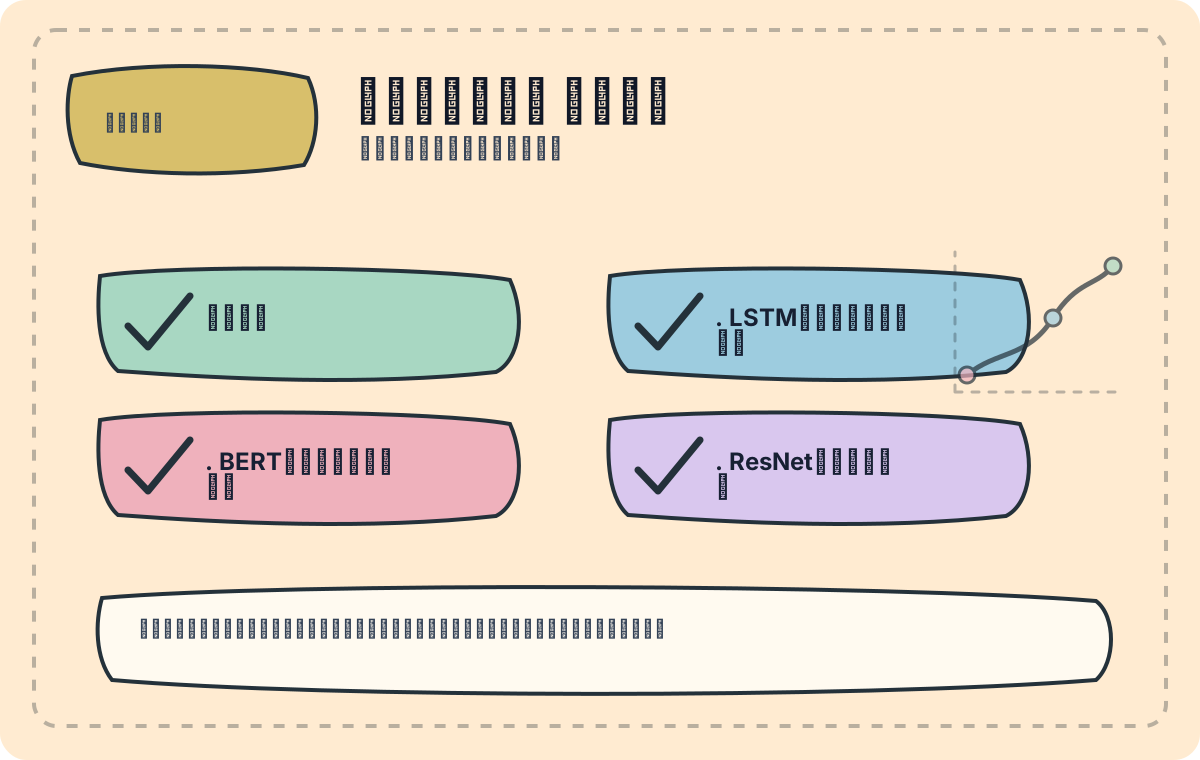
I write down the input, core modules, output, and evaluation metrics on paper. Connecting these four points makes the code and concepts in the article much easier to follow.
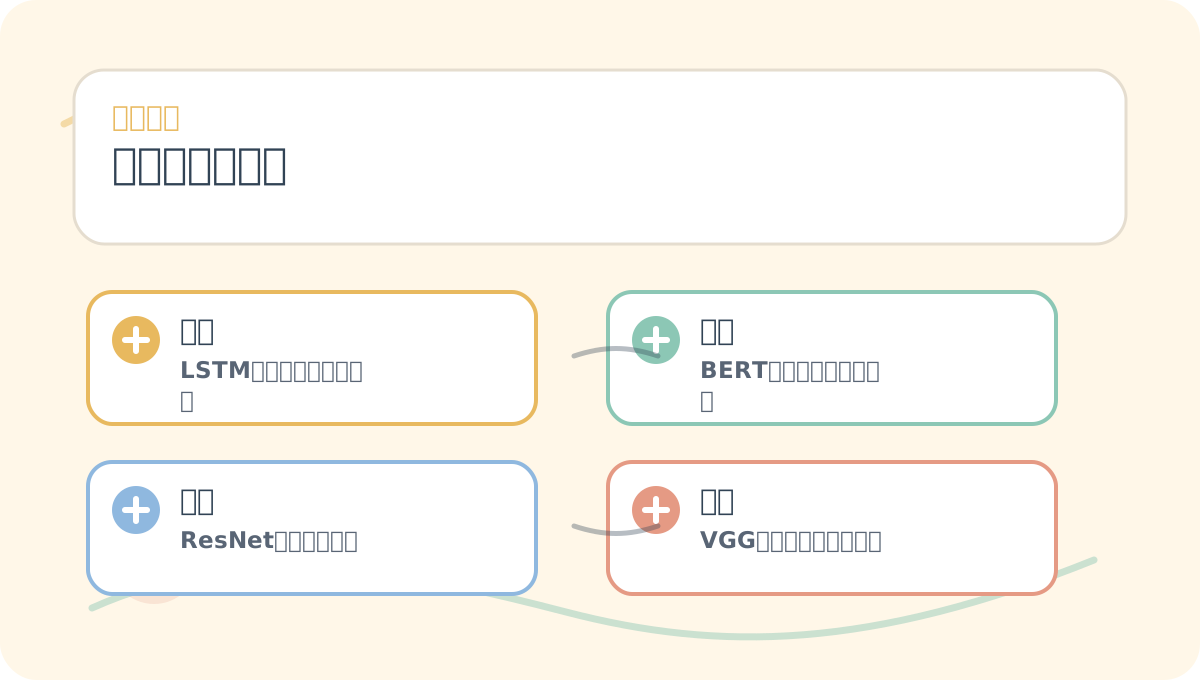
In recent years, deep learning networks have achieved remarkable progress—especially in processing image, text, and time-series data. A wide variety of network architectures have been proposed and applied to diverse problem domains, driving innovation across numerous fields. This tutorial focuses on several mainstream deep learning architectures—including LSTM, BERT, and ResNet—providing their fundamental introductions and theoretical backgrounds to lay the groundwork for subsequent scenario-based analysis.
1. LSTM (Long Short-Term Memory)
LSTM is a specialized type of RNN (Recurrent Neural Network), particularly well-suited for processing and predicting sequential data. By incorporating gated mechanisms, it effectively mitigates the vanishing gradient problem that plagues traditional RNNs when learning long sequences. LSTMs excel in natural language processing and speech recognition. For instance, in speech-to-text transcription, an LSTM retains contextual information, enabling more accurate interpretation of speech signals.

When confronted with many network names, start by categorizing them by task type. Input/output formats differ significantly across vision, language, generation, and detection tasks—so architectural differences become meaningful rather than just strings of hard-to-remember acronyms.
Example code:
import torch
import torch.nn as nn

class LSTMModel(nn.Module):
    def __init__(self, input_size, hidden_size, num_layers):
        super(LSTMModel, self).__init__()
        self.lstm = nn.LSTM(input_size, hidden_size, num_layers)
        self.fc = nn.Linear(hidden_size, 1)

    def forward(self, x):
        out, _ = self.lstm(x)
        out = self.fc(out[-1, :, :])
        return out
2. BERT (Bidirectional Encoder Representations from Transformers)
BERT is a pre-trained model built upon the Transformer architecture, highly effective for natural language processing tasks. Its bidirectional context modeling enables deeper understanding of complex linguistic features. Compared to traditional models relying solely on unidirectional context, BERT achieves superior performance in question answering, sentiment analysis, and other NLP tasks. For example, in question answering, BERT identifies more precise, contextually relevant answers.
After reading “Introduction: Overview of Neural Networks”, revisit three questions:
- What problem does it solve?
- At which step is error most likely to occur?
- Can I run a small working example end-to-end?
3. ResNet (Residual Network)
ResNet tackles the degradation problem in training very deep networks by introducing residual connections. This allows networks to grow substantially deeper while maintaining or improving performance—leading to stronger feature extraction capabilities. ResNet has consistently delivered state-of-the-art results in image recognition competitions and is widely used in image classification and object detection tasks. For example, ResNet’s breakthrough performance in the ImageNet challenge helped redefine the trajectory of deep learning research.
4. VGG (Visual Geometry Group Network)
VGG established foundational principles for image recognition through its uniform, deeply stacked architecture. Though relatively simple in design, VGG demonstrates strong feature extraction capability and is frequently adopted as a backbone for transfer learning—e.g., in object detection and semantic segmentation.
5. U-Net (U-shaped Network)
U-Net is a network specifically designed for medical image segmentation, featuring a distinctive symmetric encoder-decoder structure with skip connections. It significantly improves segmentation accuracy in biomedical imaging—commonly applied in tasks such as tumor delineation.
6. Faster R-CNN (Faster Region-based Convolutional Neural Network)
Faster R-CNN represents a major advancement in object detection. By integrating a Region Proposal Network (RPN), it achieves both high speed and high accuracy in detecting objects—making it suitable for applications like autonomous driving and video surveillance.
7. GAN (Generative Adversarial Network)
GAN consists of two competing networks—the generator and the discriminator—trained adversarially. It is widely used in image generation, style transfer, and related generative tasks. GANs opened new frontiers in generative modeling—for example, synthesizing photorealistic human faces.
Other Notable Networks
This article also touches on several additional deep learning architectures—including CNN, RNN, Transformer, and MobileNet—each playing pivotal roles across different domains and problem settings. For instance, YOLO enables real-time object detection, while Variational Autoencoders (VAEs) demonstrate strong performance in probabilistic generative modeling.
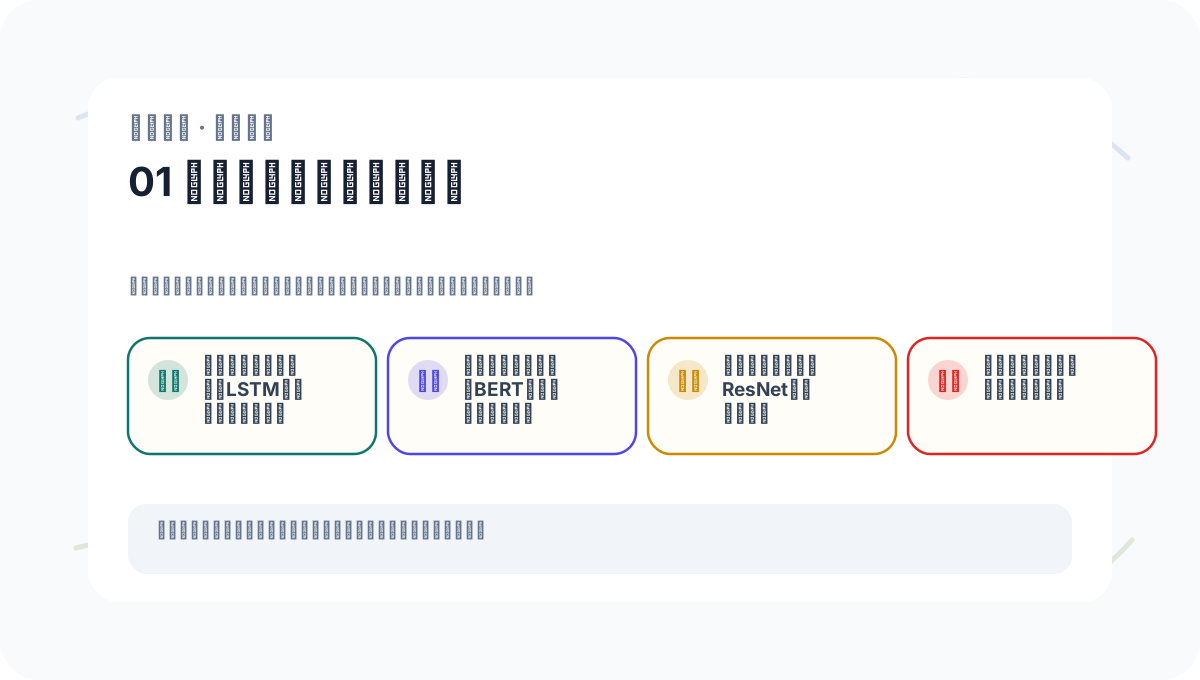
When practicing “Introduction: Overview of Neural Networks”, write the input conditions, processing steps, and observable outcomes together—making future review faster and more systematic.
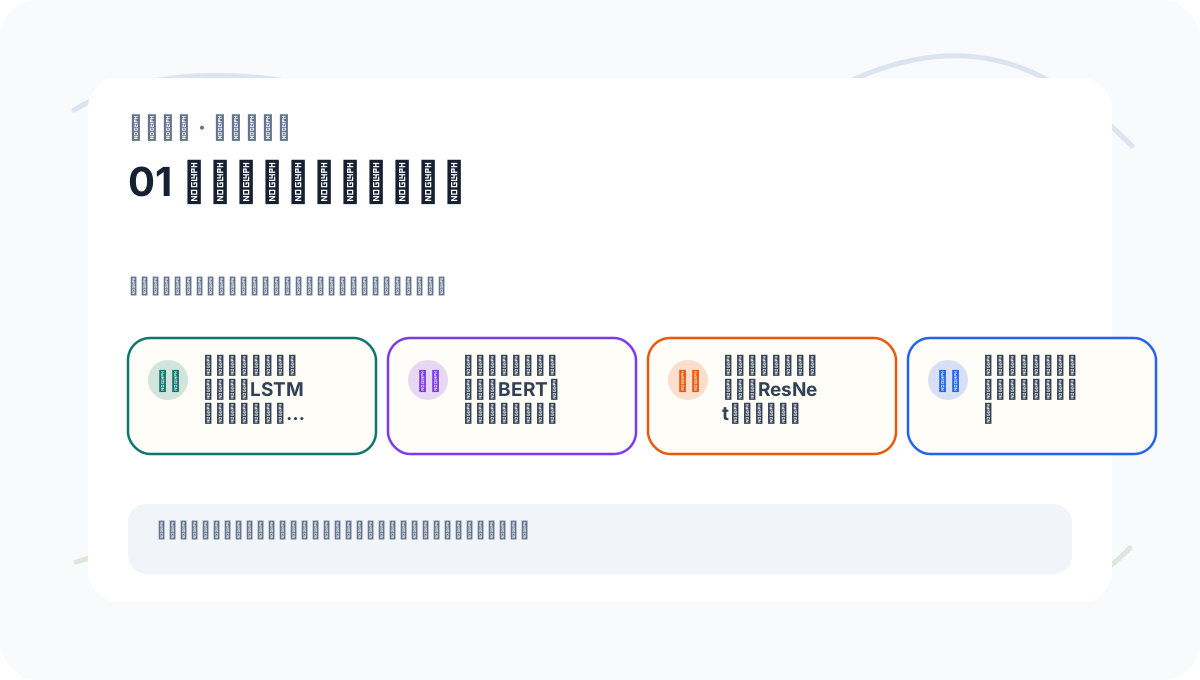
When reviewing “Introduction: Overview of Neural Networks”, place key concepts, procedural steps, and observable outcomes on the same page for efficient consolidation.
In summary, deep learning networks attract widespread attention due to their powerful feature-learning capabilities and broad applicability. Next, we will explore how these networks perform—and how they’re practically deployed—in real-world scenarios.
Apply This Lesson
Turn this article into AI software, model, API, and security decisions.
English Article FAQ
Use this article as evidence before choosing AI tools
How should I use this AI Tutorials article?
Use it as the implementation or learning layer, then connect the idea to AI software buyer guides, tool comparisons, benchmarks, API choices, and security checks before making a production decision.
Is this English article different from the Chinese original?
The English edition is localized for global AI readers while preserving the original diagrams, screenshots, prompts, code examples, and source context from the Chinese article.
What should I read after Introduction to Neural Networks?
Continue with AI Software Buyer Guides, AI Tools Workbench, Best AI Coding Agents, AI Model Benchmarks, OpenAI vs Anthropic API, or LLM Security Tools depending on the decision you need to make.
Can this article alone choose an AI product or model?
No. Treat the article as evidence and context, then validate fit with pricing, privacy requirements, integration effort, benchmark results, workflow tests, and fallback planning.
Continue