English translation
Initialize BERT tokenizer
AI Article Decision Snapshot
Turn the lesson into workflow, model, budget, and security checks before choosing tools.
Use this quick snapshot before leaving the article. It keeps the next search tied to practical AI software, model/API, cost, privacy, and implementation questions.
Workflow fit
Identify the real job behind the article: coding, research, document review, support, analytics, content, or internal automation.
Model or tool decision
Decide whether the next step is a software shortlist, an AI tool comparison, an API platform choice, or a model benchmark.
Budget and usage signal
Estimate seats, API calls, prompt volume, retries, review time, and fallback work before assuming the workflow is cheap.
Security and privacy review
Check whether source code, customer data, private documents, prompts, logs, or embeddings will enter the AI workflow.
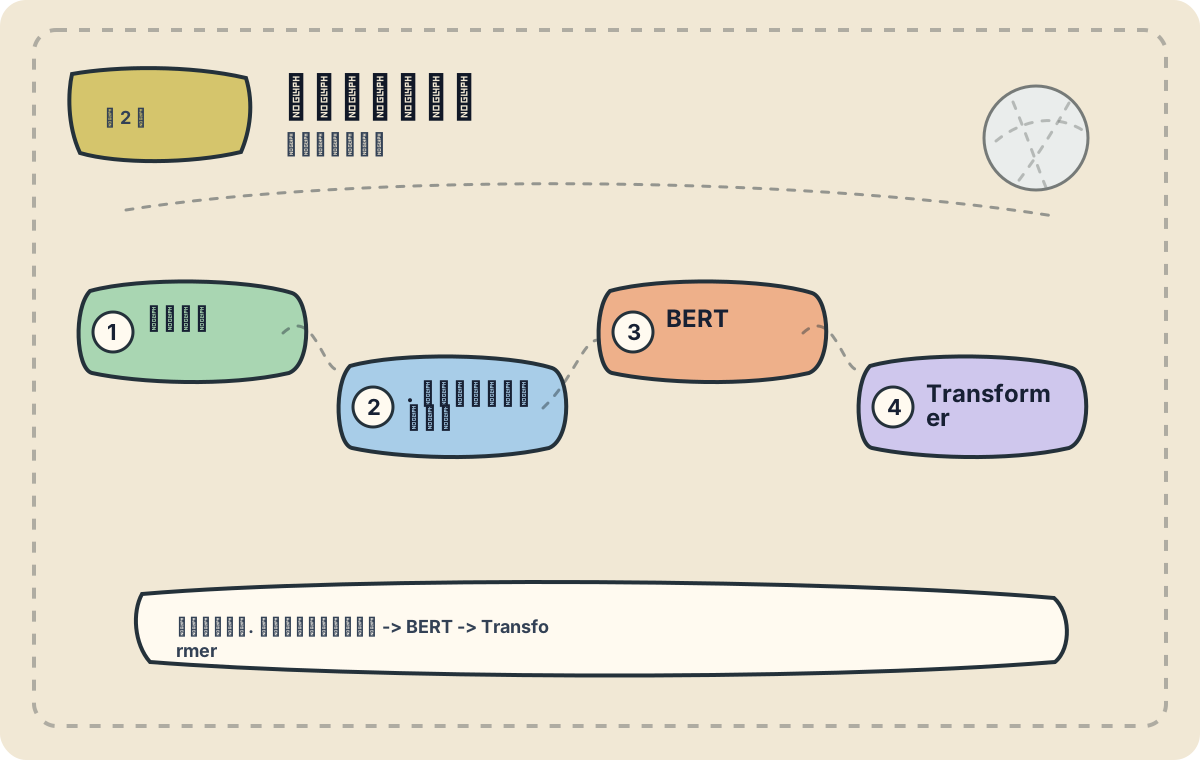
You can treat this as a small-model decomposition exercise: first identify the problem it solves; then examine how data flows into the network; finally, inspect the output format and evaluation methodology. This article focuses specifically on application scenarios. We begin by verifying whether the task truly aligns with the chosen network architecture—then assess data scale, deployment cost, and performance boundaries.
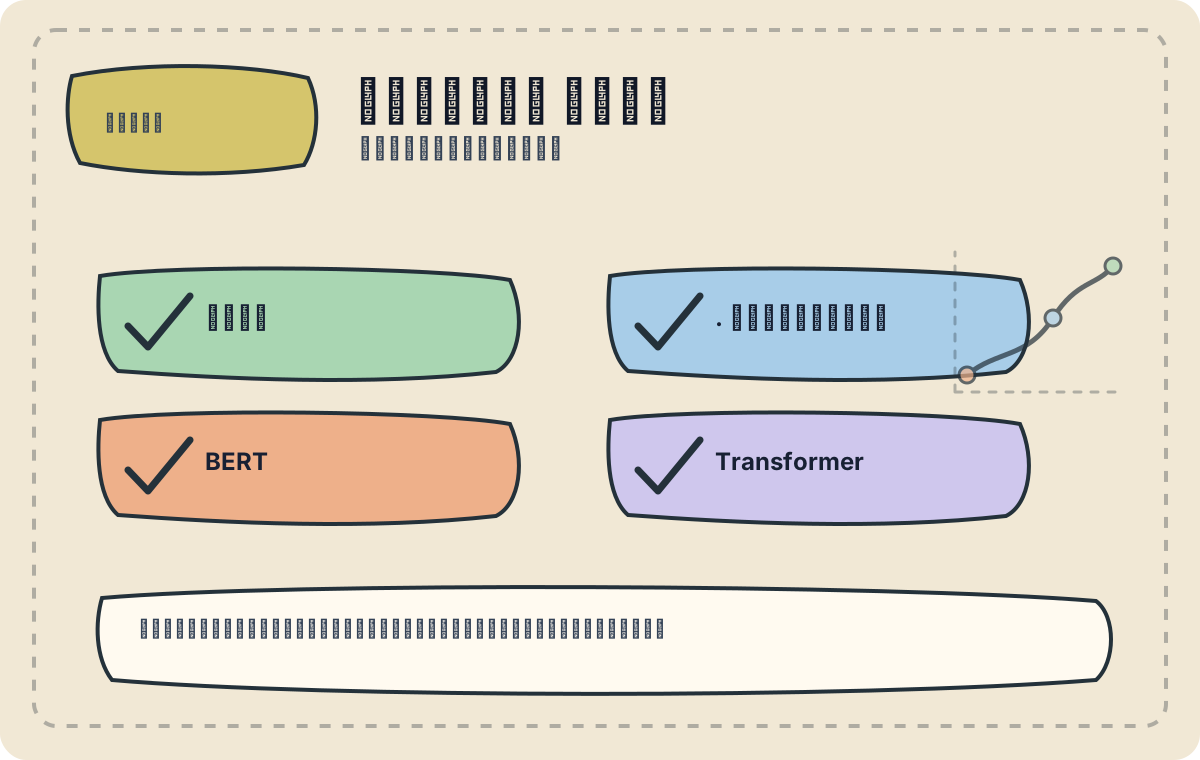
I write down the input, core modules, output, and evaluation metrics on paper. Connecting these four points helps make the code and concepts in the article significantly easier to understand.
With the rapid advancement of deep learning technologies, various neural network models have garnered widespread attention and adoption across multiple domains. In this discussion, we focus on practical application scenarios of mainstream network architectures—particularly their concrete use cases in speech recognition, computer vision, and natural language processing—to lay essential groundwork for the upcoming section, “LSTM: A Deep Dive into Principles.”
1. Applications in Natural Language Processing
BERT
BERT (Bidirectional Encoder Representations from Transformers) is a powerful pre-trained language representation model widely used in tasks such as sentiment analysis, question answering, and sentence classification. For instance, in sentiment analysis, BERT leverages contextual understanding to accurately determine the emotional polarity of text. Specifically, its implementation in sentiment analysis proceeds as follows:

When reading about application scenarios, start by clearly articulating the input materials, processing steps, output format, and acceptance criteria. With those defined, comparing different network architectures becomes much clearer—revealing precisely which part of the pipeline each architecture addresses.
from transformers import BertTokenizer, BertForSequenceClassification
import torch

# Initialize BERT tokenizer
tokenizer = BertTokenizer.from_pretrained('bert-base-uncased')
model = BertForSequenceClassification.from_pretrained('bert-base-uncased')

# Input text
inputs = tokenizer("I love this product!", return_tensors="pt")
# Model inference
outputs = model(**inputs)
Transformer
The Transformer architecture excels particularly in long-text generation and machine translation tasks. Systems like Google Translate leverage Transformer for highly efficient translation. For example, Transformer captures long-range dependencies within sentences more precisely—thereby significantly improving translation quality.
2. Applications in Computer Vision
ResNet
ResNet (Residual Network) introduces residual connections to mitigate the vanishing gradient problem in deep networks, making it widely applicable to image classification, object detection, and beyond. Notably, ResNet achieved breakthrough results in the ImageNet image classification competition, demonstrating exceptional capability in handling complex visual data.
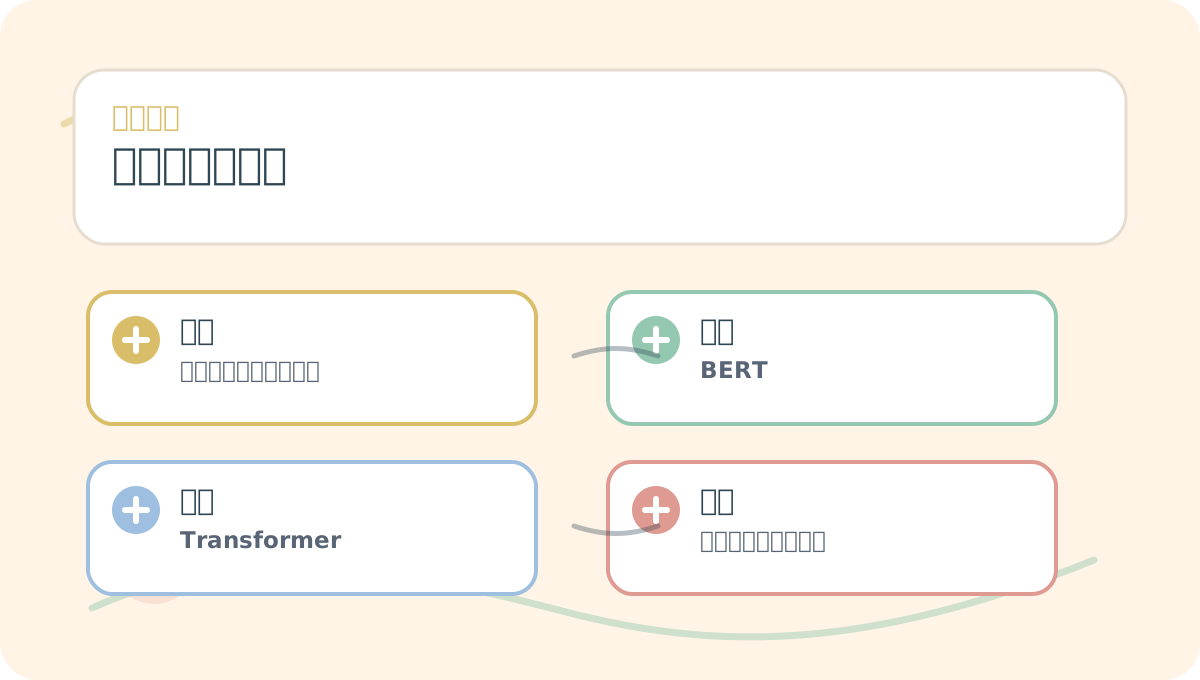
When studying “Application Scenarios in the Introduction,” begin with a small, reproducible scenario you’re familiar with. Then explore related concepts and practice steps. After reading, try retelling the material using your own example.
import torchvision.models as models

# Load pre-trained ResNet model
resnet = models.resnet50(pretrained=True)
YOLO
YOLO (You Only Look Once) is a real-time object detection system capable of simultaneously detecting and localizing multiple objects with high accuracy. It is widely deployed in autonomous driving and surveillance systems—enhancing both safety and operational efficiency through real-time scene understanding.
# Encapsulated YOLOv3 detection model
from PIL import Image
import cv2

def detect_objects(image_path):
    # YOLO detection logic goes here
    pass
3. Applications of Generative Adversarial Networks
GAN
GAN (Generative Adversarial Network) demonstrates remarkable capabilities in image generation, image restoration, and data augmentation. For example, in image generation tasks, GANs synthesize high-resolution images and find applications in digital art creation, entertainment, and more.
import torch
from torch import nn

# Minimal GAN architecture
class Generator(nn.Module):
    def __init__(self):
        super(Generator, self).__init__()
        # Generator architecture definition
        pass

class Discriminator(nn.Module):
    def __init__(self):
        super(Discriminator, self).__init__()
        # Discriminator architecture definition
        pass
CycleGAN
CycleGAN is an unsupervised image-to-image translation technique enabling style transfer between distinct visual domains—e.g., converting photographs into painting-like renditions. It has broad applications in artistic style transfer and image enhancement, greatly expanding creative possibilities for digital artists.
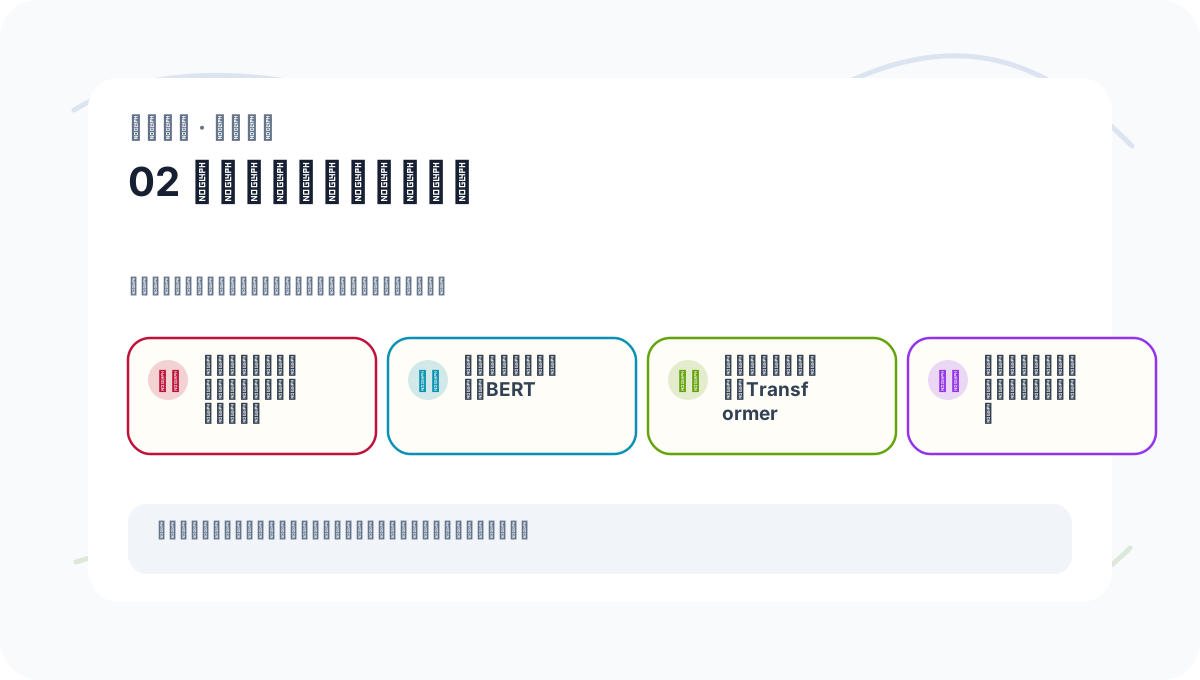
After completing “Introduction: Application Scenarios,” try applying the framework to a new scenario of your own—focusing especially on whether the input, processing, and output align coherently.
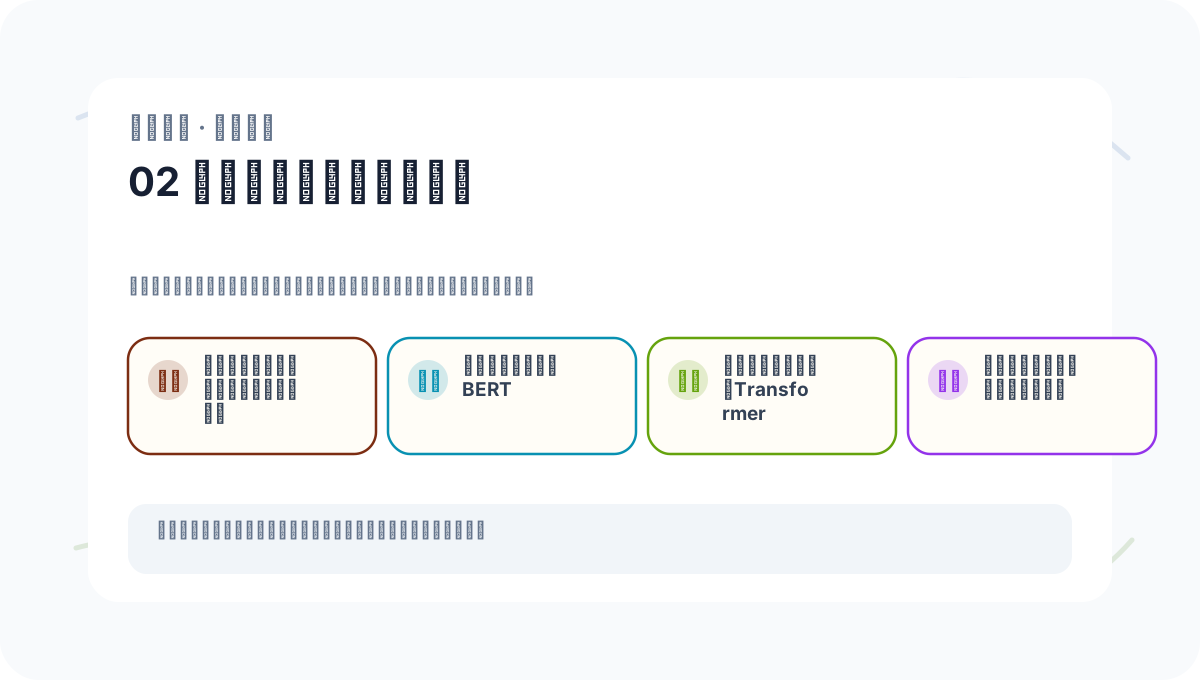
To apply “Introduction: Application Scenarios” to your own project, start by narrowing the scope—validate just one critical decision point first.
Summary
Through the above application examples, we observe how diverse deep learning models are deployed across their respective domains. These cases not only highlight the rich variety and functional power of modern neural architectures but also pave the way for our deeper exploration of LSTM—particularly its principles and unique advantages in time-series analysis. In the next section, we will delve into how LSTMs effectively model sequential data, such as natural language and financial time series.
Apply This Lesson
Turn this article into AI software, model, API, and security decisions.
English Article FAQ
Use this article as evidence before choosing AI tools
How should I use this AI Tutorials article?
Use it as the implementation or learning layer, then connect the idea to AI software buyer guides, tool comparisons, benchmarks, API choices, and security checks before making a production decision.
Is this English article different from the Chinese original?
The English edition is localized for global AI readers while preserving the original diagrams, screenshots, prompts, code examples, and source context from the Chinese article.
What should I read after Initialize BERT tokenizer?
Continue with AI Software Buyer Guides, AI Tools Workbench, Best AI Coding Agents, AI Model Benchmarks, OpenAI vs Anthropic API, or LLM Security Tools depending on the decision you need to make.
Can this article alone choose an AI product or model?
No. Treat the article as evidence and context, then validate fit with pricing, privacy requirements, integration effort, benchmark results, workflow tests, and fallback planning.
Continue