English translation
Lightweight Inception Architecture
AI Article Decision Snapshot
Turn the lesson into workflow, model, budget, and security checks before choosing tools.
Use this quick snapshot before leaving the article. It keeps the next search tied to practical AI software, model/API, cost, privacy, and implementation questions.
Workflow fit
Identify the real job behind the article: coding, research, document review, support, analytics, content, or internal automation.
Model or tool decision
Decide whether the next step is a software shortlist, an AI tool comparison, an API platform choice, or a model benchmark.
Budget and usage signal
Estimate seats, API calls, prompt volume, retries, review time, and fallback work before assuming the workflow is cheap.
Security and privacy review
Check whether source code, customer data, private documents, prompts, logs, or embeddings will enter the AI workflow.
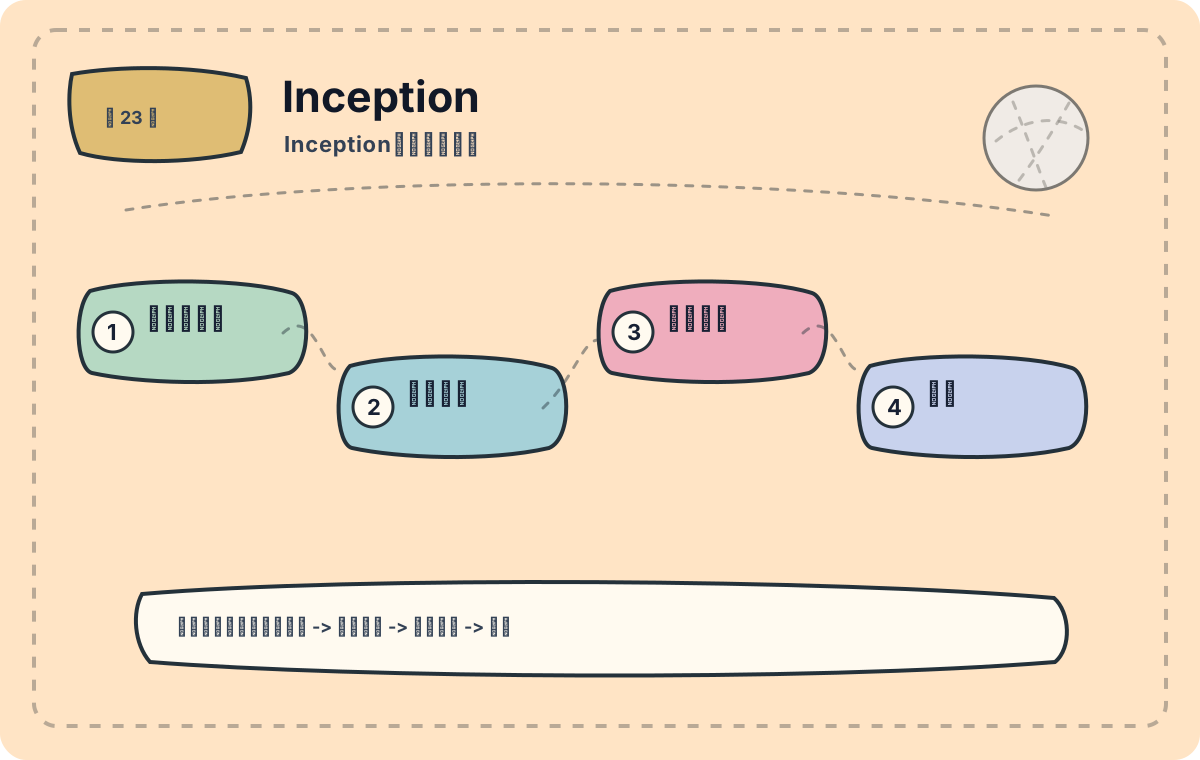
The core idea behind Inception is to enable the network to simultaneously capture features at multiple scales—and then concatenate the results. This architecture serves as an excellent case study for understanding how multi-branch structures can effectively control computational cost. This article focuses on structure: we’ll first clearly map out the data flow, key modules, and output layer—then revisit the underlying formulas or implementation code.
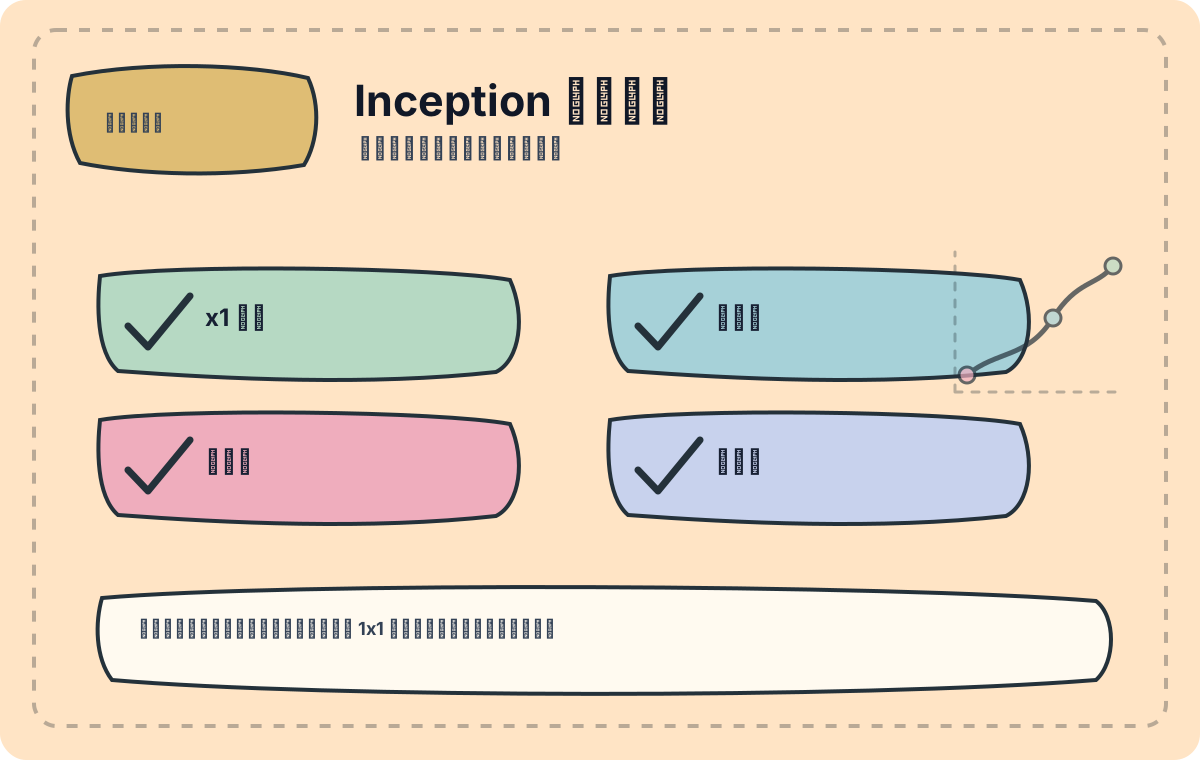
We’ll verify whether outputs from all branches have consistent spatial dimensions—and whether the 1×1 convolutions truly reduce downstream computation.
In the previous article, we discussed the advantages of the Transformer model, especially its broad applicability in natural language processing and computer vision. In this article, we shift our focus to the lightweight design of the Inception network—exploring how to reduce its computational complexity and memory footprint without sacrificing performance.
Overview of the Inception Network
The Inception network is a deep convolutional neural network originally designed to improve accuracy in image classification tasks. It achieves this by combining convolutional kernels of varying sizes with pooling operations—enabling the network to adaptively learn diverse feature representations. Its fundamental building block—the Inception module—applies different convolutional operations in parallel at the same network depth, then concatenates the resulting feature maps.
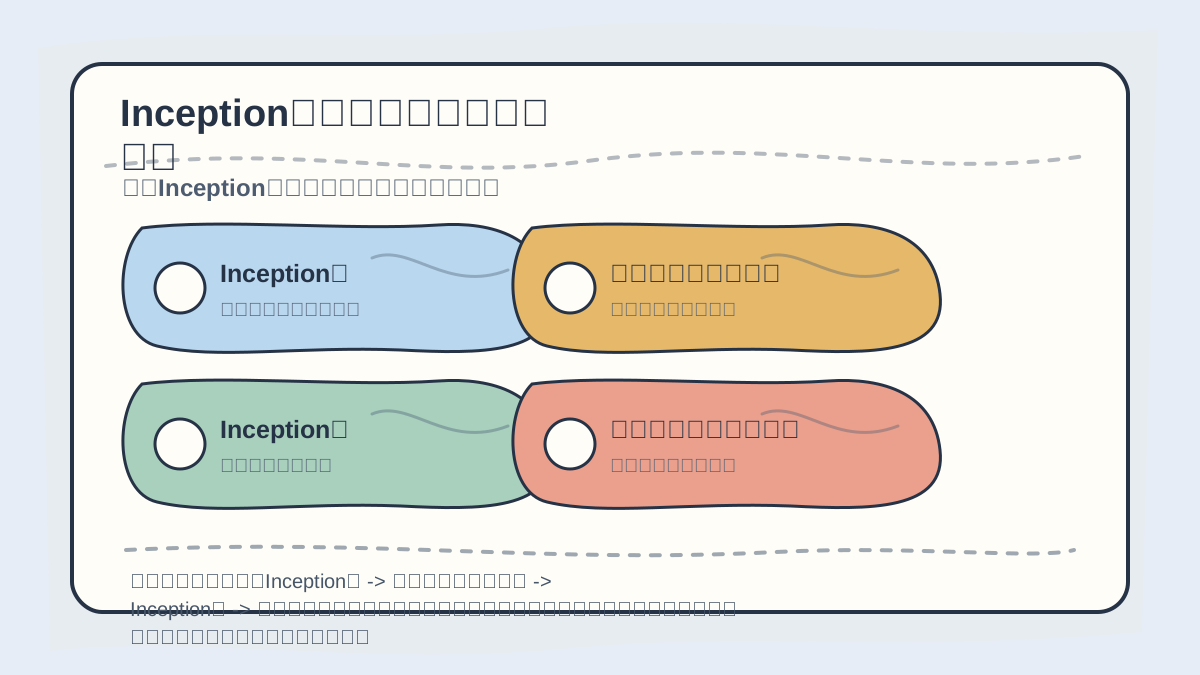
While reading this article, treat the sequence “Inception network → importance of lightweight design → Inception network → adoption of depthwise separable convolutions” as a verification checklist: first align the object, steps, and evidence; then return to concrete examples, code, or metrics for validation.
Importance of Lightweight Design
As deep learning applications diversify—especially on mobile devices and embedded systems—the demand for models with high computational efficiency and low memory requirements has intensified. Consequently, lightweight model design has become critically important. Its primary goals are:
- Reduced computational load: Fewer parameters and lower arithmetic complexity.
- Lower memory footprint: Reduced memory consumption during inference.
- Faster inference speed: Improved latency to meet real-time application requirements.
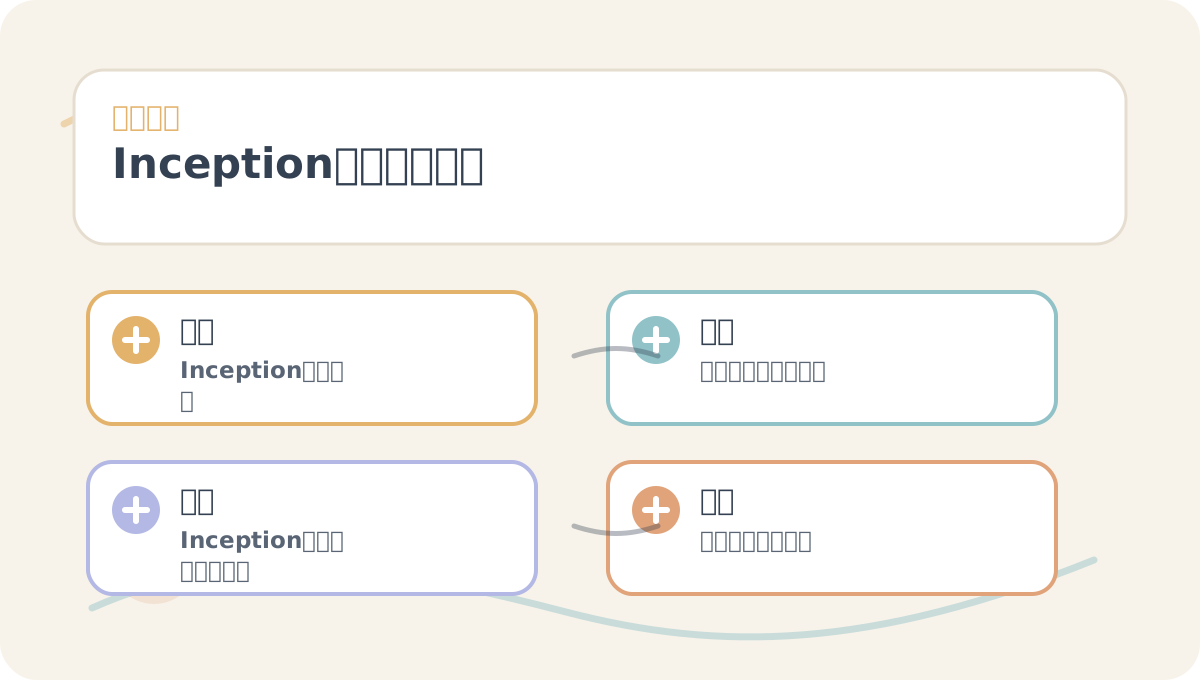
When reading “Inception’s Lightweight Design”, treat the accompanying figures as a navigational map: first grasp the overall workflow order; then examine why each step is taken; finally, verify boundary conditions and edge cases.
Lightweight Design Strategies for the Inception Network
To lightweight the Inception network, we can adopt several complementary strategies:
1. Depthwise Separable Convolutions
Depthwise separable convolution decomposes a standard convolution into two sequential steps:
- First, a depthwise convolution applies a single filter per input channel (i.e., channel-wise spatial filtering);
- Then, a pointwise convolution (1×1 convolution) projects the depthwise outputs across channels.
This decomposition significantly reduces both computational cost and parameter count.
Example:
Below is a simplified Inception module implemented using depthwise separable convolutions:
import tensorflow as tf
from tensorflow.keras.layers import Conv2D, DepthwiseConv2D, AveragePooling2D, concatenate

def inception_module(input_tensor):
    # 1x1 convolution
    conv1x1 = Conv2D(32, kernel_size=(1, 1), padding='same', activation='relu')(input_tensor)

    # 3x3 depthwise separable convolution
    depthwise_conv3x3 = DepthwiseConv2D(kernel_size=(3, 3), padding='same', activation='relu')(conv1x1)
    conv3x3 = Conv2D(64, kernel_size=(1, 1), padding='same', activation='relu')(depthwise_conv3x3)

    # 5x5 depthwise separable convolution
    depthwise_conv5x5 = DepthwiseConv2D(kernel_size=(5, 5), padding='same', activation='relu')(conv1x1)
    conv5x5 = Conv2D(64, kernel_size=(1, 1), padding='same', activation='relu')(depthwise_conv5x5)

    # Average pooling branch
    pool = AveragePooling2D(pool_size=(3, 3), strides=1, padding='same')(input_tensor)

    # Concatenate all branches along the channel axis
    return concatenate([conv1x1, conv3x3, conv5x5, pool], axis=-1)
2. Smaller Kernel Sizes
To further reduce computation and memory usage, consider replacing larger kernels (e.g., 7×7) with smaller ones (e.g., 3×3 or 5×5) in lightweight Inception variants.
3. Dimensionality Reduction via 1×1 Convolutions
Applying 1×1 convolutions within each Inception module compresses channel dimensions before expensive spatial convolutions—reducing downstream computation while preserving representational richness.
4. Adjusting Network Depth
Reducing the total number of layers (network depth) is another effective way to shrink model size. Though this may slightly degrade accuracy, it often yields favorable trade-offs for latency-critical applications—such as real-time inference on mobile devices.
Challenges in Lightweight Design
A central challenge lies in striking the right balance between model performance and computational efficiency. Aggressive compression risks losing discriminative features or causing significant drops in classification accuracy—we must therefore carefully monitor accuracy–efficiency trade-offs throughout the design process.
If you haven’t fully internalized “Inception’s Lightweight Design”, revisit this card and walk through its four actions step-by-step.
When reviewing “Inception’s Lightweight Design”, avoid jumping straight into large-scale projects. Instead, start with a simple, self-contained example to confirm whether the core logic is clear and well-grounded.
Conclusion
Lightweight design of the Inception network forms a foundational pillar for deploying deep learning models efficiently in practice. By leveraging techniques such as depthwise separable convolutions, smaller kernels, dimensionality reduction via 1×1 convolutions, and strategic depth adjustment, we can substantially improve computational efficiency and inference speed—without compromising essential performance. In the next article, we will explore further optimization strategies for the Inception network—aiming to broaden its practical applicability while maintaining high accuracy.
Apply This Lesson
Turn this article into AI software, model, API, and security decisions.
English Article FAQ
Use this article as evidence before choosing AI tools
How should I use this AI Tutorials article?
Use it as the implementation or learning layer, then connect the idea to AI software buyer guides, tool comparisons, benchmarks, API choices, and security checks before making a production decision.
Is this English article different from the Chinese original?
The English edition is localized for global AI readers while preserving the original diagrams, screenshots, prompts, code examples, and source context from the Chinese article.
What should I read after Lightweight Inception Architecture?
Continue with AI Software Buyer Guides, AI Tools Workbench, Best AI Coding Agents, AI Model Benchmarks, OpenAI vs Anthropic API, or LLM Security Tools depending on the decision you need to make.
Can this article alone choose an AI product or model?
No. Treat the article as evidence and context, then validate fit with pricing, privacy requirements, integration effort, benchmark results, workflow tests, and fallback planning.
Continue