English translation
Optimizing the Inception Architecture
AI Article Decision Snapshot
Turn the lesson into workflow, model, budget, and security checks before choosing tools.
Use this quick snapshot before leaving the article. It keeps the next search tied to practical AI software, model/API, cost, privacy, and implementation questions.
Workflow fit
Identify the real job behind the article: coding, research, document review, support, analytics, content, or internal automation.
Model or tool decision
Decide whether the next step is a software shortlist, an AI tool comparison, an API platform choice, or a model benchmark.
Budget and usage signal
Estimate seats, API calls, prompt volume, retries, review time, and fallback work before assuming the workflow is cheap.
Security and privacy review
Check whether source code, customer data, private documents, prompts, logs, or embeddings will enter the AI workflow.
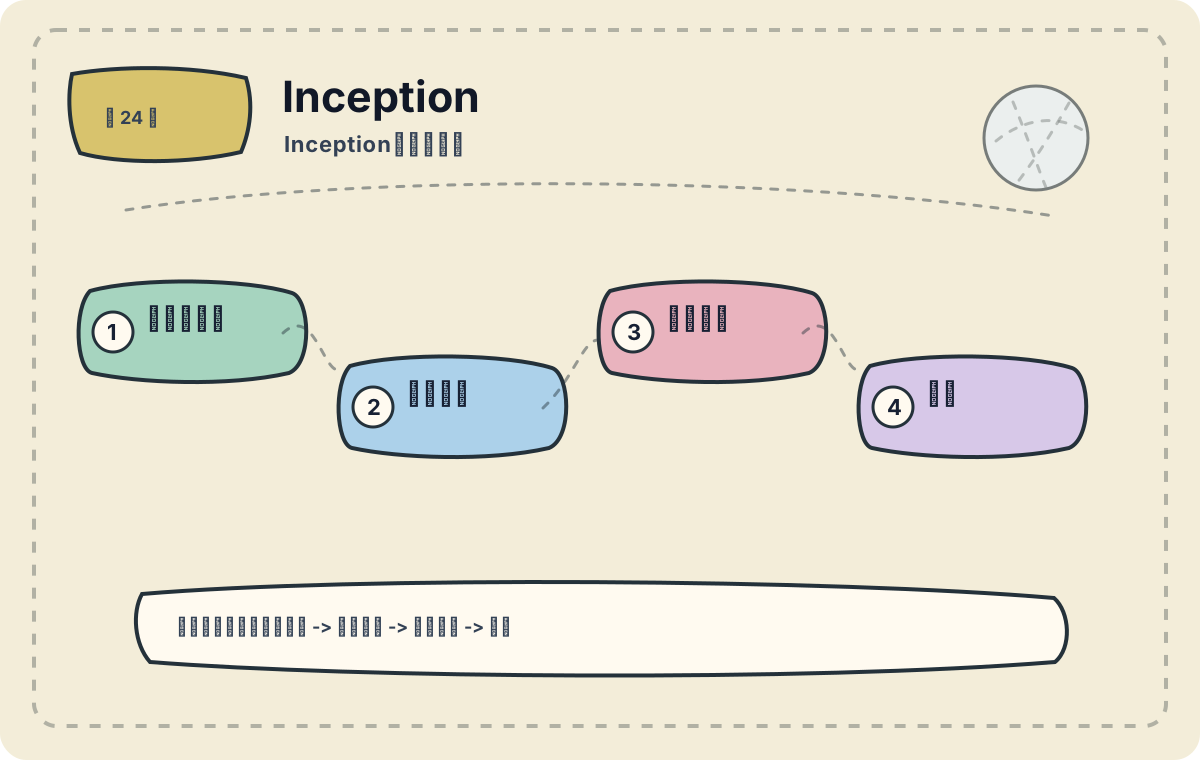
The core idea of Inception is to enable the network to simultaneously process features at multiple scales and then concatenate the results. It serves as an excellent case study for understanding how multi-branch architectures control computational cost. This article focuses on training: data preprocessing, loss functions, optimizers, and logging must form a closed loop—only then can training outcomes be fully audited and reproduced.

I will verify whether the output dimensions across all branches are consistent, and whether the 1×1 convolutions genuinely reduce subsequent computation.
In the previous article, we explored lightweight design strategies for the Inception model—streamlining its architecture to improve computational efficiency and reduce model size. This line of research responds directly to practical demands of deep learning, especially in mobile and edge computing scenarios. In this article, we focus specifically on optimization strategies for the Inception model to further enhance its performance.
Overview of the Inception Model
Inception (GoogLeNet) fundamentally reshaped how convolutional neural networks (CNNs) are constructed. By adopting a “modular” design—extracting multi-level features through parallel pathways—it expands both the depth and width of the network. However, as network depth increases, training complexity rises accordingly—necessitating targeted optimization strategies to address potential computational and performance bottlenecks.
Optimization Strategies


After reading “Optimization Strategies for Inception,” begin by walking through a small, self-contained example end-to-end. Then assess which steps you can already execute independently.
At this point, you may consolidate “Optimization Strategies for Inception” into a retrospective checklist: first clarify the main workflow, then validate it using a small task.
1. Network Architecture Optimization
One of the most critical structural components of the Inception model is its “parallel convolution” operation. To further boost model performance, consider the following optimization strategies:
-
Introducing Macro-Level Parameter Sharing: Incorporating an attention mechanism enables the model to dynamically assign greater weight to more salient features across hierarchical layers—thereby enhancing representational capacity. In Inception, attention can be embedded into feature extraction across multiple parallel paths:
where denotes the weight assigned to the -th feature, and represents the feature extracted via the -th pathway.
-
Adopting Residual Connections: Residual connections alleviate training difficulties in deep networks. Inspired by ResNet, introducing shortcut residual connections within Inception modules improves trainability and classification accuracy.
2. Regularization Techniques
To strengthen generalization, incorporate the following regularization techniques during Inception training:
-
Batch Normalization: Insert batch normalization after each convolutional layer to mitigate internal covariate shift—accelerating convergence and improving overall performance.
-
Dropout: Adding dropout layers inside Inception modules effectively prevents overfitting. Dropout can be applied selectively—for instance, right before the final output layer:
x = Dropout(0.5)(x) # 50% dropout rate
3. Improving Training Efficiency
Efficient training remains a central challenge during optimization:

While reading this article, treat the sequence “Inception module → optimization strategies → architecture optimization → regularization techniques” as a verification thread: first identify the inputs, operations, and outputs; then cross-check against concrete examples, code snippets, or evaluation metrics.
-
Knowledge Distillation: Train a compact “student” model to mimic a larger, pre-trained “teacher” model—a proven method for boosting student performance. Using Inception as the teacher allows effective knowledge transfer to lighter-weight student models.
-
Data Augmentation: Apply data augmentation techniques—such as image rotation, scaling, and cropping—to increase training sample diversity. This helps the model learn more robust and invariant features.
4. Practical Example
The following example demonstrates how to implement an Inception module in Keras, incorporating several of the above optimization strategies:
You don’t need to absorb every detail of “Optimization Strategies for Inception” all at once. Start with a small, hands-on problem you can verify experimentally—then progressively fill in conceptual gaps using diagrams and explanatory text.
from keras.layers import Input, Conv2D, MaxPooling2D, AveragePooling2D, concatenate, Dropout, BatchNormalization
from keras.models import Model

def InceptionModule(x, filters):
    # Path 1
    path1 = Conv2D(filters[0], (1, 1), padding='same', activation='relu')(x)

    # Path 2
    path2 = Conv2D(filters[1], (1, 1), padding='same', activation='relu')(x)
    path2 = Conv2D(filters[2], (3, 3), padding='same', activation='relu')(path2)

    # Path 3
    path3 = Conv2D(filters[3], (1, 1), padding='same', activation='relu')(x)
    path3 = Conv2D(filters[4], (5, 5), padding='same', activation='relu')(path3)

    # Path 4
    path4 = AveragePooling2D((3, 3), strides=(1, 1), padding='same')(x)
    path4 = Conv2D(filters[5], (1, 1), padding='same', activation='relu')(path4)

    # Concatenate all paths
    output = concatenate([path1, path2, path3, path4], axis=-1)
    return output

input_tensor = Input(shape=(224, 224, 3))
x = InceptionModule(input_tensor, [32, 64, 64, 32, 32, 32])
x = Dropout(0.5)(x)
x = BatchNormalization()(x)
model = Model(inputs=input_tensor, outputs=x)

model.summary()
5. Conclusion
Through the optimization strategies outlined above, we preserve the structural advantages of the Inception model while significantly improving its training efficiency and performance. These approaches not only elevate model accuracy but also lay essential groundwork for future lightweight design efforts. In the next article, we will delve deeper into how MobileNet optimizes feature fusion—enabling even greater flexibility in real-world applications.
The Inception model excels at efficient feature extraction; as advanced optimization techniques are progressively integrated, their practical feasibility and effectiveness in deployment continue to grow. Future research will further advance along this trajectory.
Apply This Lesson
Turn this article into AI software, model, API, and security decisions.
English Article FAQ
Use this article as evidence before choosing AI tools
How should I use this AI Tutorials article?
Use it as the implementation or learning layer, then connect the idea to AI software buyer guides, tool comparisons, benchmarks, API choices, and security checks before making a production decision.
Is this English article different from the Chinese original?
The English edition is localized for global AI readers while preserving the original diagrams, screenshots, prompts, code examples, and source context from the Chinese article.
What should I read after Optimizing the Inception Architecture?
Continue with AI Software Buyer Guides, AI Tools Workbench, Best AI Coding Agents, AI Model Benchmarks, OpenAI vs Anthropic API, or LLM Security Tools depending on the decision you need to make.
Can this article alone choose an AI product or model?
No. Treat the article as evidence and context, then validate fit with pricing, privacy requirements, integration effort, benchmark results, workflow tests, and fallback planning.
Continue