English translation
39. Graph Neural Network Architectures
AI Article Decision Snapshot
Turn the lesson into workflow, model, budget, and security checks before choosing tools.
Use this quick snapshot before leaving the article. It keeps the next search tied to practical AI software, model/API, cost, privacy, and implementation questions.
Workflow fit
Identify the real job behind the article: coding, research, document review, support, analytics, content, or internal automation.
Model or tool decision
Decide whether the next step is a software shortlist, an AI tool comparison, an API platform choice, or a model benchmark.
Budget and usage signal
Estimate seats, API calls, prompt volume, retries, review time, and fallback work before assuming the workflow is cheap.
Security and privacy review
Check whether source code, customer data, private documents, prompts, logs, or embeddings will enter the AI workflow.
Graph neural networks (GNNs) process relational data. The core idea is not merely reshaping tabular data—but enabling nodes to exchange information via edges. This article focuses on architecture. We’ll first clarify the data flow, key modules, and output layer—then revisit the underlying formulas or code.

I begin by explicitly identifying nodes, edges, and target labels—then decide whether the task is node classification, link prediction, or graph-level classification. Different tasks entail distinct evaluation strategies.
Graph Neural Networks (GNNs) are a class of deep learning models designed specifically for graph-structured data. They are widely applied in domains such as social networks, recommendation systems, and bioinformatics. Unlike traditional neural networks, GNNs effectively capture both local relationships between nodes and the global structural properties of the network.
1. Fundamental Concepts of Graph Neural Networks
In a graph, nodes represent entities, and edges represent relationships among them. GNNs learn node representations through a message-passing mechanism. A typical GNN pipeline consists of the following steps:
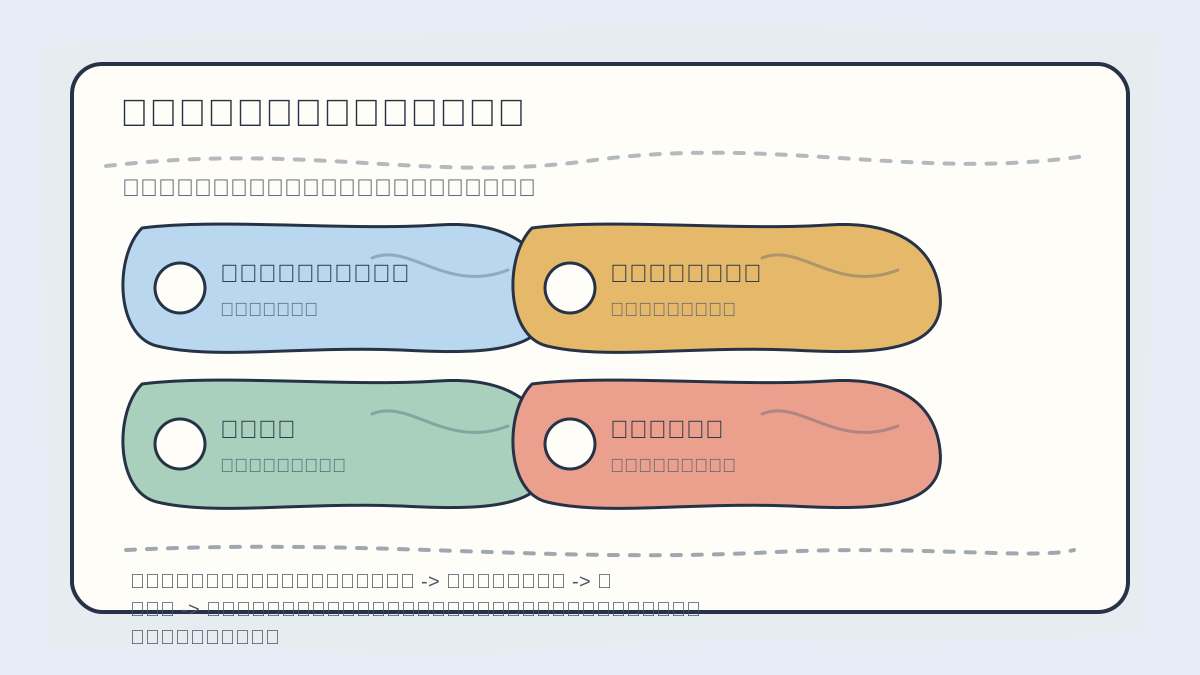
While reading this article, treat the progression “Fundamental Concepts → GNN Architecture → Basic Architectures → Advanced Architectures” as a verification checklist: First distinguish the main topic, logical path, and validation points—then return to concrete examples, code, or metrics for cross-checking.
- Message Passing: Each node receives information from its neighboring nodes.
- Aggregation: The node updates its state representation based on the received messages.
- Update: Finally, the node refines its representation using both its own current state and the aggregated neighbor information.
This iterative process enables GNNs to progressively capture increasingly complex structural patterns within the graph.
2. Architectures of Graph Neural Networks
2.1 Basic Architectures
When reading “Graph Neural Network Model Architecture”, treat the accompanying diagrams as navigational aids: First grasp the overall workflow order; then understand why each step is designed that way; finally verify boundary conditions and assumptions.
A foundational GNN architecture is the Graph Convolutional Network (GCN). Its core idea is to extract features via graph convolution operations. The layer-wise update rule is given by:
where denotes the node feature matrix at layer , is the graph’s adjacency matrix, is the degree matrix, is a learnable weight matrix, and is an activation function.
2.2 More Advanced Architectures
Beyond GCN, subsequent research has introduced numerous GNN variants tailored to diverse application needs. Examples include:
- Graph Attention Network (GAT): Uses attention mechanisms to assign different weights to neighbors during aggregation—allowing heterogeneous influence from different neighbors.
- GraphSAGE: Samples a fixed-size neighborhood for each node to accelerate training—especially effective for large-scale graphs.
import torch
import torch.nn as nn
from torch_geometric.nn import GCNConv

class GCN(nn.Module):
    def __init__(self, num_features, num_classes):
        super(GCN, self).__init__()
        self.conv1 = GCNConv(num_features, 16)
        self.conv2 = GCNConv(16, num_classes)

    def forward(self, data):
        x, edge_index = data.x, data.edge_index
        x = self.conv1(x, edge_index).relu()
        x = self.conv2(x, edge_index)
        return x
This code implements a simple two-layer GCN for node classification. torch_geometric is a widely used library for handling graph-structured data in PyTorch.
3. Application Cases
3.1 Social Network Analysis
Consider a social network graph where nodes represent users and edges represent interactions (e.g., likes, shares, or follows). Using GNNs, we can predict user interests or behaviors. For instance, by training on historical interaction patterns, a GNN can recommend personalized content to users.
3.2 Molecular Graph Classification
In chemistry, molecules can be naturally represented as graphs: atoms serve as nodes, and chemical bonds as edges. GNNs effectively learn such structural representations and support classification or regression tasks—accelerating applications like novel drug discovery.
If you haven’t yet fully internalized “Graph Neural Network Model Architecture”, revisit this card and walk through its four actions step-by-step.
When reviewing “Graph Neural Network Model Architecture”, avoid launching a full-scale project upfront. Instead, start with one simple example to confirm whether the core logic is clear.
4. Summary and Outlook
Graph neural networks provide powerful, principled tools for modeling graph-structured data—and both their architectural design and application scope continue to evolve rapidly. As underlying technologies mature, we anticipate GNNs will play increasingly pivotal roles across ever more complex real-world tasks.
In the next tutorial, we will delve into performance evaluation for graph neural networks—including how to design rigorous experiments and select appropriate evaluation metrics.
Apply This Lesson
Turn this article into AI software, model, API, and security decisions.
English Article FAQ
Use this article as evidence before choosing AI tools
How should I use this AI Tutorials article?
Use it as the implementation or learning layer, then connect the idea to AI software buyer guides, tool comparisons, benchmarks, API choices, and security checks before making a production decision.
Is this English article different from the Chinese original?
The English edition is localized for global AI readers while preserving the original diagrams, screenshots, prompts, code examples, and source context from the Chinese article.
What should I read after 39. Graph Neural Network Architectures?
Continue with AI Software Buyer Guides, AI Tools Workbench, Best AI Coding Agents, AI Model Benchmarks, OpenAI vs Anthropic API, or LLM Security Tools depending on the decision you need to make.
Can this article alone choose an AI product or model?
No. Treat the article as evidence and context, then validate fit with pricing, privacy requirements, integration effort, benchmark results, workflow tests, and fallback planning.
Continue