English translation
Simplified Capsule Network framework
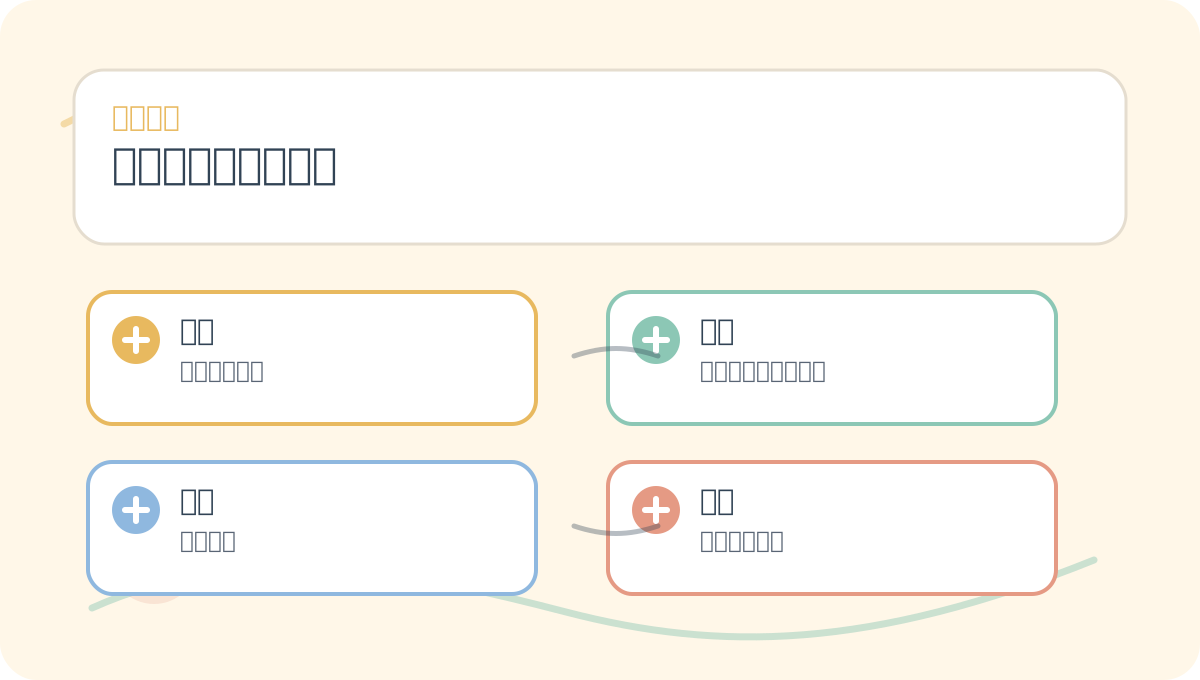
AI Article Decision Snapshot
Turn the lesson into workflow, model, budget, and security checks before choosing tools.
Use this quick snapshot before leaving the article. It keeps the next search tied to practical AI software, model/API, cost, privacy, and implementation questions.
Workflow fit
Identify the real job behind the article: coding, research, document review, support, analytics, content, or internal automation.
Model or tool decision
Decide whether the next step is a software shortlist, an AI tool comparison, an API platform choice, or a model benchmark.
Budget and usage signal
Estimate seats, API calls, prompt volume, retries, review time, and fallback work before assuming the workflow is cheap.
Security and privacy review
Check whether source code, customer data, private documents, prompts, logs, or embeddings will enter the AI workflow.
Capsule networks attempt to represent part-whole relationships using vectors. Rather than merely detecting whether features are present, they also encode how those features are oriented and assembled. This article focuses on architectural structure: we first clarify the data flow, key modules, and output layer—then revisit the underlying formulas or code.

I’ll examine capsule dimensionality, number of routing iterations, and squash outputs. Too many routing iterations slow down training; too few may prevent learning meaningful hierarchical relationships.
In the previous article, we explored performance evaluation of Graph Neural Networks, establishing a solid foundation for understanding the technical underpinnings of different architectures. This article introduces key technical components of Capsule Networks (CapsNets), clarifying how they operate and why they offer advantages—laying essential groundwork for subsequent practical case studies.
Overview of Capsule Networks
The Capsule Network (CapsNet) is a novel neural network architecture proposed by Geoffrey Hinton and colleagues in 2017. Unlike conventional Convolutional Neural Networks (CNNs), CapsNets aim to better capture and exploit spatial relationships—especially for object recognition under pose variations and deformations. In CapsNets, a capsule is a group of neurons acting as a unified signal-processing unit that collectively detects a specific feature.
At its core, CapsNet uses activation magnitude (representing presence probability) and vector direction (encoding properties such as orientation, pose, or scale) to preserve relational information across layers—thereby mitigating information loss during deep processing.
Core Construction Techniques
1. Capsule Structure
In a capsule network, each capsule outputs a vector representing both the existence and attributes of a feature. Suppose a capsule outputs vector : its norm indicates the likelihood of the feature’s presence, while its direction encodes other properties—e.g., orientation, pose, or scale. The output vector is typically computed as:
where is a weighted sum derived from transformed inputs.
2. Dynamic Routing Algorithm
Dynamic routing is the cornerstone of CapsNets—it governs how information flows between capsules across layers. The process unfolds in roughly three steps:
- Initialize weights: Each capsule maintains a weight matrix connecting it to all capsules in the preceding layer.
- Compute coupling coefficients: Use the
softmaxfunction to compute normalized weights () indicating how strongly capsule in layer contributes to capsule in layer . - Update output capsules: Iteratively refine predictions so that higher-level capsules reinforce representations consistent with their input votes.
The final dynamic routing update is expressed as:
where denotes the prediction vector from capsule to capsule , and are the learned coupling coefficients.
3. Squash Activation Function
Capsule networks introduce a specialized activation function—the Squash function—defined as:
This function compresses the vector’s norm into the interval while preserving its direction—making it ideal for representing feature instantiation probability and spatial configuration.
Case Study

While reading this article, treat the sequence “Capsule Network Overview → Construction Techniques → Capsule Structure → Dynamic Routing Algorithm” as a verification checklist: first align the objects, steps, and evidence; then return to concrete examples, code snippets, or evaluation metrics for validation.
Image Classification Using Capsule Networks
Suppose we apply a capsule network to handwritten digit classification (e.g., MNIST). Below is a simplified implementation skeleton:
import torch
import torch.nn as nn
import torch.nn.functional as F

class CapsuleLayer(nn.Module):
    # Define a capsule layer
    def __init__(self, num_capsules, num_routes, in_dim, out_dim):
        super(CapsuleLayer, self).__init__()
        self.num_capsules = num_capsules
        self.num_routes = num_routes
        self.W = nn.Parameter(torch.randn(num_capsules, num_routes, in_dim, out_dim))

    def forward(self, x):
        # Implement dynamic routing logic here
        pass  # Placeholder: actual routing algorithm to be implemented

# Simplified Capsule Network framework
class CapsuleNetwork(nn.Module):
    def __init__(self):
        super(CapsuleNetwork, self).__init__()
        # Define additional layers and integrate capsule layers

    def forward(self, x):
        # Execute forward pass
        pass  # Placeholder: forward propagation logic to be implemented

# Instantiate the model
model = CapsuleNetwork()

# At this point, the basic Capsule Network scaffold is complete;
# further functionality can now be added to support specific tasks.
Real-World Application Scenarios
Capsule networks excel in challenging domains such as pose estimation, 3D object classification, and image generation. Their ability to explicitly model spatial hierarchies enables robust performance on complex images—even under significant deformation, occlusion, or viewpoint changes.
After reading Key Technical Components of Capsule Networks, don’t stop at “I understand.” Instead, pick one step and implement it yourself—then document exactly where you get stuck. This hands-on reflection will make future learning more grounded and effective.

When reviewing Key Technical Components of Capsule Networks, place core concepts, procedural steps, and observable outcomes side-by-side on a single page for efficient consolidation.

When practicing Key Technical Components of Capsule Networks, write down the input conditions, processing actions, and observable results together—so you can efficiently recheck them later.
Summary and Outlook
A deep understanding of the key technical components of Capsule Networks lays a critical foundation for real-world applications. Their unique architecture—particularly vector-based feature representation and dynamic routing—confers distinct advantages over traditional CNNs in image recognition, especially when interpreting complex, multi-pose scenes. In the next article, we’ll explore concrete use cases demonstrating Capsule Networks’ performance in real-world settings.
Apply This Lesson
Turn this article into AI software, model, API, and security decisions.
English Article FAQ
Use this article as evidence before choosing AI tools
How should I use this AI Tutorials article?
Use it as the implementation or learning layer, then connect the idea to AI software buyer guides, tool comparisons, benchmarks, API choices, and security checks before making a production decision.
Is this English article different from the Chinese original?
The English edition is localized for global AI readers while preserving the original diagrams, screenshots, prompts, code examples, and source context from the Chinese article.
What should I read after Simplified Capsule Network framework?
Continue with AI Software Buyer Guides, AI Tools Workbench, Best AI Coding Agents, AI Model Benchmarks, OpenAI vs Anthropic API, or LLM Security Tools depending on the decision you need to make.
Can this article alone choose an AI product or model?
No. Treat the article as evidence and context, then validate fit with pricing, privacy requirements, integration effort, benchmark results, workflow tests, and fallback planning.
Continue