English translation
Example input
AI Article Decision Snapshot
Turn the lesson into workflow, model, budget, and security checks before choosing tools.
Use this quick snapshot before leaving the article. It keeps the next search tied to practical AI software, model/API, cost, privacy, and implementation questions.
Workflow fit
Identify the real job behind the article: coding, research, document review, support, analytics, content, or internal automation.
Model or tool decision
Decide whether the next step is a software shortlist, an AI tool comparison, an API platform choice, or a model benchmark.
Budget and usage signal
Estimate seats, API calls, prompt volume, retries, review time, and fallback work before assuming the workflow is cheap.
Security and privacy review
Check whether source code, customer data, private documents, prompts, logs, or embeddings will enter the AI workflow.
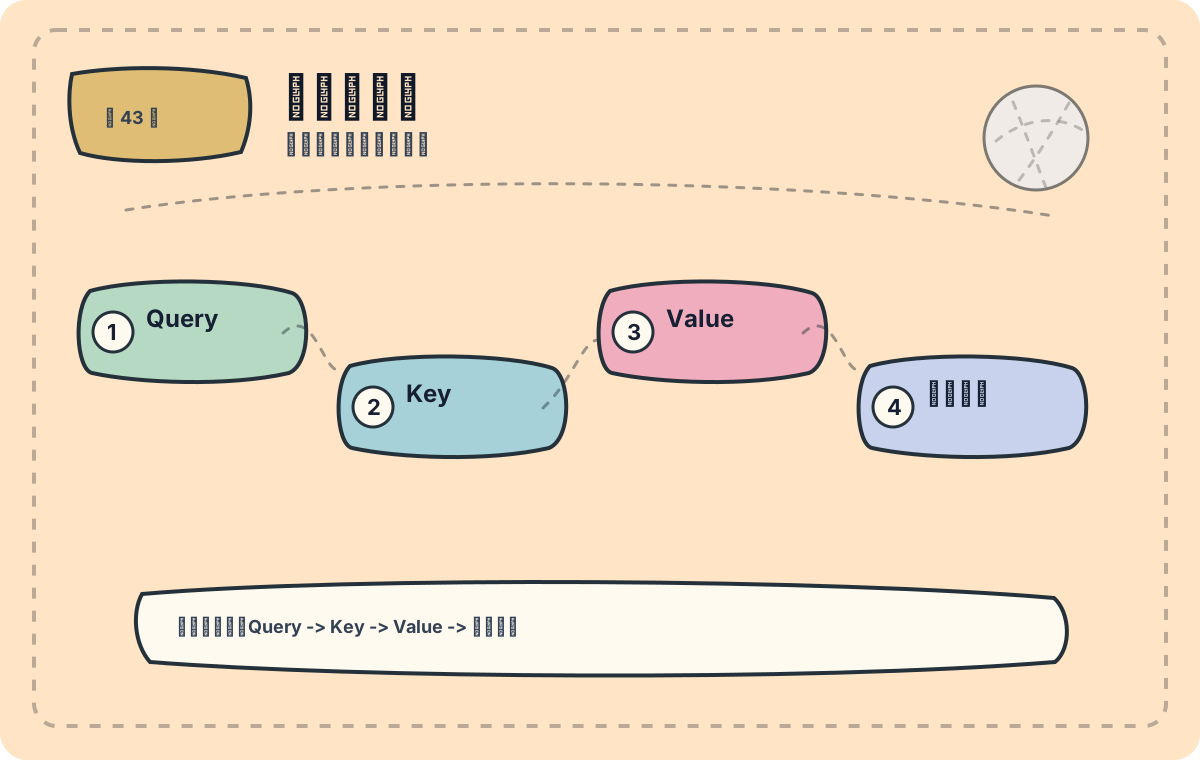
Attention mechanisms answer the question: Where should the model look right now? Whether applied to text or images, it’s helpful to first clarify the relationships among Query (Q), Key (K), and Value (V). This article focuses on architecture. Start by mapping out the data flow, key modules, and output layer—then revisit the underlying formulas or code.

I’ll verify three critical aspects: masking, attention weights, and output dimensions. Visualizing attention weights helps reveal what the model is actually attending to.
In deep learning—especially when processing sequential data and images—the emergence of attention mechanisms has significantly boosted model performance. While widely adopted in natural language processing (NLP), attention is also gaining traction in computer vision (CV) and beyond. In the previous article, we explored practical applications of Capsule Networks, opening the door to deeper investigation of emerging techniques. This article focuses on emerging attention mechanisms across domains—and highlights their unique value in image processing and text generation.
Introduction to Attention Mechanisms
The core idea behind attention mechanisms is to emulate how humans selectively focus on information. By assigning different weights to various parts of the input, models can prioritize the most relevant features—thereby improving prediction accuracy and classification performance. For sequential data—particularly in NLP—the classic Seq2Seq architecture was enhanced with attention, enabling the model to dynamically attend to different segments of the input sequence at each decoding time step.
Emerging Methods and Applications
1. Self-Attention
Self-attention has become a cornerstone method in many text-based tasks. The Transformer architecture is a canonical example. It allows every element in an input sequence to interact with all other elements—e.g., in machine translation, it directly retrieves contextually relevant words surrounding the current token.
Case Study: Text Classification Using Self-Attention
import torch
import torch.nn as nn

class SelfAttention(nn.Module):
    def __init__(self, in_dim):
        super(SelfAttention, self).__init__()
        self.query_linear = nn.Linear(in_dim, in_dim)
        self.key_linear = nn.Linear(in_dim, in_dim)
        self.value_linear = nn.Linear(in_dim, in_dim)

    def forward(self, x):
        query = self.query_linear(x)
        key = self.key_linear(x)
        value = self.value_linear(x)

        scores = torch.matmul(query, key.transpose(-2, -1)) / (key.size(-1) ** 0.5)
        attention_weights = nn.functional.softmax(scores, dim=-1)
        output = torch.matmul(attention_weights, value)
        return output

# Example input
x = torch.rand(10, 32, 128)  # batch_size × seq_length × embedding_dim
attention = SelfAttention(128)
output = attention(x)
2. Multi-Head Attention
Multi-head attention extends self-attention by computing multiple attention distributions in parallel. This enables the model to jointly attend to information from different representation subspaces. The Transformer leverages multi-head attention to capture complex, long-range dependencies within sentences.
Application Domain: Image Captioning
In image captioning, multi-head attention simultaneously attends to distinct regions of an image—enabling richer, more contextually grounded descriptions.
3. Attention in Image Segmentation
In segmentation architectures like U-Net, attention mechanisms highlight salient feature regions. Recently, attention-enhanced variants—such as Attention U-Net—have been proposed to improve precision in medical image segmentation.
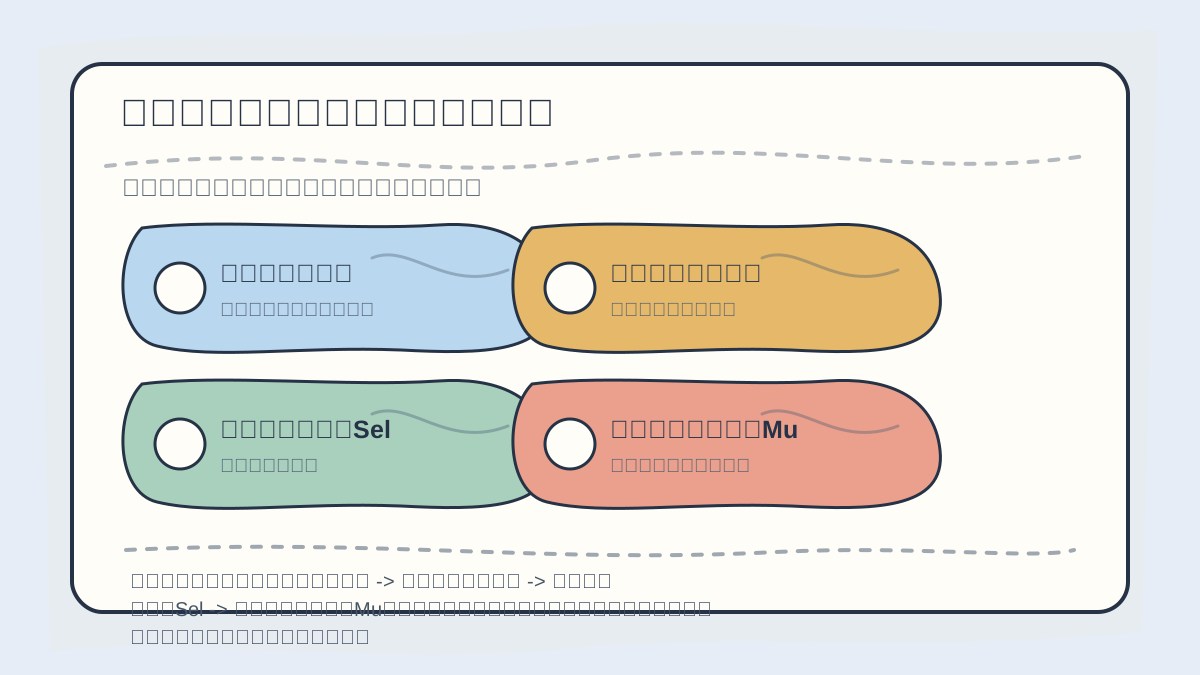
While reading this article, treat the progression “Introduction → Emerging Methods → Self-Attention → Multi-Head Attention” as a verification checklist: First align the object, steps, and evidence; then circle back to examine concrete examples, code, or evaluation metrics.
class AttentionBlock(nn.Module):
    def __init__(self, in_channels, gate_channels):
        super(AttentionBlock, self).__init__()
        self.W_g = nn.Conv2d(in_channels, gate_channels, kernel_size=1)
        self.W_x = nn.Conv2d(in_channels, gate_channels, kernel_size=1)
        self.psi = nn.Conv2d(gate_channels, 1, kernel_size=1)

    def forward(self, x, g):
        g1 = self.W_g(g)
        x1 = self.W_x(x)
        psi = torch.sigmoid(self.psi(torch.nn.functional.relu(g1 + x1)))
        return x * psi

# x: feature map, g: gating signal
attention_block = AttentionBlock(64, 32)
output = attention_block(x, g)
4. Cross-Modal Attention
When handling multimodal data—e.g., images paired with text—cross-modal attention effectively fuses representations across modalities. In image retrieval, for instance, relevance between images and text queries is modeled explicitly via cross-modal attention.
Application Case: Image–Text Matching
5. Attention in Chatbots
In conversational AI systems, attention mechanisms help select the most contextually appropriate response from dialogue history—enhancing fluency and coherence. Models like the GPT series rely heavily on attention to generate natural, context-aware dialogue.
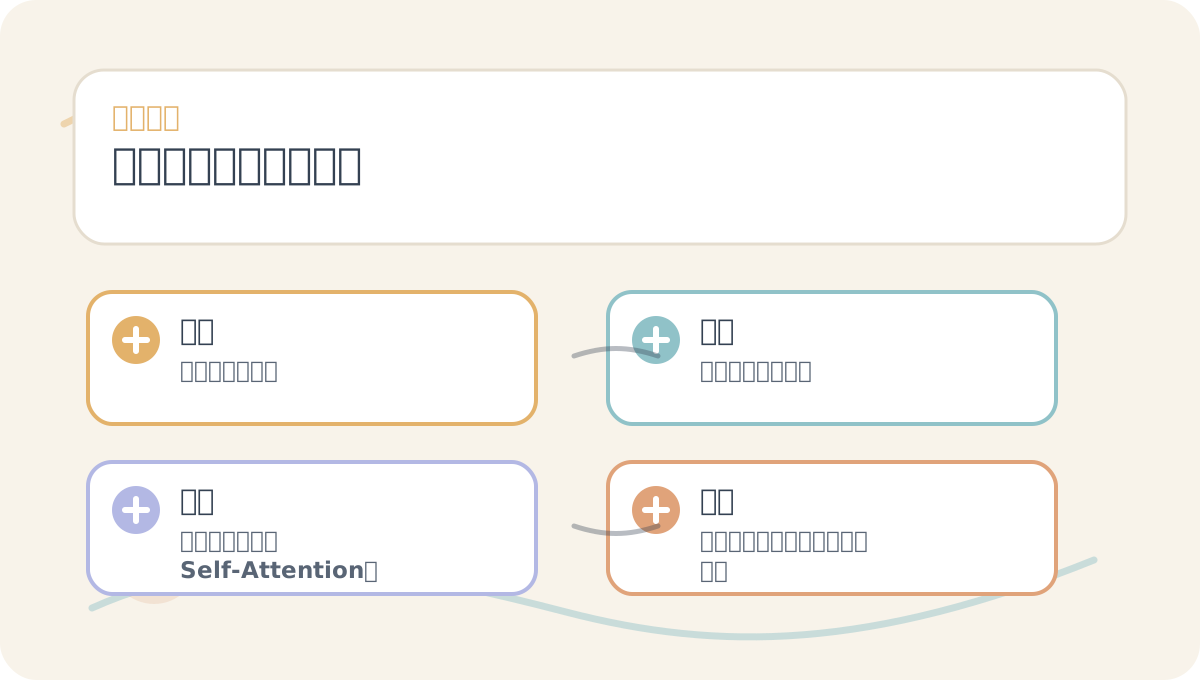
Articles like “Emerging Attention Mechanisms” risk getting lost in technical details. Start by tracing the central narrative in the diagrams—then return to the main text to verify the environment, inputs, outputs, and evaluation criteria.
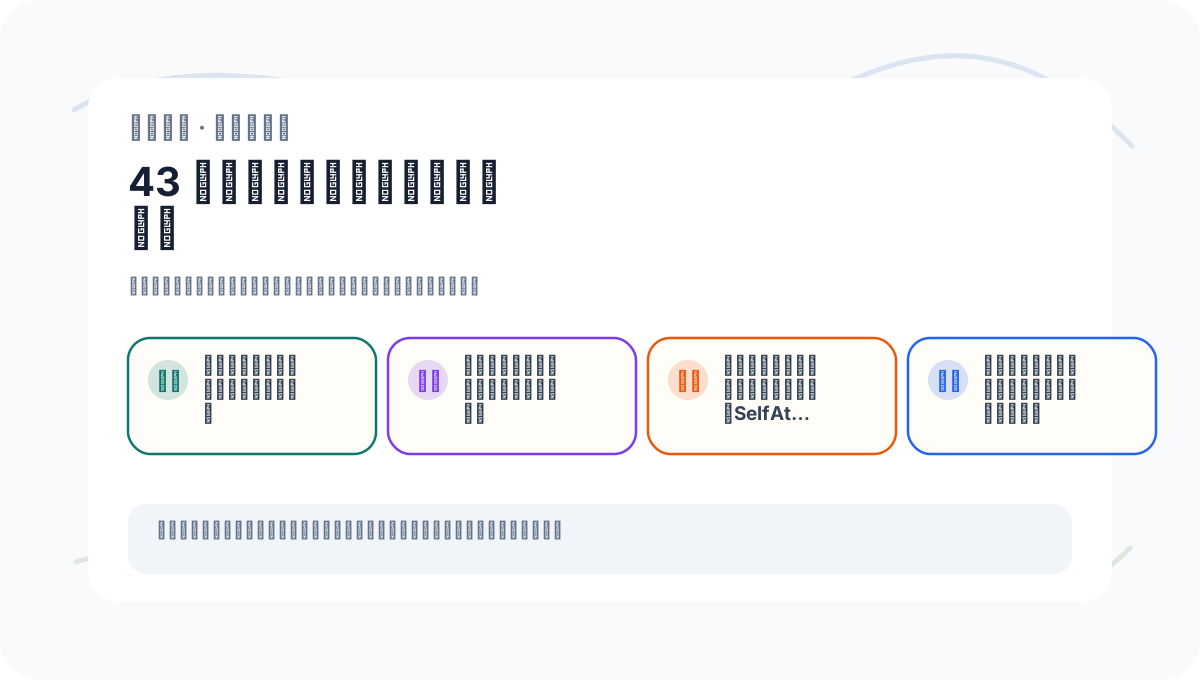
If “Emerging Attention Mechanisms” hasn’t fully clicked yet, walk through the four actions outlined on this card to reinforce understanding.
When revisiting “Emerging Attention Mechanisms”, avoid launching large-scale projects upfront. Instead, begin with one simple, runnable example to confirm whether the core logic is clear.
Summary
The emerging attention mechanisms introduced in this article have substantially advanced research across multiple domains. As the field evolves, novel application scenarios will continue to emerge. In the next article, we’ll delve into cutting-edge research on attention—uncovering deeper theoretical foundations and innovative real-world applications. We hope this foundation inspires readers to develop new ideas and deploy attention mechanisms in broader, more impactful contexts.
Apply This Lesson
Turn this article into AI software, model, API, and security decisions.
English Article FAQ
Use this article as evidence before choosing AI tools
How should I use this AI Tutorials article?
Use it as the implementation or learning layer, then connect the idea to AI software buyer guides, tool comparisons, benchmarks, API choices, and security checks before making a production decision.
Is this English article different from the Chinese original?
The English edition is localized for global AI readers while preserving the original diagrams, screenshots, prompts, code examples, and source context from the Chinese article.
What should I read after Example input?
Continue with AI Software Buyer Guides, AI Tools Workbench, Best AI Coding Agents, AI Model Benchmarks, OpenAI vs Anthropic API, or LLM Security Tools depending on the decision you need to make.
Can this article alone choose an AI product or model?
No. Treat the article as evidence and context, then validate fit with pricing, privacy requirements, integration effort, benchmark results, workflow tests, and fallback planning.
Continue