English translation
Example: Simple RNN-based attention layer
AI Article Decision Snapshot
Turn the lesson into workflow, model, budget, and security checks before choosing tools.
Use this quick snapshot before leaving the article. It keeps the next search tied to practical AI software, model/API, cost, privacy, and implementation questions.
Workflow fit
Identify the real job behind the article: coding, research, document review, support, analytics, content, or internal automation.
Model or tool decision
Decide whether the next step is a software shortlist, an AI tool comparison, an API platform choice, or a model benchmark.
Budget and usage signal
Estimate seats, API calls, prompt volume, retries, review time, and fallback work before assuming the workflow is cheap.
Security and privacy review
Check whether source code, customer data, private documents, prompts, logs, or embeddings will enter the AI workflow.
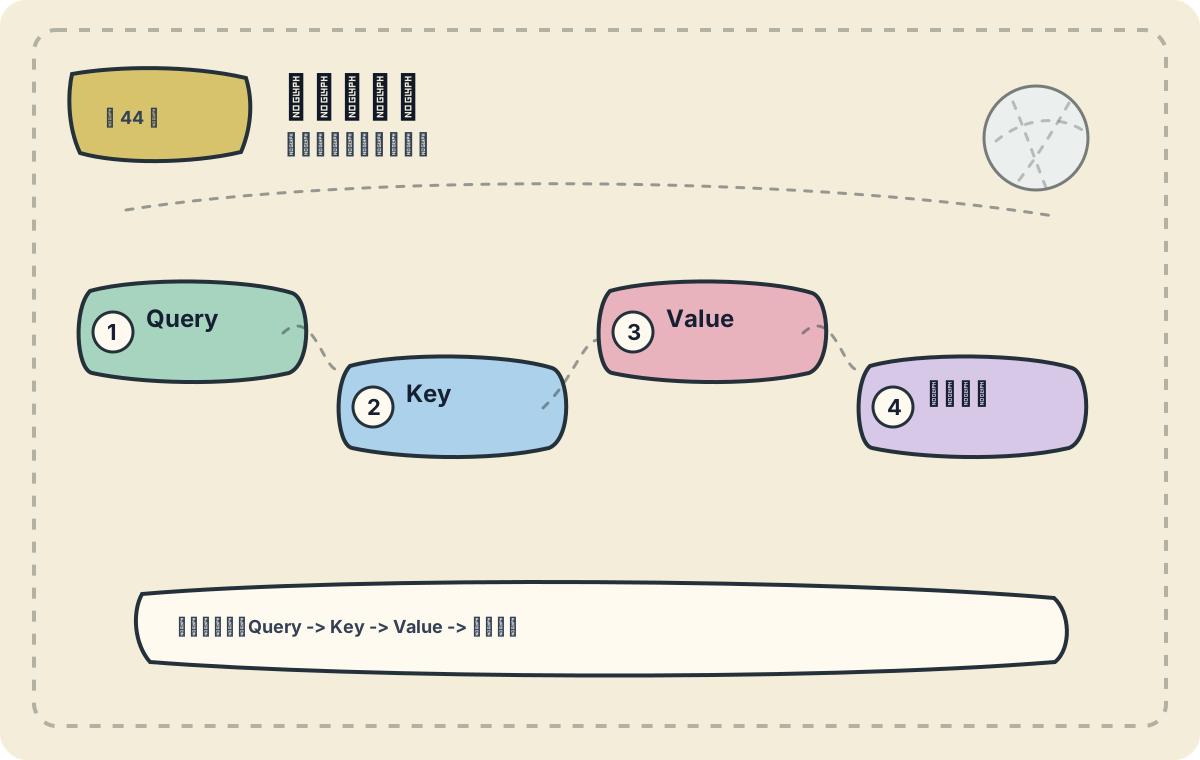
Attention mechanisms answer the question: Where should the model look right now? Whether applied to text or images, it’s helpful to first clarify the relationships among Query (Q), Key (K), and Value (V). This article focuses primarily on architectural design—first mapping out the data flow, key modules, and output layers, then revisiting the underlying formulas or code.

I verify three critical aspects: masking logic, attention weight distributions, and output dimensions. Visualizing attention weights helps reveal what the model is actually attending to.
In deep learning, the attention mechanism has become a pivotal tool for enhancing model performance. By emulating how humans selectively focus on specific information, attention enables models to concentrate more effectively on the most relevant parts of input data. This article surveys recent advances in attention research across diverse application domains, emphasizing practical implementation strategies and real-world use cases—while maintaining conceptual continuity with the previous article on emerging attention methods and the next article on self-supervised learning model architectures.
Fundamental Concepts of Attention
At its core, an attention mechanism performs a weighted summation: the model computes “importance scores” over input features to determine how to combine them. The two canonical forms are additive attention and multiplicative attention (also known as scaled dot-product attention). Both are widely adopted in natural language processing (NLP) and computer vision.
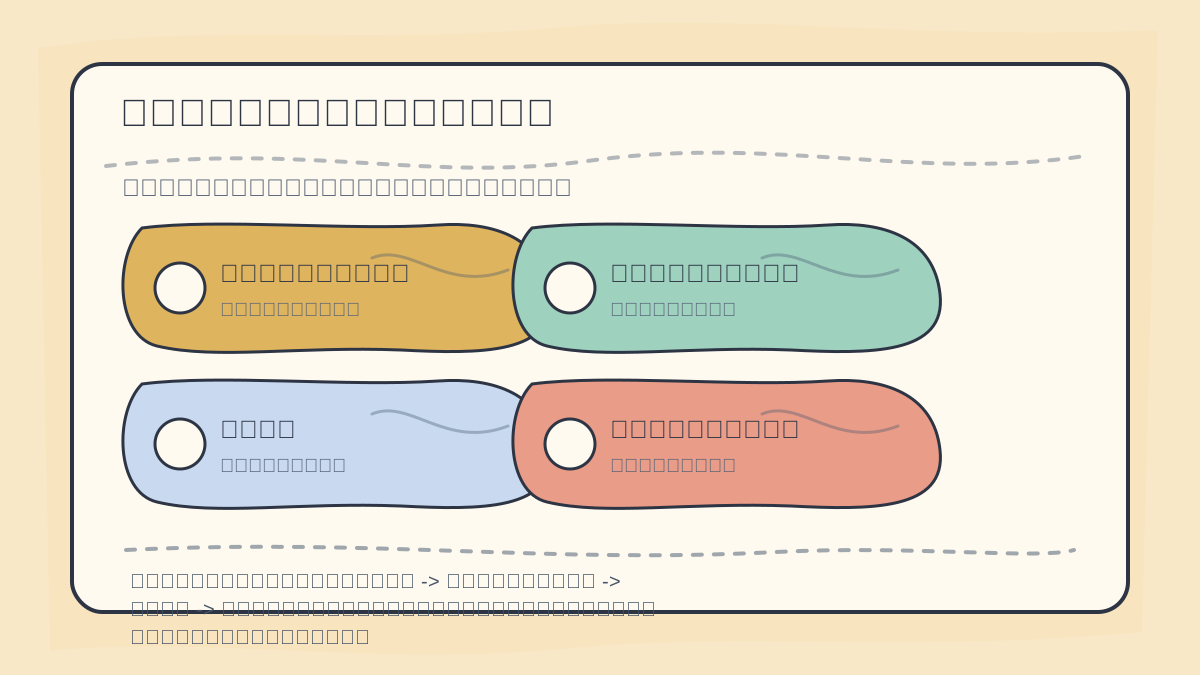
While reading this article, treat the following sequence as your verification checklist:
“Fundamental concepts → Additive vs. multiplicative attention → Research advances → Cross-modal attention in vision & language.”
First identify the materials (inputs), actions (operations), and outcomes (outputs); then revisit concrete examples, code snippets, or evaluation metrics for validation.
1. Additive vs. Multiplicative Attention
-
Additive Attention computes attention weights by jointly transforming Q, K, and V:
-
Multiplicative Attention directly measures similarity via dot products:
More sophisticated variants—such as self-attention and multi-head attention—introduce distinct sets of Q, K, and V projections to capture hierarchical or complementary feature representations.
Recent Research Advances
Researchers have made substantial progress across multiple dimensions of attention mechanisms. Below are several prominent directions:
When studying Cutting-Edge Research on Attention Mechanisms, start with a small, reproducible scenario you can implement yourself. Then map related concepts and step-by-step exercises onto it. After reading, re-express the entire workflow using your own example.
1. Cross-Modal Attention for Vision and Language
In the convergence of computer vision and NLP, cross-modal attention plays a central role. For instance, in image captioning tasks, models must generate descriptive text conditioned on visual content.
Case Study: In the Show and Tell model, a CNN extracts image features, which are then fed into an RNN decoder augmented with attention. The attention module dynamically assigns weights to different image regions, ensuring generated captions remain semantically grounded.
# Example: Simple RNN-based attention layer
import torch
import torch.nn as nn

class AttentionLayer(nn.Module):
    def __init__(self, hidden_size):
        super(AttentionLayer, self).__init__()
        self.W = nn.Linear(hidden_size, hidden_size)
        self.U = nn.Linear(hidden_size, hidden_size)

    def forward(self, h_t, encoder_outputs):
        scores = torch.matmul(self.W(h_t), encoder_outputs.t())
        weights = nn.functional.softmax(scores, dim=-1)
        context_vector = torch.matmul(weights, encoder_outputs)
        return context_vector

# Usage example
encoder_outputs = torch.rand(10, 64)  # Encoder outputs over 10 time steps
h_t = torch.rand(64)                  # Current decoder hidden state
attention_layer = AttentionLayer(64)
context_vector = attention_layer(h_t, encoder_outputs)
2. Attention in Medical Image Analysis
Attention mechanisms have achieved notable success in medical imaging—particularly for tumor detection and segmentation. Integrating attention into convolutional networks allows models to prioritize diagnostically salient regions within complex anatomical structures.
Case Study: In U-Net–based tumor segmentation, researchers introduced attention gates, which modulate encoder-decoder skip connections by applying spatially adaptive attention to feature maps—yielding sharper, more accurate segmentations.
# Implementation of Attention Gate in U-Net
class AttentionBlock(nn.Module):
    def __init__(self, F_g, F_l, F_int):
        super(AttentionBlock, self).__init__()
        self.W_g = nn.Conv2d(F_g, F_int, kernel_size=1)
        self.W_x = nn.Conv2d(F_l, F_int, kernel_size=1)
        self.psi = nn.Conv2d(F_int, 1, kernel_size=1)
        self.sigmoid = nn.Sigmoid()

    def forward(self, g, x):
        g1 = self.W_g(g)
        x1 = self.W_x(x)
        psi = self.sigmoid(self.psi(g1 + x1))
        return x * psi

# Usage example
g = torch.rand(1, 64, 32, 32)  # Gating signal (decoder feature)
x = torch.rand(1, 64, 32, 32)  # Local feature (encoder feature)
attention_block = AttentionBlock(64, 64, 32)
output = attention_block(g, x)
3. Multi-Scale Attention Mechanisms
Multi-scale attention enables models to capture features at varying granularities—an essential capability for analyzing complex scenes (e.g., natural images with objects at multiple scales). By applying attention across hierarchical feature levels, models integrate both global context and fine-grained local details.
Empirical studies show multi-scale attention significantly improves performance on object detection and scene parsing tasks. For example, integrating multi-scale attention into Faster R-CNN enhances detection accuracy—especially for small objects.
At this point, consolidate Cutting-Edge Research on Attention Mechanisms into a retrospective summary table: clearly articulate the central narrative first, then validate it using a small, concrete task.
After finishing Cutting-Edge Research on Attention Mechanisms, select one compact example and walk through the full pipeline end-to-end. Then assess which steps you can now execute independently.
Future Directions
Although attention mechanisms have advanced rapidly across domains, several promising frontiers remain open for exploration—including improving computational efficiency, optimizing attention for low-resource settings, and synergistically combining attention with self-supervised learning frameworks. These represent compelling avenues for future research.
Next, we will explore model architectures for self-supervised learning, continuing our journey into the forefront of deep learning innovation.
We hope this overview provides you with a comprehensive and insightful perspective on cutting-edge attention research. If you have questions or wish to dive deeper into any topic, feel free to reach out!
Apply This Lesson
Turn this article into AI software, model, API, and security decisions.
English Article FAQ
Use this article as evidence before choosing AI tools
How should I use this AI Tutorials article?
Use it as the implementation or learning layer, then connect the idea to AI software buyer guides, tool comparisons, benchmarks, API choices, and security checks before making a production decision.
Is this English article different from the Chinese original?
The English edition is localized for global AI readers while preserving the original diagrams, screenshots, prompts, code examples, and source context from the Chinese article.
What should I read after Example: Simple RNN-based attention layer?
Continue with AI Software Buyer Guides, AI Tools Workbench, Best AI Coding Agents, AI Model Benchmarks, OpenAI vs Anthropic API, or LLM Security Tools depending on the decision you need to make.
Can this article alone choose an AI product or model?
No. Treat the article as evidence and context, then validate fit with pricing, privacy requirements, integration effort, benchmark results, workflow tests, and fallback planning.
Continue