English translation
Assume contentimg and generatedimg are already loaded as NumPy arrays
AI Article Decision Snapshot
Turn the lesson into workflow, model, budget, and security checks before choosing tools.
Use this quick snapshot before leaving the article. It keeps the next search tied to practical AI software, model/API, cost, privacy, and implementation questions.
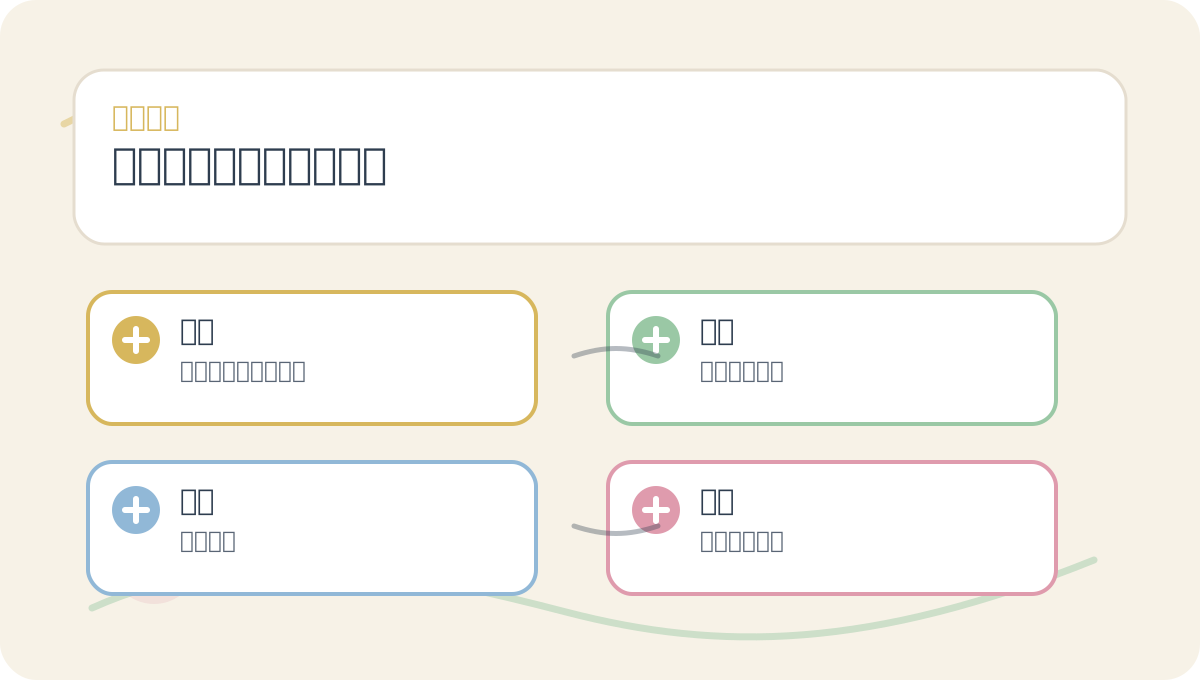
Workflow fit
Identify the real job behind the article: coding, research, document review, support, analytics, content, or internal automation.
Model or tool decision
Decide whether the next step is a software shortlist, an AI tool comparison, an API platform choice, or a model benchmark.
Budget and usage signal
Estimate seats, API calls, prompt volume, retries, review time, and fallback work before assuming the workflow is cheap.
Security and privacy review
Check whether source code, customer data, private documents, prompts, logs, or embeddings will enter the AI workflow.
Neural style transfer must simultaneously preserve both the structural content and the textural style. A visually pleasing output is insufficient—performance must also be evaluated in terms of speed, GPU memory usage, and reproducible configurations. This article focuses on evaluation methodology: speed, accuracy, memory footprint, and reproducibility must all be recorded together—no single metric alone tells the full story.
I record content weight, style weight, image resolution, and runtime. Without these parameters, reproducing identical results in future runs becomes highly unlikely.
In the previous article, we explored the principle of spatial transformation in neural style transfer—how content and style images are fused to generate novel artistic outputs. This article dives deeper into the performance analysis of neural style transfer, covering computational efficiency, output quality, and hardware requirements—providing practical reference points for research and real-world deployment.
Key Performance Metrics
When evaluating neural style transfer performance, the following core metrics are typically considered:
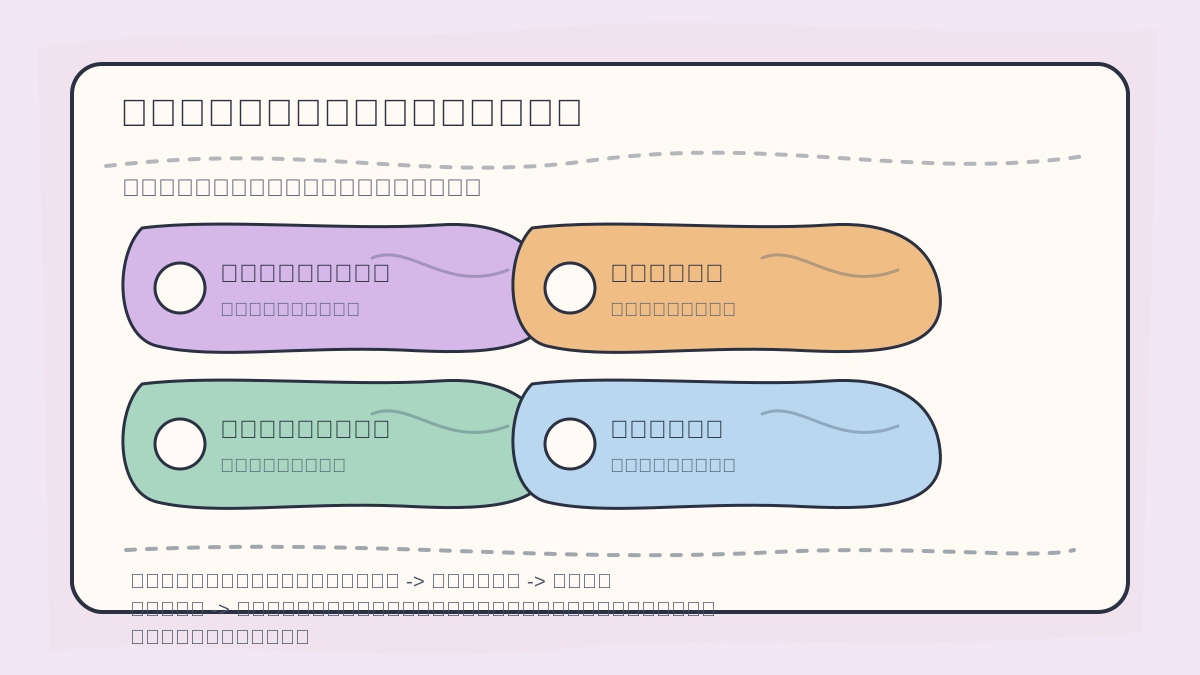
While reading this article, treat the sequence “Key Performance Metrics → Computational Time Analysis → Code Example: Timing Measurement → Memory Consumption Assessment” as a verification checklist: first identify the object, action, and evaluation criteria, then revisit concrete examples, code snippets, or quantitative metrics to validate understanding.
- Computational Time: Reflects the wall-clock time required to execute the neural style transfer algorithm—strongly influenced by network architecture and available hardware resources.
- Memory Consumption: Critically important—especially when processing high-resolution images—since model complexity directly impacts memory demand.
- Output Image Quality: The ultimate objective; assessed via visual fidelity and structural similarity to the original content image.
- Scalability: How well the algorithm handles content and style images of varying sizes and categories.
Computational Time Analysis
Two widely adopted implementations illustrate the spectrum of timing behavior: VGG19-based neural style transfer and Fast Neural Style Transfer. When using VGG19 as the feature extractor, stylizing a 768×512 image typically takes tens of seconds. In contrast, Fast Neural Style Transfer completes stylization of a similarly sized image in tens of milliseconds.
When reading Performance Analysis of Neural Style Transfer, start with the task, concepts, exercises, and decision points illustrated in the accompanying figures—then return to the main text to fill in technical details. This approach helps you quickly assess which real-world scenarios this content applies to.
Code Example: Measuring Computational Time
Below is a simple timing test implemented in TensorFlow:
import time
import tensorflow as tf

def style_transfer(model, content_image, style_image):
    # Load and preprocess images
    # ... preprocessing code ...

    start_time = time.time()
    generated_image = model(content_image, style_image)
    end_time = time.time()

    print(f"Execution time: {end_time - start_time:.2f} seconds")
    return generated_image
Memory Consumption Assessment
Memory consumption varies significantly across architectures. Deep networks like VGG19 demand substantial GPU memory—processing a 768×512 image may require ~4 GB of VRAM. By comparison, lightweight alternatives such as MobileNet substantially reduce memory overhead.
Factors Influencing Memory Consumption
- Image Resolution: Higher input resolution linearly increases memory footprint.
- Network Architecture: More complex models (e.g.,
ResNet) consume more memory than compact ones. - Optimization Strategies: Techniques such as model quantization or mixed-precision computation (e.g., FP16) can significantly lower memory usage.
Output Image Quality Assessment
Output quality remains the most critical evaluation criterion for neural style transfer. Common assessment methods include:
- Structural Similarity Index (SSIM): Quantifies pixel-level structural similarity between the generated image and the original content image.
- Visual Inspection: Subjective evaluation by human observers—often used alongside objective metrics.
In practice, pre-trained perceptual models can automate such assessments.
Code Example: Computing SSIM
import cv2
from skimage.metrics import structural_similarity as ssim

# Assume content_img and generated_img are already loaded as NumPy arrays
ssim_index = ssim(content_img, generated_img, multichannel=True)
print(f"SSIM: {ssim_index:.4f}")
Scalability Considerations
To ensure broad applicability, neural style transfer algorithms should support:
- Diversity: Robust handling of varied content domains (e.g., portraits, landscapes) and diverse artistic styles (e.g., Van Gogh, Picasso).
- Adaptability: Tunable hyperparameters and hardware-aware optimizations—enabling deployment across heterogeneous environments (e.g., cloud GPUs, edge devices).
After studying Performance Analysis of Neural Style Transfer, try adapting it to your own use case—focus specifically on whether inputs, processing steps, and outputs align coherently.
To apply Performance Analysis of Neural Style Transfer to your own project, begin by narrowing scope—validate just one critical decision point first.
Conclusion
Neural style transfer is both exciting and technically demanding. Rigorous performance analysis enables deeper insight into its operational characteristics—guiding optimization, resource planning, and methodological improvement. In upcoming articles, we’ll examine neural style transfer across diverse application domains—continuing to deliver cutting-edge techniques and hands-on experience from the deep learning frontier.
Apply This Lesson
Turn this article into AI software, model, API, and security decisions.
English Article FAQ
Use this article as evidence before choosing AI tools
How should I use this AI Tutorials article?
Use it as the implementation or learning layer, then connect the idea to AI software buyer guides, tool comparisons, benchmarks, API choices, and security checks before making a production decision.
Is this English article different from the Chinese original?
The English edition is localized for global AI readers while preserving the original diagrams, screenshots, prompts, code examples, and source context from the Chinese article.
What should I read after Assume contentimg and generatedimg are already loaded as NumPy arrays?
Continue with AI Software Buyer Guides, AI Tools Workbench, Best AI Coding Agents, AI Model Benchmarks, OpenAI vs Anthropic API, or LLM Security Tools depending on the decision you need to make.
Can this article alone choose an AI product or model?
No. Treat the article as evidence and context, then validate fit with pricing, privacy requirements, integration effort, benchmark results, workflow tests, and fallback planning.
Continue