English translation
In the previous article, we thoroughly examined ResNet’s architecture and how its innovative residual connections improve training in deep neural networks. Yet every technique has trade-offs—and today, we’ll dive into ResNet’s key advantages and limitations to better understand its suitability across diverse application scenarios.
AI Article Decision Snapshot
Turn the lesson into workflow, model, budget, and security checks before choosing tools.
Use this quick snapshot before leaving the article. It keeps the next search tied to practical AI software, model/API, cost, privacy, and implementation questions.
Workflow fit
Identify the real job behind the article: coding, research, document review, support, analytics, content, or internal automation.
Model or tool decision
Decide whether the next step is a software shortlist, an AI tool comparison, an API platform choice, or a model benchmark.
Budget and usage signal
Estimate seats, API calls, prompt volume, retries, review time, and fallback work before assuming the workflow is cheap.
Security and privacy review
Check whether source code, customer data, private documents, prompts, logs, or embeddings will enter the AI workflow.
The core innovation of ResNet lies in providing a shorter path for information to flow backward during training. Residual connections are not mere decorative elements—they fundamentally determine whether very deep networks can be trained stably. This article focuses on evaluation: speed, accuracy, GPU memory usage, and reproducible experimental settings must all be recorded together; no single metric alone suffices to characterize overall performance.
I always verify whether the input and output channel dimensions match within each residual block—and if they don’t, whether a projection shortcut (e.g., 1×1 convolution) is properly implemented. A mismatch here typically triggers an immediate dimensionality error during runtime.
In the previous article, we thoroughly examined ResNet’s architecture and how its innovative residual connections improve training in deep neural networks. Yet every technique has trade-offs—and today, we’ll dive into ResNet’s key advantages and limitations to better understand its suitability across diverse application scenarios.
Advantages
- Mitigating the Vanishing Gradient Problem
- ResNet introduces residual learning, using “shortcut connections” to enable more efficient information propagation through the network. This design alleviates the vanishing gradient problem common in deep networks. Theoretically, as network depth increases, gradients shrink dramatically during backpropagation—hindering convergence. With residual connections, optimizing the residual mapping becomes significantly easier, thereby improving training efficiency.
When evaluating ResNet’s advantages and limitations, first assess training stability conferred by residual connections, then consider parameter count, inference cost, and task adaptability.
For example, in the ImageNet competition, ResNet successfully trained a 152-layer network—achieving markedly superior performance compared to prior architectures.
-
Enabling Extremely Deep Networks
- ResNet makes it feasible to construct exceptionally deep models (e.g., 1202 layers), a feat previously impractical with conventional architectures. Such depth enhances representational capacity and consistently yields substantial performance gains across numerous vision tasks.
-
Strong Transfer Learning Capability
- ResNet serves as an excellent pre-trained backbone for transfer learning. Its training on large-scale datasets allows it to learn rich, general-purpose features—readily transferable to downstream tasks such as image classification, object detection, and semantic segmentation.
-
Foundation for Advanced Ensemble Architectures
- As a high-performing base architecture, ResNet underpins many state-of-the-art ensemble methods—for instance, Faster R-CNN and Mask R-CNN. These models augment ResNet with specialized modules (e.g., region proposal networks or mask heads), significantly boosting detection and segmentation accuracy.
Limitations
-
High Computational Resource Demand
- While ResNet enables greater depth, deeper variants incur substantially higher computational costs and GPU memory consumption. In resource-constrained environments (e.g., edge devices or embedded systems), deploying deep ResNets may be infeasible.
-
Risk of Overfitting
- Although residual connections mitigate vanishing gradients, excessively deep models remain prone to overfitting—especially on small or low-diversity datasets. Such models may achieve near-perfect training accuracy but generalize poorly to unseen test data.
-
Dependence on Traditional CNN Design Principles
- Despite its innovations, ResNet still relies heavily on standard CNN building blocks (e.g., convolutional layers, batch normalization, ReLU). For certain small-scale or domain-specific tasks, simpler CNNs may outperform ResNet—offering better efficiency and lower overfitting risk.
-
Sensitivity to Hyperparameter Choices
- While residual connections improve trainability, ResNet’s final performance remains highly sensitive to hyperparameter selection (e.g., learning rate, weight decay, batch size). Real-world deployment thus often requires extensive empirical tuning and ablation studies.
Practical Example
Consider the following PyTorch implementation of a simple ResNet model applied to the CIFAR-10 classification task:
import torch
import torch.nn as nn
import torchvision.transforms as transforms
from torchvision import datasets
from torch.utils.data import DataLoader
from torchvision.models import resnet18

# Data preprocessing
transform = transforms.Compose([
    transforms.Resize((224, 224)),
    transforms.ToTensor(),
])

# Download CIFAR-10 dataset
train_dataset = datasets.CIFAR10(root='data', train=True, download=True, transform=transform)
train_loader = DataLoader(dataset=train_dataset, batch_size=64, shuffle=True)

# Load pre-trained ResNet18
model = resnet18(pretrained=True)
model.fc = nn.Linear(model.fc.in_features, 10)  # Adapt final layer for CIFAR-10's 10 classes

# Define loss function and optimizer
criterion = nn.CrossEntropyLoss()
optimizer = torch.optim.Adam(model.parameters(), lr=0.001)

# Train the model
model.train()
for epoch in range(5):  # 5 epochs
    for images, labels in train_loader:
        optimizer.zero_grad()
        outputs = model(images)
        loss = criterion(outputs, labels)
        loss.backward()
        optimizer.step()
    print(f"Epoch [{epoch+1}/5], Loss: {loss.item():.4f}")
This example demonstrates how ResNet can be readily adapted for image classification—and highlights its strengths: robust learning capability and strong generalization, especially on complex visual tasks.
After reading this article, consolidate “Advantages and Limitations of ResNet” into a structured retrospective table: first clarify the central narrative, then validate it using a small-scale task.
Upon finishing “Advantages and Limitations of ResNet”, begin by walking through a minimal end-to-end example—then identify which steps you can now execute independently.
Conclusion
Overall, ResNet represents a groundbreaking architectural paradigm that has achieved remarkable success across numerous computer vision benchmarks. Though it exhibits certain limitations, its compelling advantages make it a default choice for many deep learning applications. In our next article, we’ll explore VGG’s application domains—broadening our understanding of deep learning model design principles.
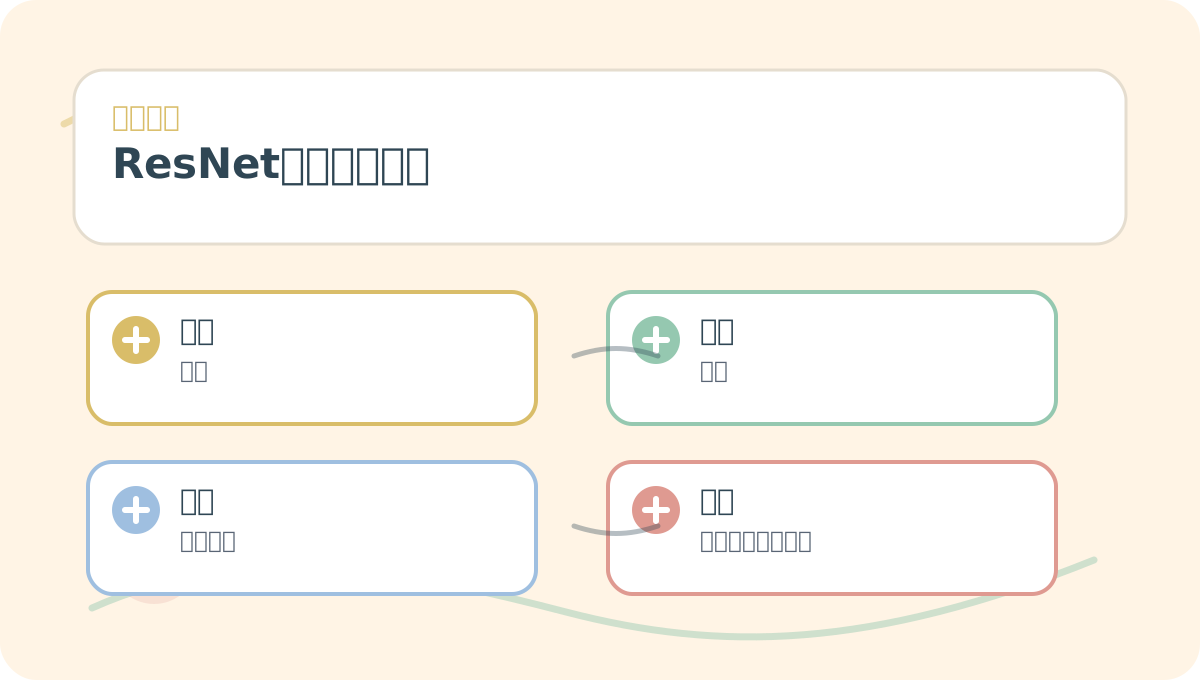
Read “Advantages and Limitations of ResNet” through the lens of Scenario–Concept–Action–Outcome. First align these four dimensions, then revisit the parameters, code snippets, or procedural details in the main text.
Apply This Lesson
Turn this article into AI software, model, API, and security decisions.
English Article FAQ
Use this article as evidence before choosing AI tools
How should I use this AI Tutorials article?
Use it as the implementation or learning layer, then connect the idea to AI software buyer guides, tool comparisons, benchmarks, API choices, and security checks before making a production decision.
Is this English article different from the Chinese original?
The English edition is localized for global AI readers while preserving the original diagrams, screenshots, prompts, code examples, and source context from the Chinese article.
What should I read after In the previous article, we thoroughly examined ResNet’s architecture and how its innovative residual connections improve training in deep neural networks. Yet every technique has trade-offs—and today, we’ll dive into ResNet’s key advantages and limitations to better understand its suitability across diverse application scenarios.?
Continue with AI Software Buyer Guides, AI Tools Workbench, Best AI Coding Agents, AI Model Benchmarks, OpenAI vs Anthropic API, or LLM Security Tools depending on the decision you need to make.
Can this article alone choose an AI product or model?
No. Treat the article as evidence and context, then validate fit with pricing, privacy requirements, integration effort, benchmark results, workflow tests, and fallback planning.
Continue