English translation
Load pre-trained VGG16 without the top classification layer
AI Article Decision Snapshot
Turn the lesson into workflow, model, budget, and security checks before choosing tools.
Use this quick snapshot before leaving the article. It keeps the next search tied to practical AI software, model/API, cost, privacy, and implementation questions.
Workflow fit
Identify the real job behind the article: coding, research, document review, support, analytics, content, or internal automation.
Model or tool decision
Decide whether the next step is a software shortlist, an AI tool comparison, an API platform choice, or a model benchmark.
Budget and usage signal
Estimate seats, API calls, prompt volume, retries, review time, and fallback work before assuming the workflow is cheap.
Security and privacy review
Check whether source code, customer data, private documents, prompts, logs, or embeddings will enter the AI workflow.
VGG’s key strength lies in its clean, transparent architecture—making it an ideal baseline for understanding convolutional neural networks. While not necessarily the most computationally efficient model, it excels at illustrating how features become progressively more abstract across layers. This article focuses specifically on application domains. Before adopting VGG, first assess whether the task genuinely aligns with its design; then evaluate data scale, deployment cost, and performance boundaries.
I analyze convolutional layers, pooling layers, and fully connected layers separately—and verify whether the total parameter count exceeds what the current task actually requires.
In the previous article, we examined the strengths and limitations of ResNet. Next, we turn our attention to the application domains of the VGG model. Renowned for its simplicity and strong empirical performance, VGG has been widely adopted across diverse fields. This article explores concrete use cases of VGG in image classification, object detection, image segmentation, and transfer learning.
Image Classification
VGG was originally designed for the ImageNet competition, and its deep architecture delivers outstanding performance on image classification tasks. It constructs deep networks by stacking multiple convolutional and pooling layers—making it especially well-suited for hierarchical feature extraction from images.
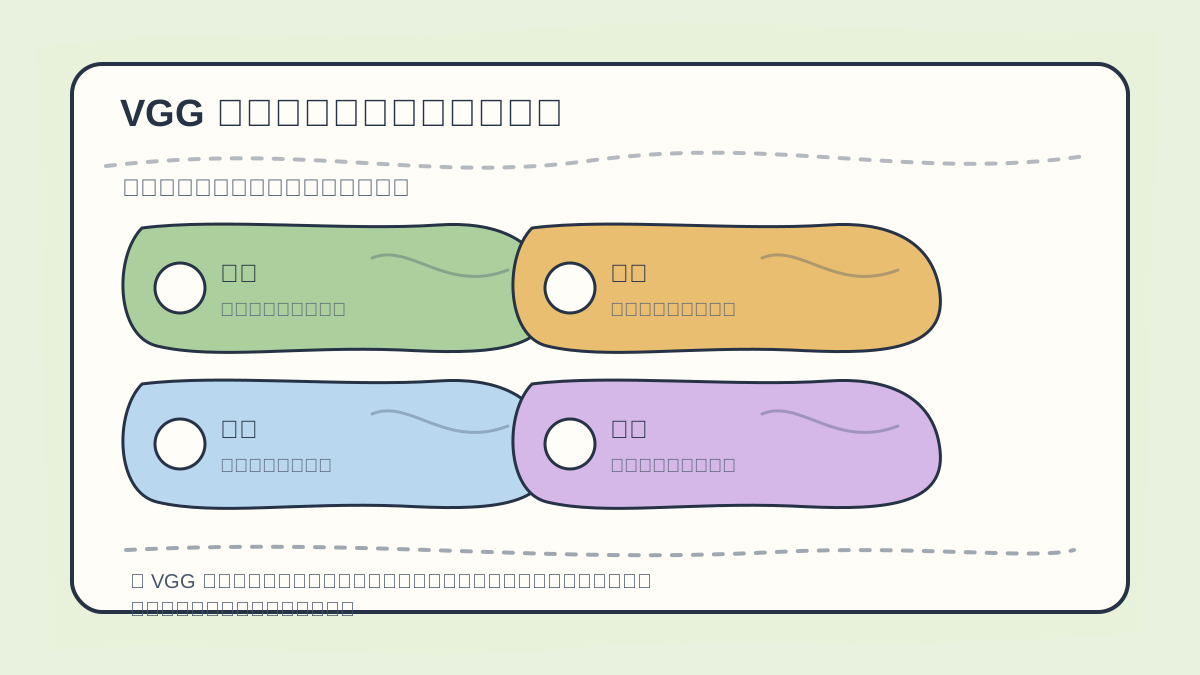
When evaluating VGG’s applicability, first distinguish among: image classification, feature extraction, transfer learning, and pedagogical benchmarking. Its regular, uniform structure makes it an excellent baseline for convolutional networks.
Application Example
For instance, in a cat-vs-dog binary classification task, we can employ the VGG16 model to differentiate between the two classes. Using transfer learning, a pre-trained VGG16 model can be adapted to small-scale datasets simply by replacing and fine-tuning the final fully connected layer. In TensorFlow/Keras, this can be implemented as follows:
from keras.applications import VGG16
from keras.models import Model
from keras.layers import Dense, Flatten

# Load pre-trained VGG16 without the top classification layer
base_model = VGG16(weights='imagenet', include_top=False, input_shape=(224, 224, 3))

# Add custom top layers
x = Flatten()(base_model.output)
x = Dense(1, activation='sigmoid')(x)  # Assuming binary cat/dog classification
model = Model(inputs=base_model.input, outputs=x)

# Freeze pre-trained layers
for layer in base_model.layers:
    layer.trainable = False
Object Detection
In object detection tasks, VGG commonly serves as the backbone (i.e., feature extractor), for example within frameworks like Faster R-CNN. Leveraging VGG’s robust feature representation enables detection models to localize and classify objects more accurately.
After reading “Application Domains of VGG”, reflect on three questions:
- What problem does it solve?
- Which step is most error-prone?
- Can I run a minimal working example end-to-end?
Application Example
When using VGG as a feature extractor for object detection, it can be integrated with a Region Proposal Network (RPN). Below is a simplified illustration of how VGG functions as the backbone in such a pipeline:
import torchvision
from torchvision.models import vgg16

# Load pre-trained VGG16 and extract only the feature-extraction layers
vgg_model = vgg16(pretrained=True).features

# Use VGG features as input to RPN
def extract_features(input_image):
    features = vgg_model(input_image)
    return features
Image Segmentation
Another prominent application of VGG is in image segmentation—particularly in medical imaging. Architectures like U-Net often adopt VGG’s encoder-decoder structure to extract multi-scale features and achieve pixel-level segmentation.
Application Example
In tumor segmentation from MRI scans, a U-Net model can be built upon VGG’s encoder to extract discriminative features and perform precise tumor delineation. Here's a representative snippet:
class UNetModel(torch.nn.Module):
    def __init__(self):
        super(UNetModel, self).__init__()
        self.encoder = vgg16(pretrained=True).features
        # ... (additional layer definitions)

    def forward(self, x):
        # ... (forward pass logic)
        return x

# Instantiate and train the model
unet = UNetModel()
Transfer Learning
VGG stands out particularly in transfer learning scenarios. Thanks to its general-purpose architecture, it adapts readily to diverse downstream tasks—including style transfer, fine-grained object classification, and more.
Application Example
We can apply VGG to neural style transfer, combining content loss and style loss to produce high-fidelity artistic stylizations. Implementation details—including model architecture and loss function design—are well-documented in major deep learning frameworks.
When reviewing “Application Domains of VGG”, consolidate key concepts, procedural steps, and observable outcomes onto a single page for efficient revision.
When practicing “Application Domains of VGG”, explicitly write down the input conditions, processing actions, and expected observable results together—facilitating future verification and debugging.
Summary
Thanks to its elegant architecture and consistent performance, the VGG model has found broad adoption across numerous domains. Its proven effectiveness in image classification, object detection, and image segmentation has cemented its role as a foundational pillar in deep learning research and practice. In the next article, we will delve into evaluation methodologies for VGG, helping clarify its real-world performance characteristics and guiding principles for optimization.
Apply This Lesson
Turn this article into AI software, model, API, and security decisions.
English Article FAQ
Use this article as evidence before choosing AI tools
How should I use this AI Tutorials article?
Use it as the implementation or learning layer, then connect the idea to AI software buyer guides, tool comparisons, benchmarks, API choices, and security checks before making a production decision.
Is this English article different from the Chinese original?
The English edition is localized for global AI readers while preserving the original diagrams, screenshots, prompts, code examples, and source context from the Chinese article.
What should I read after Load pre-trained VGG16 without the top classification layer?
Continue with AI Software Buyer Guides, AI Tools Workbench, Best AI Coding Agents, AI Model Benchmarks, OpenAI vs Anthropic API, or LLM Security Tools depending on the decision you need to make.
Can this article alone choose an AI product or model?
No. Treat the article as evidence and context, then validate fit with pricing, privacy requirements, integration effort, benchmark results, workflow tests, and fallback planning.
Continue