English translation
AI Agent Fundamentals
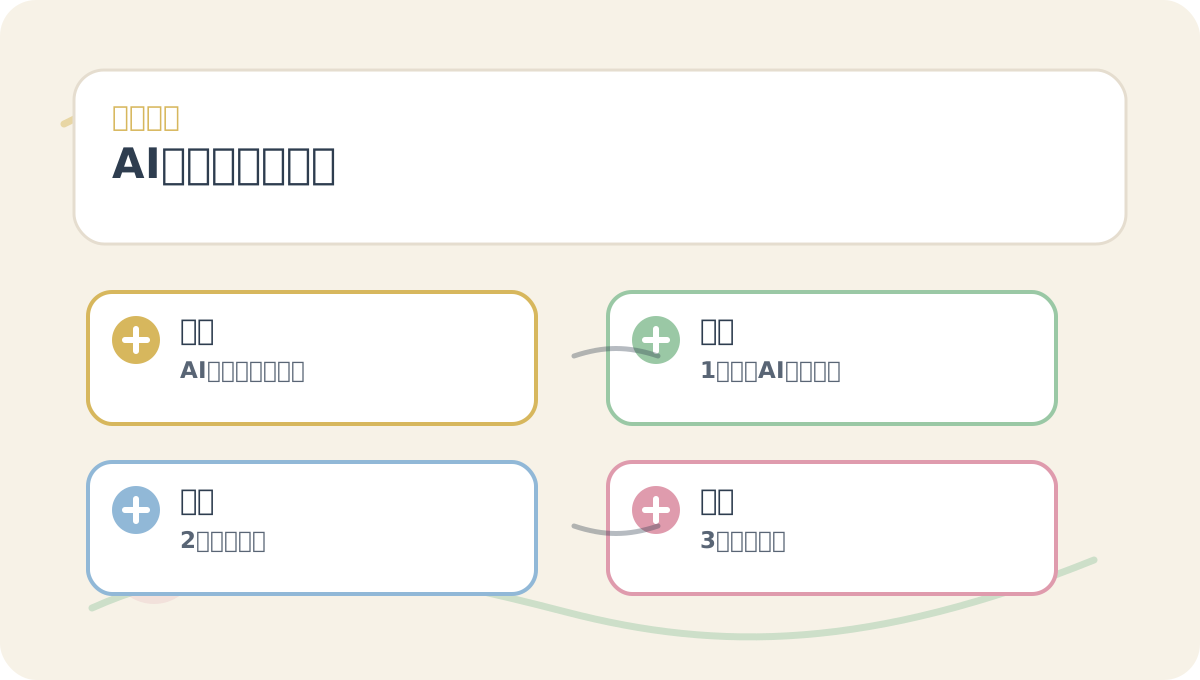
AI Article Decision Snapshot
Turn the lesson into workflow, model, budget, and security checks before choosing tools.
Use this quick snapshot before leaving the article. It keeps the next search tied to practical AI software, model/API, cost, privacy, and implementation questions.
Workflow fit
Identify the real job behind the article: coding, research, document review, support, analytics, content, or internal automation.
Model or tool decision
Decide whether the next step is a software shortlist, an AI tool comparison, an API platform choice, or a model benchmark.
Budget and usage signal
Estimate seats, API calls, prompt volume, retries, review time, and fallback work before assuming the workflow is cheap.
Security and privacy review
Check whether source code, customer data, private documents, prompts, logs, or embeddings will enter the AI workflow.
I’ll explain AI agents first as a closed-loop system—not as some mystical concept: they receive environmental information, retain key contextual data, reason about the next step to take, and then execute actions via tools or interfaces. If these four steps aren’t fully connected, the system remains just a conventional question-answering model—not a truly task-capable agent.
To determine whether a system qualifies as an agent, assess whether it possesses goals, memory, tools, and feedback. If it merely generates text—without producing actionable outcomes or enabling iterative refinement—it functions more like a chat assistant. Only when it can observe results and adapt its behavior accordingly does it begin to resemble a real-world workflow agent.
Foundational Concepts of AI Agents
When practicing Foundational Concepts of AI Agents, we recommend documenting input conditions, processing actions, and observable outcomes together—making future review straightforward.
When reviewing Foundational Concepts of AI Agents, place key concepts, operational steps, and observable outcomes on the same page for efficient re-examination.
The Foundational Concepts of AI Agents module is best studied alongside diagrams. First confirm the problem statement and evaluation criteria; then read the conceptual explanations and practice steps—this helps integrate information into a coherent mental model.
1.1 What Is an AI Agent?
An AI agent is a computational system capable of perceiving its environment and taking actions to achieve specific goals. Unlike traditional AI models, agents exhibit a degree of autonomy—they can make decisions and perform operations in response to environmental changes.
Core characteristics of agents include:
- Perception: Sensing the environment via sensors or data inputs
- Decision Making: Choosing actions based on environmental information and internal state
- Action: Interacting with the environment through actuators or API calls
- Learning: Improving future decisions through experience
- Goal-Oriented Behavior: Acting under the guidance of explicit objectives
1.2 Agent Architecture
A typical AI agent architecture comprises the following components:
- Perception Module: Collects information from the environment
- Memory System: Stores historical interactions and learned experiences
- Reasoning Engine: Analyzes information and generates action plans
- Decision Module: Selects the optimal action
- Execution Module: Translates decisions into concrete operations
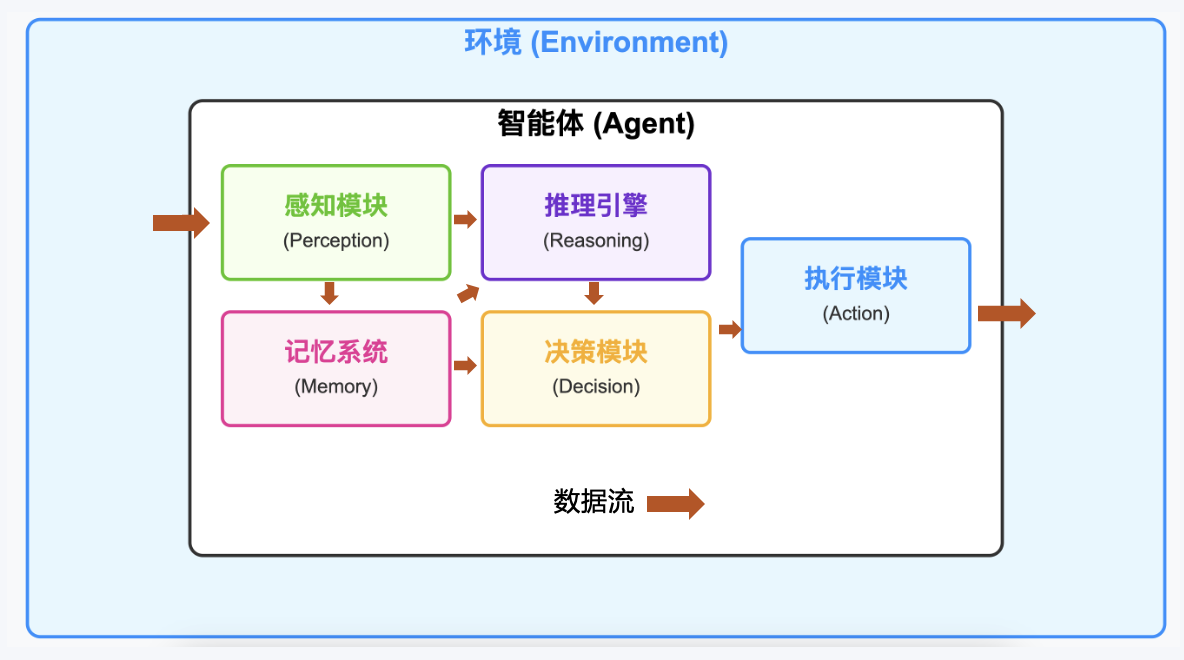
These five core components interact closely, forming a complete information-processing and decision-making pipeline:
- The Perception Module first gathers information from the environment—the agent’s window into the external world. It receives diverse input types (e.g., text, images, audio, or sensor signals) and converts them into internally processable formats.
- Processed perceptions are passed to the Memory System, which stores not only current observations but also past interactions and accumulated experience. This enables contextual awareness—allowing the agent to make more informed decisions grounded in history. The memory system simultaneously supports both the reasoning engine and decision module with critical contextual data.
- The Reasoning Engine receives both real-time perceptual input (from the perception module) and historical context (from memory). Using logical analysis, pattern recognition, or machine learning algorithms, it interprets the situation and extracts insights—generating candidate action plans.
- The Decision Module, drawing on reasoning outputs and historical experience from memory, evaluates potential actions by weighing their likely consequences and alignment with goals—and selects the optimal or goal-satisfying strategy. This module serves as the agent’s “central brain,” determining behavioral direction.
- The Execution Module receives instructions from the decision module and translates them into concrete operations—interacting directly with the environment. Feedback from execution flows back to the perception module, closing the loop.
Together, these five components form a self-sustaining cycle: perception gathers data, memory supplies context, reasoning interprets the situation, decision selects the action, and execution carries it out—whose outcome is again perceived, initiating a new iteration. This closed-loop design enables continuous learning and adaptation to environmental change.
Data Flow
The data flow describes how information moves among agent components:
- Environment → Perception Module: Raw environmental data (e.g., images, sound, text, or sensor signals) enters and is processed by the perception module.
- Perception Module → Memory System: Processed perceptual data is stored in memory and linked with prior knowledge.
- Perception Module → Reasoning Engine: Current perceptual input is fed directly to the reasoning engine for real-time analysis.
- Memory System → Reasoning Engine: Historical data and experience are retrieved from memory to support contextual reasoning.
- Memory System → Decision Module: Past decisions and outcomes inform current evaluations.
- Reasoning Engine → Decision Module: Analytical outputs and candidate actions are passed to guide selection.
- Decision Module → Execution Module: Final decisions are transmitted for operational implementation.
- Execution Module → Environment: Actions taken by the execution module alter the environment—producing new observable states.
1.3 Types of Agents
Based on complexity and functionality, AI agents fall into several major categories:
Simple Reflex Agents
These agents react solely to the current environmental state—ignoring history. They typically rely on basic “if-then” rules. Example: A thermostat turns the air conditioner on or off based only on the instantaneous temperature reading.
Model-Based Agents
These agents maintain an internal model of the environment and use it to predict the consequences of possible actions. Example: A chess AI simulates multiple future board states to select the strongest immediate move.
Goal-Based Agents
These agents pursue explicitly defined objectives and choose actions that advance toward those goals. Example: A navigation system computes and follows the shortest path to a destination.
Utility-Based Agents
These agents assign a numeric “utility” (value or satisfaction score) to each possible state—and select actions expected to maximize overall utility. Example: A recommendation system ranks content by predicted user engagement or preference alignment.
Learning Agents
These agents improve performance over time by learning from experience—often through trial-and-error or feedback-driven adaptation. Example: A reinforcement-learning robot refines its gait through iterative attempts and reward signals.
1.4 Environmental Characteristics
The nature of an agent’s operating environment significantly influences its design. Key environmental properties include:
- Fully Observable vs. Partially Observable: Whether the agent has access to complete environmental state information
- Deterministic vs. Stochastic: Whether actions produce predictable or probabilistic outcomes
- Static vs. Dynamic: Whether the environment changes while the agent is deliberating
- Discrete vs. Continuous: Whether states and actions are finite and countable—or infinite and smooth
- Single-Agent vs. Multi-Agent: Whether other intelligent entities coexist and interact within the environment
1.5 Real-World Agent Applications
AI agents have demonstrated strong practical value across diverse domains:
- Virtual Assistants: Siri, Alexa, and similar systems understand natural language and execute user requests
- Autonomous Driving: Vehicles perceive road conditions and make real-time driving decisions
- Game AI: Agents compete against humans in complex, dynamic game environments
- Trading Bots: Systems analyze financial markets and autonomously execute trades
- Smart Homes: Coordinated control of appliances and sensors optimizes comfort, energy use, and security
In upcoming chapters, we will delve deeper into designing, implementing, and optimizing AI agents—from simple rule-based systems to sophisticated large-language-model-powered agents.
The next chapter details agent perception and decision mechanisms—and walks you through building your first simple agent using Python.
Apply This Lesson
Turn this article into AI software, model, API, and security decisions.
English Article FAQ
Use this article as evidence before choosing AI tools
How should I use this AI Tutorials article?
Use it as the implementation or learning layer, then connect the idea to AI software buyer guides, tool comparisons, benchmarks, API choices, and security checks before making a production decision.
Is this English article different from the Chinese original?
The English edition is localized for global AI readers while preserving the original diagrams, screenshots, prompts, code examples, and source context from the Chinese article.
What should I read after AI Agent Fundamentals?
Continue with AI Software Buyer Guides, AI Tools Workbench, Best AI Coding Agents, AI Model Benchmarks, OpenAI vs Anthropic API, or LLM Security Tools depending on the decision you need to make.
Can this article alone choose an AI product or model?
No. Treat the article as evidence and context, then validate fit with pricing, privacy requirements, integration effort, benchmark results, workflow tests, and fallback planning.
Continue