English translation
Using the Dify API to generate personalized learning materials
AI Article Decision Snapshot
Turn the lesson into workflow, model, budget, and security checks before choosing tools.
Use this quick snapshot before leaving the article. It keeps the next search tied to practical AI software, model/API, cost, privacy, and implementation questions.
Workflow fit
Identify the real job behind the article: coding, research, document review, support, analytics, content, or internal automation.
Model or tool decision
Decide whether the next step is a software shortlist, an AI tool comparison, an API platform choice, or a model benchmark.
Budget and usage signal
Estimate seats, API calls, prompt volume, retries, review time, and fallback work before assuming the workflow is cheap.
Security and privacy review
Check whether source code, customer data, private documents, prompts, logs, or embeddings will enter the AI workflow.

Dify’s usage varies significantly across industries. Risk profiles differ drastically—for example, educational content recommendation, medical report summarization, financial analysis, and operational automation each carry distinct risk implications; therefore, a single deployment standard cannot apply universally.

I begin by assigning a risk level to each use case: Does it involve personal information, money, health, legal commitments, or external users? The higher the risk level, the more critical it becomes to incorporate human review and comprehensive audit logging.
In the previous tutorial, we demonstrated concrete use cases and showed how to build applications with Dify to solve specific problems. Today, we’ll dive deeper into real-world industry applications of Dify—analyzing the innovation and value it delivers—and lay the groundwork for subsequent user feedback and iterative improvement.
I. Education Sector
In education, Dify leverages generative AI tools to enhance teaching quality and enrich learning experiences.

When analyzing Dify’s industry applications, first examine: industry context, user roles, data ingestion points, workflow nodes, output deliverables, and compliance boundaries.
Case Study: Intelligent Tutoring System
For instance, an online education platform built an intelligent tutoring system using Dify. This system analyzes students’ learning behaviors and questions to automatically generate personalized learning resources.
# Using the Dify API to generate personalized learning materials
def generate_learning_material(student_id):
    material = Dify.generate('learning material', for_student=student_id)
    return material
This approach enables students to receive content tailored to their proficiency level and individual needs—boosting both learning efficiency and engagement.
II. Healthcare Sector
In healthcare, Dify’s generative AI applications help clinicians rapidly produce clinical documentation—improving operational efficiency.
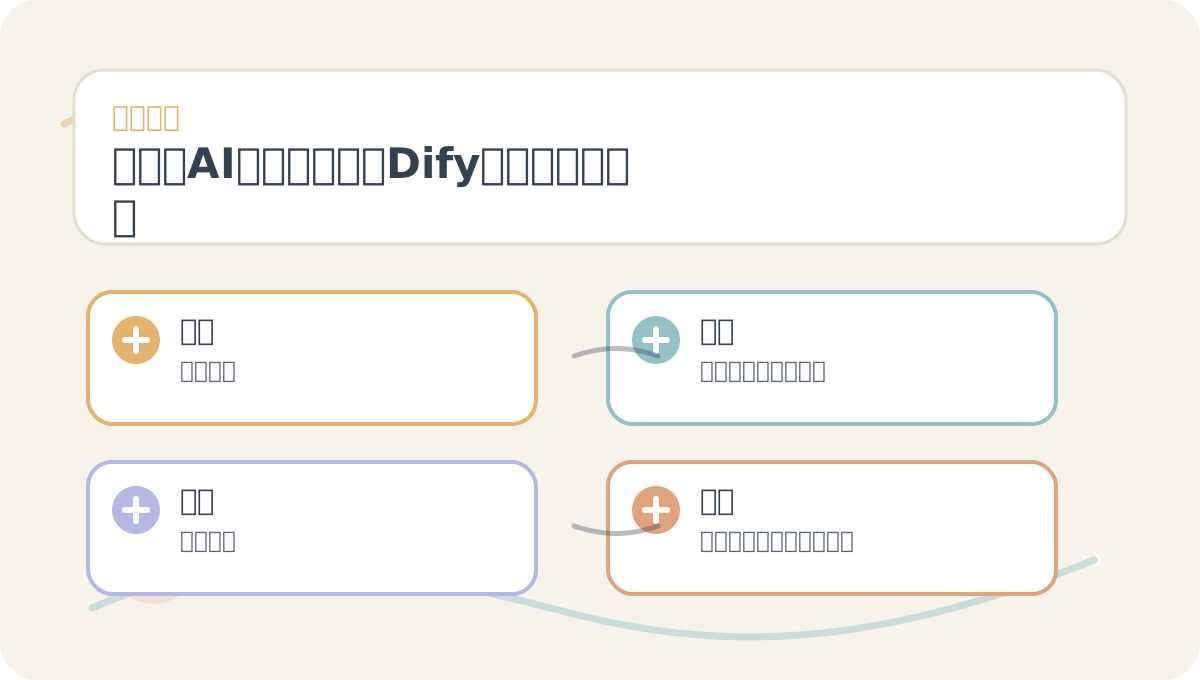
Before reading Industry Application Analysis of Dify: A Generative AI Application Innovation Engine, use the accompanying illustration to confirm the core narrative. After reading, revisit the diagram to identify which steps are immediately actionable—and which require supplementary information or preparation.
Case Study: Automated Medical Report Generation
Some hospitals deploy Dify to auto-generate patient medical reports. The system extracts symptoms, test results, and physician diagnoses to produce standardized, structured reports.
# Generating a patient medical report
def generate_medical_report(patient_data):
    report = Dify.generate('medical report', patient_info=patient_data)
    return report
This application substantially reduces physicians’ administrative burden—freeing up valuable time for direct patient care and consultation.
III. Financial Services Sector
In finance, Dify supports decision-making by generating analytical reports and market forecasts.
Case Study: Market Analysis Reporting
An investment firm uses Dify to generate market analysis reports. By integrating historical data and real-time market trends, the system produces high-quality, timely reports for investor review.
# Generating a market analysis report
def generate_market_analysis(market_data):
    report = Dify.generate('market analysis', data=market_data)
    return report
Automated report generation not only saves analysts’ time but also enhances report freshness and analytical accuracy.
IV. Retail Sector
In retail, Dify powers personalized recommendations—elevating customer satisfaction and engagement.
Case Study: Personalized Shopping Recommendations
E-commerce platforms leverage Dify’s algorithms to analyze user purchase behavior and generate customized product recommendations.
# Generating personalized shopping recommendations
def generate_recommendations(user_profile):
    recommendations = Dify.generate('product recommendation', user_info=user_profile)
    return recommendations
Such targeted suggestions improve shopping relevance, enhance user experience, and increase conversion rates.
After completing Industry Application Analysis of Dify: A Generative AI Application Innovation Engine, try adapting the framework to your own scenario. Focus especially on whether inputs, processing logic, and outputs align coherently.
To apply Industry Application Analysis of Dify: A Generative AI Application Innovation Engine to your own task, start by narrowing the scope—validate just one critical decision point first.
V. Summary
The above industry case studies illustrate the broad applicability of generative AI—and highlight the tangible gains in efficiency and innovation it delivers. Dify demonstrates strong potential not only in education, healthcare, finance, and retail, but also as a catalyst for future application innovation across domains.
In upcoming chapters, we’ll explore user feedback mechanisms and continuous improvement strategies—providing further insights and practical pathways to advance Dify-based applications.
Apply This Lesson
Turn this article into AI software, model, API, and security decisions.
English Article FAQ
Use this article as evidence before choosing AI tools
How should I use this AI Tutorials article?
Use it as the implementation or learning layer, then connect the idea to AI software buyer guides, tool comparisons, benchmarks, API choices, and security checks before making a production decision.
Is this English article different from the Chinese original?
The English edition is localized for global AI readers while preserving the original diagrams, screenshots, prompts, code examples, and source context from the Chinese article.
What should I read after Using the Dify API to generate personalized learning materials?
Continue with AI Software Buyer Guides, AI Tools Workbench, Best AI Coding Agents, AI Model Benchmarks, OpenAI vs Anthropic API, or LLM Security Tools depending on the decision you need to make.
Can this article alone choose an AI product or model?
No. Treat the article as evidence and context, then validate fit with pricing, privacy requirements, integration effort, benchmark results, workflow tests, and fallback planning.
Continue