English translation
Dify Tutorial Series #19: Key Takeaways and Future Outlook
AI Article Decision Snapshot
Turn the lesson into workflow, model, budget, and security checks before choosing tools.
Use this quick snapshot before leaving the article. It keeps the next search tied to practical AI software, model/API, cost, privacy, and implementation questions.
Workflow fit
Identify the real job behind the article: coding, research, document review, support, analytics, content, or internal automation.
Model or tool decision
Decide whether the next step is a software shortlist, an AI tool comparison, an API platform choice, or a model benchmark.
Budget and usage signal
Estimate seats, API calls, prompt volume, retries, review time, and fallback work before assuming the workflow is cheap.
Security and privacy review
Check whether source code, customer data, private documents, prompts, logs, or embeddings will enter the AI workflow.

Completing the full Dify tutorial series shouldn’t just mean memorizing where each menu item is located. More importantly, it should help you internalize a complete workflow: selecting a use case, building an application, connecting data sources, testing, deploying, collecting user feedback, and iterating.

When reviewing your progress, ask yourself: Can I now build a small application from scratch—and clearly explain why each component or step exists? If you can articulate this confidently, then your learning has truly taken root.
In previous sections, we explored the importance of Community Support and Resources, especially how to effectively leverage them when tackling common challenges—ensuring users can smoothly adopt Dify, the generative AI application innovation engine. This article continues that theme by summarizing the key concepts covered across this tutorial series and outlining future directions for innovation.
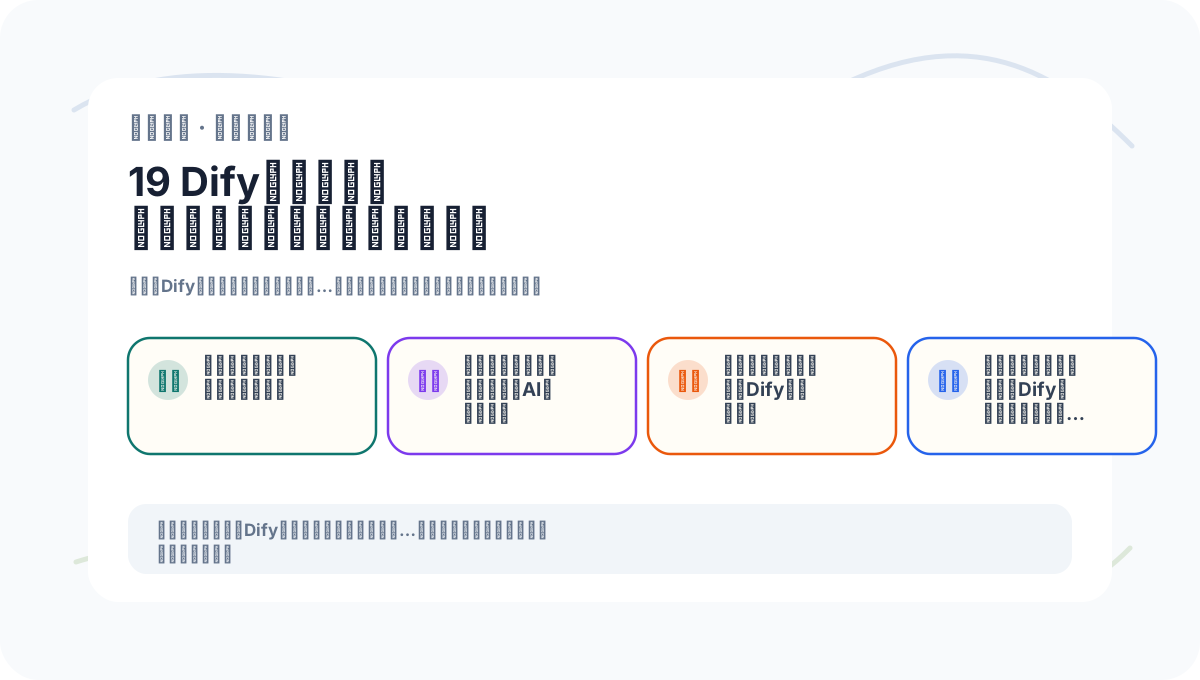
If you haven’t fully absorbed “Dify Tutorial Series: Knowledge Summary & Future Outlook”, revisit it using the four actions outlined on this card.
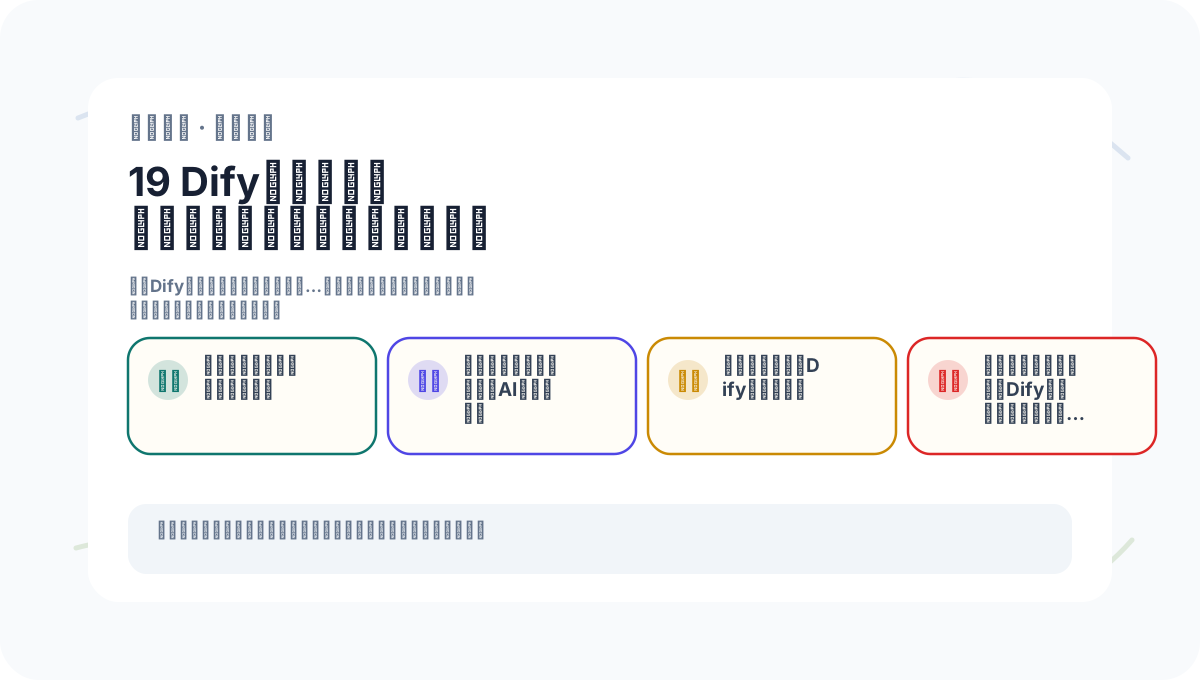
When revisiting “Dify Tutorial Series: Knowledge Summary & Future Outlook”, don’t jump straight into a large-scale project. Instead, first validate your understanding of the core workflow using a simple, concrete example.
Knowledge Summary
Fundamental Concepts of Generative AI

When reviewing Dify’s knowledge points and future outlook, begin by assessing your mastery across five key dimensions: node capabilities, data integration, model invocation, operational troubleshooting, and team collaboration practices.
Generative AI is a technology that creates new content by learning patterns from large volumes of data. By comprehending the structure and relationships within input data, it can generate diverse outputs—including text, images, and audio. As a generative AI platform, Dify leverages deep learning models to enable efficient content generation and real-world application development.
Core Features of Dify
-
Model Training and Fine-Tuning:
Dify supports custom model training and fine-tuning. Users can adjust model parameters according to specific needs to optimize output quality. With only a dataset and a few lines of API code, users can upload data and initiate training. -
Data Integration and Analysis:
Dify offers seamless integration with multiple data sources, enabling users to easily ingest data from various platforms and process it using built-in analytical tools. -
Highly Controllable Content Generation:
Dify provides granular control over generated content—for instance, setting keywords, defining themes, or even adjusting tone and stylistic preferences. This significantly enhances flexibility and precision in content creation.
Use Case Analysis
Our tutorial series highlighted several successful real-world applications:
-
Marketing Copy Generation:
A startup used Dify to generate personalized marketing copy at scale. By analyzing user behavior data, the system automatically produced thousands of unique variants—boosting campaign visibility and user engagement. -
Intelligent Customer Support System:
A Dify-powered intelligent customer service system delivers real-time, high-quality responses to frequently asked questions. This improved customer satisfaction while reducing the workload on human support agents.
Technical Architecture and Integration
Built upon a robust cloud-native architecture, Dify supports massive parallel computation—enabling rapid response to user requests. It also exposes RESTful APIs, making integration into existing business systems straightforward for developers. Below is a simple API usage example:
import requests

url = "https://api.dify.com/generate"
payload = {
    "prompt": "Write an article about the future of AI",
    "model": "gpt-3.5",
    "max_tokens": 100
}
response = requests.post(url, json=payload)
print(response.json())
Future Outlook
Looking ahead, Dify will continue innovating and refining its platform across multiple dimensions—with the overarching goal of enhancing both user experience and application effectiveness.
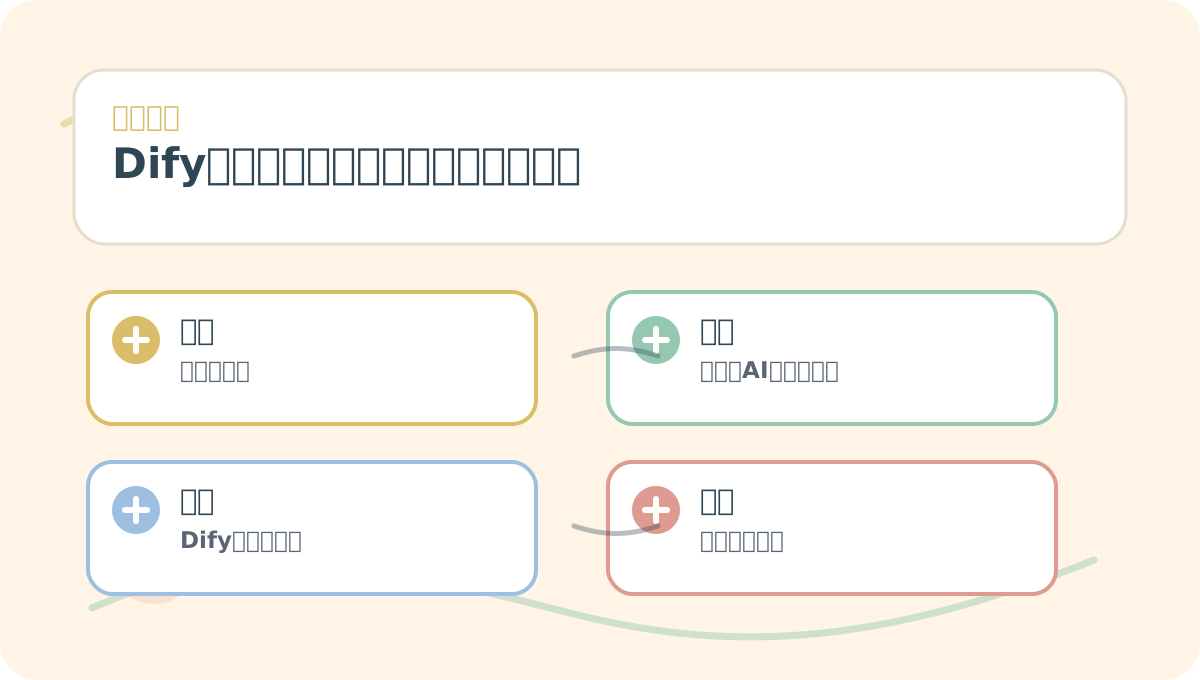
When studying “Dify Tutorial Series: Knowledge Summary & Future Outlook”, start by identifying a small, reproducible scenario you’re familiar with. Then explore related concepts and hands-on steps. After reading, try restating everything using your own example.
Reinforcement Learning and Personalized Recommendations
Moving forward, Dify will deepen its exploration of reinforcement learning. By continuously incorporating user feedback—such as click-throughs, edits, or explicit ratings—the system will progressively refine its output quality and relevance. For instance, user interactions will directly inform model updates, enabling increasingly tailored content generation.
Multimodal AI Integration
To meet the demands of more complex applications, Dify plans to integrate multimodal AI capabilities—not limited to text, but extending to images, video, and other modalities. For example, users could provide both textual prompts and reference images to jointly guide the generation of rich, multimodal outputs (e.g., illustrated articles or annotated infographics) with higher fidelity and coherence.
Enhanced Community Engagement
Dify will further strengthen ties with its user community—encouraging members to share practical experiences, best practices, and success stories to foster collective learning and growth. Additionally, regular developer and user forums are planned to gather feature requests, co-design upcoming capabilities, and align roadmap priorities with real-world needs.
Summary
This article summarized the core knowledge points covered in the Dify tutorial series and outlined promising future directions. With ongoing support from the community and continuous feedback from users, we believe Dify will keep evolving—delivering ever more powerful, accessible, and impactful generative AI applications to empower efficient, creative, and scalable content creation.
The next article will focus on Dify’s “Future Development Roadmap.” Stay tuned!
Apply This Lesson
Turn this article into AI software, model, API, and security decisions.
English Article FAQ
Use this article as evidence before choosing AI tools
How should I use this AI Tutorials article?
Use it as the implementation or learning layer, then connect the idea to AI software buyer guides, tool comparisons, benchmarks, API choices, and security checks before making a production decision.
Is this English article different from the Chinese original?
The English edition is localized for global AI readers while preserving the original diagrams, screenshots, prompts, code examples, and source context from the Chinese article.
What should I read after Dify Tutorial Series #19: Key Takeaways and Future Outlook?
Continue with AI Software Buyer Guides, AI Tools Workbench, Best AI Coding Agents, AI Model Benchmarks, OpenAI vs Anthropic API, or LLM Security Tools depending on the decision you need to make.
Can this article alone choose an AI product or model?
No. Treat the article as evidence and context, then validate fit with pricing, privacy requirements, integration effort, benchmark results, workflow tests, and fallback planning.
Continue