English translation
Dify Tutorial: Summary and Future Development Roadmap
AI Article Decision Snapshot
Turn the lesson into workflow, model, budget, and security checks before choosing tools.
Use this quick snapshot before leaving the article. It keeps the next search tied to practical AI software, model/API, cost, privacy, and implementation questions.
Workflow fit
Identify the real job behind the article: coding, research, document review, support, analytics, content, or internal automation.
Model or tool decision
Decide whether the next step is a software shortlist, an AI tool comparison, an API platform choice, or a model benchmark.
Budget and usage signal
Estimate seats, API calls, prompt volume, retries, review time, and fallback work before assuming the workflow is cheap.
Security and privacy review
Check whether source code, customer data, private documents, prompts, logs, or embeddings will enter the AI workflow.
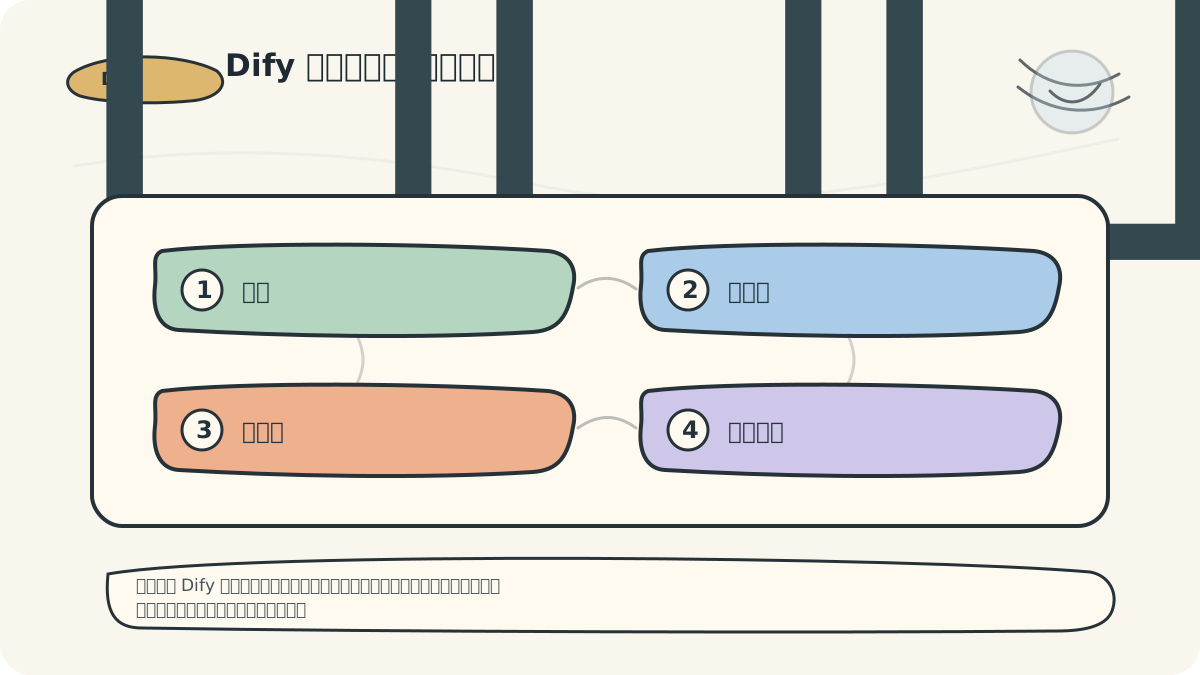
When expanding Dify applications in the future, it’s not enough to simply ask what new features can be added. Every additional tool, model, or data source increases maintenance overhead, permission management complexity, and troubleshooting effort.
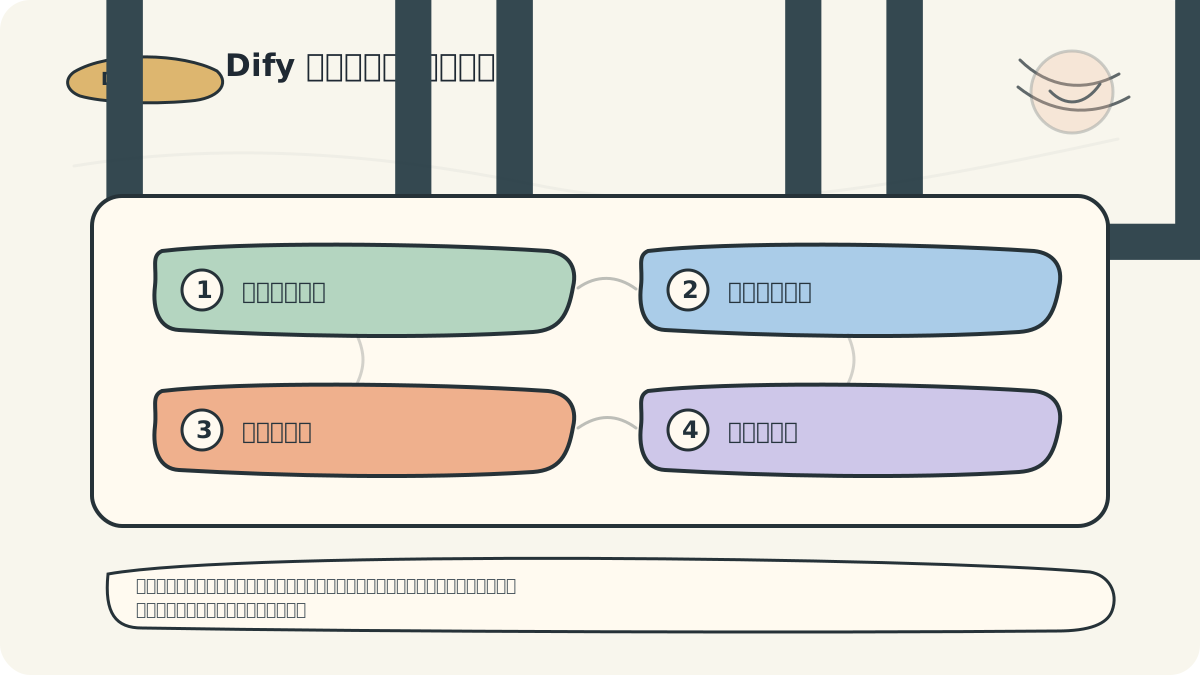
For each new feature, I’ll draft a concise “feature card” specifying:
- What problem it solves,
- Who owns its maintenance,
- How it degrades gracefully upon failure, and
- Where its logs are located.
If any of these points cannot be clearly articulated, the feature will not be deployed.
In the previous article, we comprehensively summarized key concepts of Dify—the generative AI application innovation engine—and reviewed its core capabilities and use cases. As technology evolves rapidly and user needs continuously shift, Dify’s future development plan will focus on several strategic areas to further enhance functionality and user experience.
I. User-Centric Feature Expansion
To ensure Dify remains responsive to evolving market demands, future development will place greater emphasis on user feedback and emerging trends. We plan to conduct regular user research—collecting and analyzing pain points and feature requests gathered during real-world usage. For example:

When evaluating Dify’s future development priorities, first assess needs in: workflow orchestration, knowledge base capabilities, team collaboration, monitoring & debugging, plugin ecosystem, and enterprise deployment.
- Multimodal Support: Demand for unified handling of text, images, and audio continues to grow. We plan to introduce robust multimodal capabilities to meet this need.
- Custom Templates: Users increasingly want to create, share, and reuse custom generation templates—especially in content creation and marketing. We’ll deliver a more flexible template management module enabling seamless sharing and application of templates.
II. Advancing Intelligence and Automation
Leveraging advances in machine learning, Dify will experiment with and optimize intelligent and automated capabilities:
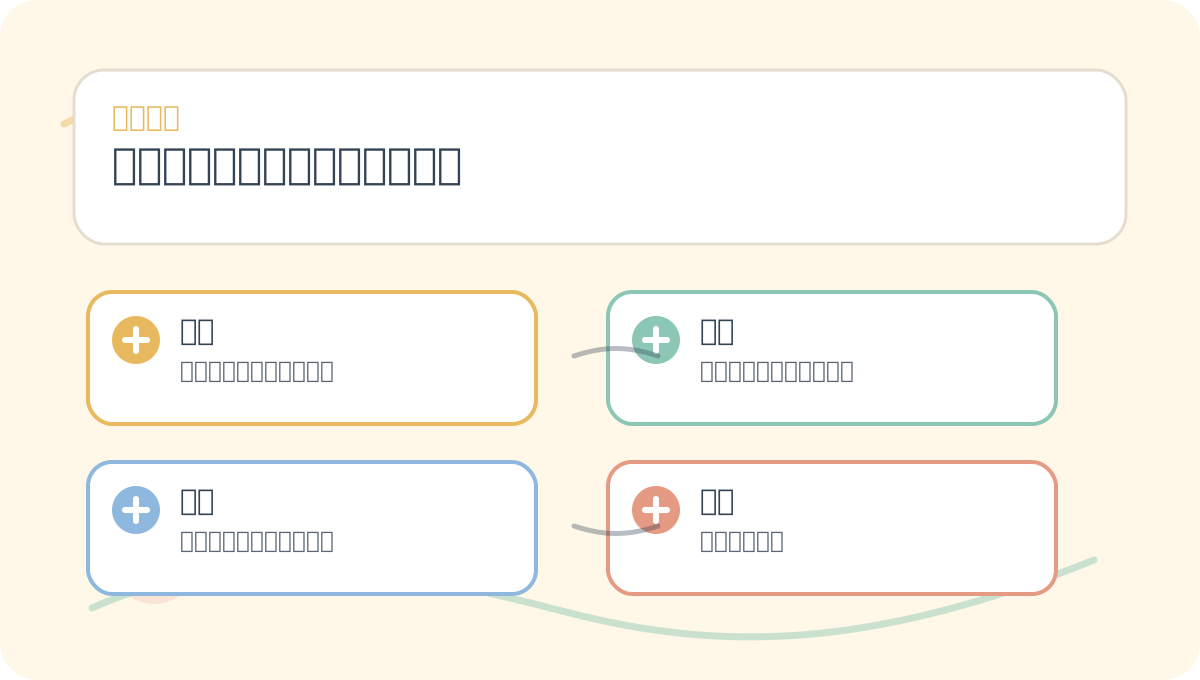
After reading “Summary and Future Outlook: Development Roadmap”, take one minute to reflect:
-
Are key concepts clearly distinguished?
-
Can the practice steps be reproduced?
-
Can you restate the conclusions in your own words?
-
Intelligent Recommendation System: By analyzing users’ historical interactions, the system will learn preferred content-generation patterns and proactively recommend optimal strategies. For instance, if a user frequently generates marketing copy, Dify could automatically suggest relevant, high-performing examples as they begin drafting.
def recommend_template(user_history): # Pseudocode: Recommend template based on user history recommended_template = analyze_user_history(user_history) return recommended_template -
Automated Workflows: We’ll expand API and webhook support to enable seamless integration of Dify with other tools—empowering users to embed Dify into their broader automation pipelines.
III. UI Improvements for Enhanced User Experience
The user interface is a critical determinant of overall experience. To make Dify more intuitive and accessible, we’ll implement a series of targeted UI enhancements, including:
- Onboarding Guidance: A contextual, interactive onboarding system will guide new users through core features. For example, when a user first accesses a feature, an overlay will appear explaining its purpose and step-by-step usage.
- Real-Time Collaboration Tools: We’ll introduce collaborative editing and generation features—allowing teams to co-create content simultaneously and boosting productivity.
IV. Exploring Emerging Technologies
To maintain Dify’s technological leadership, we’ll continue R&D into cutting-edge innovations, including:
-
Adaptive Learning: Future versions will incorporate advanced adaptive learning algorithms that dynamically fine-tune models during usage—delivering increasingly precise, context-aware responses.
where denotes the ground-truth output and the model’s predicted output.
-
Ethics and Transparency: As generative AI’s societal impact grows, we’ll actively explore ways to strengthen transparency and ethical accountability within Dify—ensuring responsible, traceable, and auditable content generation.
Having reached this point, summarize “Summary and Future Outlook: Development Roadmap” into a retrospective table: First articulate the central narrative, then validate it using a small-scale task.
After finishing “Summary and Future Outlook: Development Roadmap”, try walking through a small end-to-end example. Then assess which steps you can now execute independently.
Summary
This article reviewed Dify’s future development roadmap—highlighting planned innovations across user-driven feature expansion, intelligence & automation, UX refinement, and frontier technology exploration. In the next article, we’ll focus on user engagement and feedback mechanisms, exploring how to further empower users in shaping Dify’s evolution. By establishing effective feedback channels, we aim to continuously refine the product and deliver ever-greater value to our users.
Apply This Lesson
Turn this article into AI software, model, API, and security decisions.
English Article FAQ
Use this article as evidence before choosing AI tools
How should I use this AI Tutorials article?
Use it as the implementation or learning layer, then connect the idea to AI software buyer guides, tool comparisons, benchmarks, API choices, and security checks before making a production decision.
Is this English article different from the Chinese original?
The English edition is localized for global AI readers while preserving the original diagrams, screenshots, prompts, code examples, and source context from the Chinese article.
What should I read after Dify Tutorial: Summary and Future Development Roadmap?
Continue with AI Software Buyer Guides, AI Tools Workbench, Best AI Coding Agents, AI Model Benchmarks, OpenAI vs Anthropic API, or LLM Security Tools depending on the decision you need to make.
Can this article alone choose an AI product or model?
No. Treat the article as evidence and context, then validate fit with pricing, privacy requirements, integration effort, benchmark results, workflow tests, and fallback planning.
Continue