English translation
Define a 3×3 matrix
AI Article Decision Snapshot
Turn the lesson into workflow, model, budget, and security checks before choosing tools.
Use this quick snapshot before leaving the article. It keeps the next search tied to practical AI software, model/API, cost, privacy, and implementation questions.
Workflow fit
Identify the real job behind the article: coding, research, document review, support, analytics, content, or internal automation.
Model or tool decision
Decide whether the next step is a software shortlist, an AI tool comparison, an API platform choice, or a model benchmark.
Budget and usage signal
Estimate seats, API calls, prompt volume, retries, review time, and fallback work before assuming the workflow is cheap.
Security and privacy review
Check whether source code, customer data, private documents, prompts, logs, or embeddings will enter the AI workflow.

When computing determinants, low-order matrices can be expanded directly; for higher-order matrices, it’s more efficient to use row operations to convert the matrix into triangular form, then multiply the diagonal entries.

I record all row swaps and scalar multiplications during row reduction. A single sign error at the end usually means I missed tracking one of these operations.
In the previous article, we explored the properties of determinants and gained insight into their pivotal role within matrices. Today, we focus on how to compute determinants. Mastering determinant computation is essential for deepening your understanding of core linear algebra concepts—especially when solving systems of linear equations.
Definition and Basic Computational Rules
The determinant is a scalar value defined for square matrices. It reveals critical information about the matrix—such as whether it is invertible—and encodes geometric properties of the associated linear transformation. For an matrix , its determinant is denoted or .

Before computing a determinant, first assess whether simplification is possible via row/column operations, triangularization, or block structure—then decide whether cofactor expansion is necessary.
Computing 2×2 Determinants
For a matrix
the determinant is given by
Example:
Consider
Then
Computing 3×3 Determinants
For a matrix
the determinant can be computed using Laplace expansion (cofactor expansion), yielding
Example:
Let
Then
Key Properties and Computational Techniques
When computing determinants, we frequently leverage the following properties:
- Row swapping: Swapping two rows multiplies the determinant by .
- Row addition: Adding a scalar multiple of one row to another leaves the determinant unchanged.
- Zero determinant: If two rows are identical, or one row is a linear combination of others, the determinant is zero.
Computing Higher-Order Determinants
For determinants of order 4 or greater, we may apply recursive Laplace expansion along any row or column—or simplify first using determinant properties.
Example Code (Python)
We can compute determinants efficiently using NumPy. Here's a brief example:
import numpy as np

# Define a 3×3 matrix
matrix_B = np.array([[1, 2, 3],
                     [0, 1, 4],
                     [5, 6, 0]])

# Compute its determinant
det_B = np.linalg.det(matrix_B)

print(f"Matrix B's determinant is: {det_B}")
Running this code yields:
Matrix B's determinant is: 1.0
If you haven’t fully internalized Determinant Computation, revisit this card and walk through its four actionable steps.
When reviewing Determinant Computation, avoid tackling large projects upfront. Instead, test your understanding with one simple example to verify whether the core logic is clear.
Summary
By mastering determinant computation, we gain deeper insight into the structural properties of matrices in linear algebra—particularly regarding invertibility and solvability of linear systems. In the next article, we’ll define systems of linear equations and explore how determinants help solve them. Stay tuned—to build a solid foundation for further study.
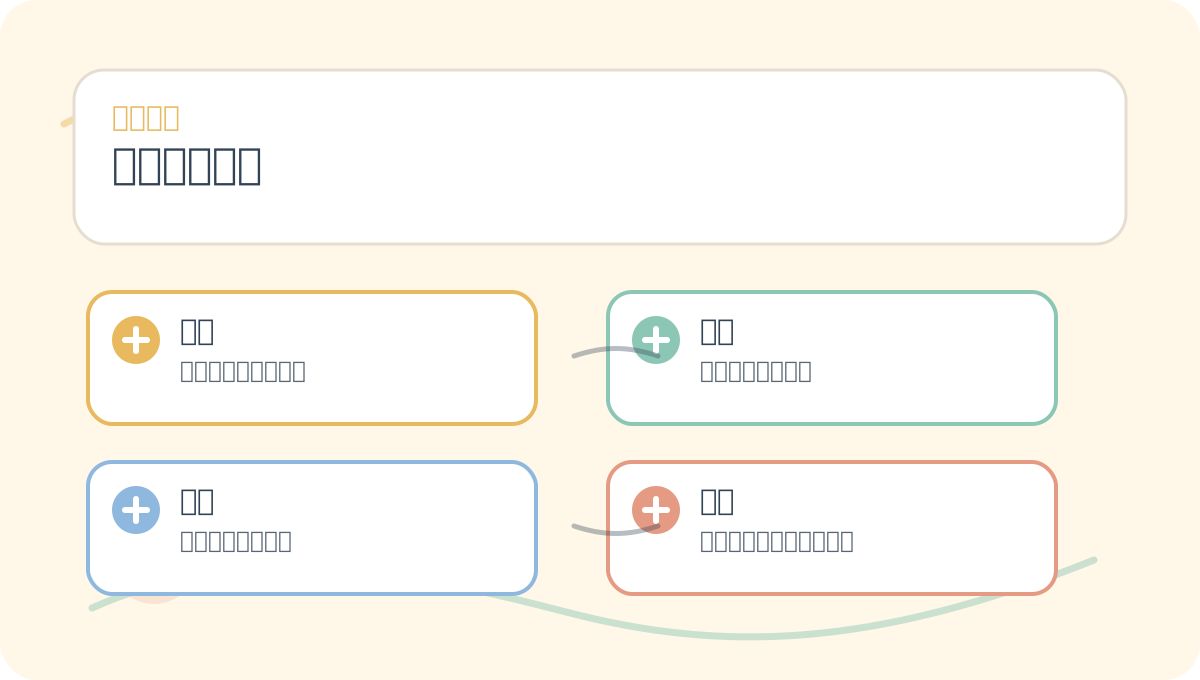
After reading Determinant Computation, take one minute to reflect:
- Are the key concepts clearly distinguished?
- Can you reproduce the computational steps confidently?
- Can you restate the main conclusions in your own words?
Apply This Lesson
Turn this article into AI software, model, API, and security decisions.
English Article FAQ
Use this article as evidence before choosing AI tools
How should I use this AI Tutorials article?
Use it as the implementation or learning layer, then connect the idea to AI software buyer guides, tool comparisons, benchmarks, API choices, and security checks before making a production decision.
Is this English article different from the Chinese original?
The English edition is localized for global AI readers while preserving the original diagrams, screenshots, prompts, code examples, and source context from the Chinese article.
What should I read after Define a 3×3 matrix?
Continue with AI Software Buyer Guides, AI Tools Workbench, Best AI Coding Agents, AI Model Benchmarks, OpenAI vs Anthropic API, or LLM Security Tools depending on the decision you need to make.
Can this article alone choose an AI product or model?
No. Treat the article as evidence and context, then validate fit with pricing, privacy requirements, integration effort, benchmark results, workflow tests, and fallback planning.
Continue