English translation
16. Eigenvectors: Definition and Intuition
AI Article Decision Snapshot
Turn the lesson into workflow, model, budget, and security checks before choosing tools.
Use this quick snapshot before leaving the article. It keeps the next search tied to practical AI software, model/API, cost, privacy, and implementation questions.
Workflow fit
Identify the real job behind the article: coding, research, document review, support, analytics, content, or internal automation.
Model or tool decision
Decide whether the next step is a software shortlist, an AI tool comparison, an API platform choice, or a model benchmark.
Budget and usage signal
Estimate seats, API calls, prompt volume, retries, review time, and fallback work before assuming the workflow is cheap.
Security and privacy review
Check whether source code, customer data, private documents, prompts, logs, or embeddings will enter the AI workflow.

An eigenvector is not a fixed-length arrow—it is a direction. As long as the direction remains unchanged, scalar multiples of the same vector still represent the same eigenvector.

I will substitute back into to verify. Solving only for candidate values without substituting them back to check risks misidentifying ordinary vectors as eigenvectors.
In the previous article, we discussed the definition and computation of eigenvalues—a foundation essential for understanding eigenvectors. Eigenvectors are a central concept in linear algebra and play critical roles across many applications, especially in artificial intelligence, machine learning, and data analysis.
Definition of Eigenvectors
An eigenvector is a special type of vector that—when transformed by a linear map—changes only in magnitude (and possibly sign), but not in direction. Specifically, for a given square matrix , if there exists a nonzero vector and a scalar satisfying:
After reading “Eigenvectors — Definition”, try working through a small concrete example step-by-step, then assess which steps you can now perform independently.
By this point, you can organize “Eigenvectors — Definition” into a reflection table: first clarify the main conceptual thread, then validate it using a small, self-contained task.
then is called an eigenvector of matrix , and is the corresponding eigenvalue.
Example Illustration
Consider the simple matrix:
We wish to find the eigenvectors of . First, we compute its eigenvalues by solving the characteristic equation:
where is the identity matrix.
Computing , we obtain:
Its determinant is:
Thus, the eigenvalues are and .
Next, we compute the eigenvectors associated with each eigenvalue.
Computing Eigenvectors
For each eigenvalue , we solve to find the corresponding eigenvectors.

To determine whether a vector is an eigenvector:
- Confirm it is nonzero;
- Compute the result of applying the matrix to it;
- Check whether the output is a scalar multiple of the original vector.
Eigenvalue :
We solve:
Here,
Solving yields an eigenvector:
We often prefer normalized eigenvectors—i.e., those of unit length. The above eigenvector normalizes to:
Eigenvalue :
Similarly, solve:
Here,
Solving gives an eigenvector:
Normalizing:
Summary
Eigenvectors are vectors whose direction remains invariant under a given linear transformation. They provide deep insight into the geometric and algebraic structure of linear maps—and serve as foundational tools in dimensionality reduction, image processing, recommendation systems, and beyond.
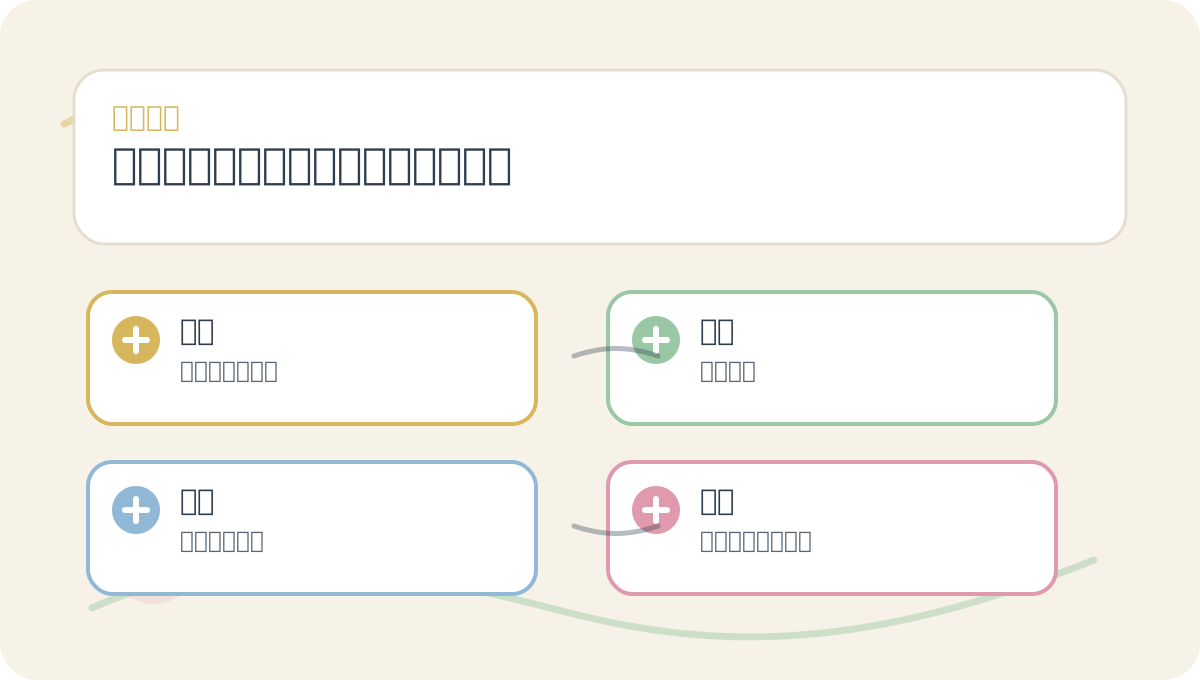
“Eigenvectors — Definition” is best read alongside its diagrams. Begin by clarifying the core question and verification criteria; then proceed to the conceptual explanation and worked steps—this helps connect ideas into a coherent mental model.
In the next article, we’ll explore the relationship between eigenvalues and eigenvectors—namely, eigen-decomposition, a concept tightly linked to today’s topic. Stay tuned!
Apply This Lesson
Turn this article into AI software, model, API, and security decisions.
English Article FAQ
Use this article as evidence before choosing AI tools
How should I use this AI Tutorials article?
Use it as the implementation or learning layer, then connect the idea to AI software buyer guides, tool comparisons, benchmarks, API choices, and security checks before making a production decision.
Is this English article different from the Chinese original?
The English edition is localized for global AI readers while preserving the original diagrams, screenshots, prompts, code examples, and source context from the Chinese article.
What should I read after 16. Eigenvectors: Definition and Intuition?
Continue with AI Software Buyer Guides, AI Tools Workbench, Best AI Coding Agents, AI Model Benchmarks, OpenAI vs Anthropic API, or LLM Security Tools depending on the decision you need to make.
Can this article alone choose an AI product or model?
No. Treat the article as evidence and context, then validate fit with pricing, privacy requirements, integration effort, benchmark results, workflow tests, and fallback planning.
Continue